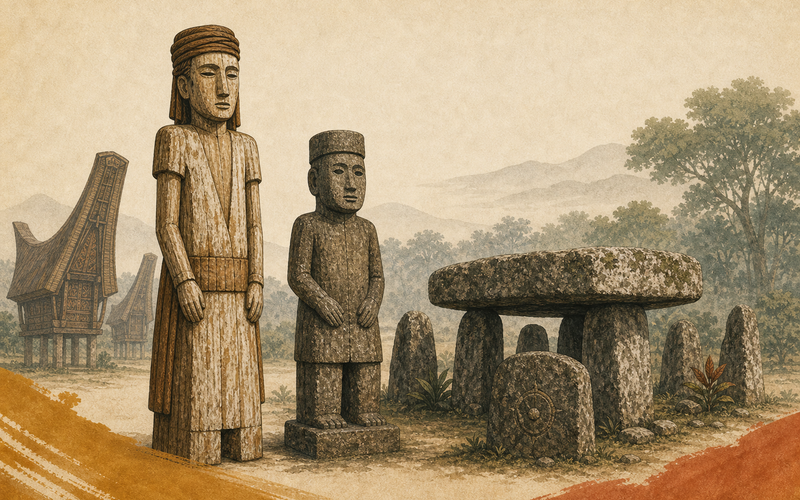
Across the Indonesian archipelago, relationships with the dead have often remained part of everyday social life. In many communities, ancestors were not understood as figures who vanished completely from family concern after burial. They could remain present through memory, ritual responsibility, sacred objects, houses, or landscapes associated with descent. For that reason, ancestor worship is best approached not as a single doctrine, but as a broad category covering many local traditions.
For museums, this subject matters because objects linked to the dead are rarely only funerary decorations. Carved effigies, shrines, stone monuments, textiles, and ritual offerings often belonged to systems of kinship, authority, and moral obligation. When displayed without context, they risk appearing exotic or isolated. A museum-style interpretation should instead show how remembrance of ancestors connected the living to lineage, place, and social order.
Ancestors, Kinship, and the Moral Structure of Society
In many Indonesian settings, reverence for ancestors helped define who belonged to a family and what obligations came with that belonging. The dead could serve as witnesses to continuity between generations, reinforcing inheritance, ritual rank, and the legitimacy of customary leadership. To honor forebears was therefore not simply to express grief. It was also to acknowledge that the living stood within a chain of transmission shaped by earlier generations.
This wider perspective helps explain why ancestor traditions often extended beyond burial rites. Families might preserve heirlooms, maintain shrines, sponsor commemorative ceremonies, or return repeatedly to the same ritual sites. In such settings, the dead were remembered through continuing acts of care. A museum should treat this not as superstition detached from daily life, but as part of a social world in which memory, authority, and spiritual obligation were intertwined.
Toraja Effigies and the Public Presence of the Dead
Among the Toraja of Sulawesi, one of the best-known forms of ancestor-related material culture is the tau-tau, an effigy associated with the dead. Museum documentation emphasizes that such figures played an important role in elaborate funerary ceremonies and were later placed in rock-cut settings or balconies overlooking the community. Their presence made remembrance visibly public. The deceased was not only mourned, but also represented in enduring sculptural form.
For museum audiences, tau-tau figures show that ancestor veneration was expressed through artistry as well as ritual. Clothing, posture, and placement all mattered. Yet careful interpretation is needed. Not every Toraja person received such treatment, and the role of the effigy changed over time as religious life, tourism, and local practice changed. The most responsible interpretation presents tau-tau not as a timeless symbol of all Indonesian spirituality, but as a specific Toraja response to death, status, and remembrance.
Nias Ancestors, Household Figures, and Family Communication
On Nias, ancestor devotion was historically central to local belief, and family statues known as Adu Zatua played an important role in the domestic sphere. The Nias Heritage Museum explains that these wooden sculptures represented deceased elders and were treated as a continuing focus of communication within the household. Important family events such as births, marriages, and deaths could be ritually addressed in relation to these ancestor figures.
This is a useful reminder that ancestor worship was not always centered on one dramatic public ceremony alone. In Nias, the household itself could become a site of ritual continuity. The presence of ancestral figures in the main room of a house suggests that memory of the dead was woven into ordinary family life. For museums, such evidence encourages a more intimate interpretation of ancestor traditions, one rooted not only in monuments and spectacle but also in repeated acts of domestic reverence.
Sumba, Marapu, and Sacred Landscapes
In Sumba, discussions of ancestral religion often turn to Marapu, a complex indigenous system in which ancestors remain significant within ritual life and relations to the environment. Scholarly work on Karendi describes sacred places where ancestral presence helps regulate the use of valued resources. This is important because it shows that ancestor reverence may be tied not only to descent and ceremony, but also to the ethical management of land, water, and forest resources.
This regional case broadens the museum conversation. Ancestor worship in Sumba cannot be reduced to the making of an image alone. It includes sacred geography, reciprocal exchange, and rules that connect people to territory through inherited obligation. Such traditions demonstrate that the dead may be remembered through ritual restrictions and ecological care as much as through carved objects. A museum can therefore use Sumba to show how ancestral belief shaped both social identity and environmental practice.
Bali and the Ritual Care of Lineage
Balinese traditions add another important dimension. Anthropological work on Balinese temple groups describes the continuing significance of ancestors within ritual organization and descent. Here the focus is not on one single island-wide pattern, but on the way family groups, temple obligations, and ancestor lore can reinforce each other over time. The dead remain part of how lineage is explained, ordered, and publicly remembered.
This case is especially valuable because it cautions against treating ancestor worship as static. Balinese ancestor traditions persisted through political and social change while being reformulated in new historical circumstances. For museum interpretation, that means shrines, temple objects, and ritual spaces should be read as parts of ongoing historical life. Ancestor veneration was not frozen in the past. It adapted while continuing to shape the ceremonial responsibilities of the living.
Korwar and Bisj in Their Own Regional Settings
The korwar figures of Cenderawasih Bay belong to a northwestern New Guinea tradition of representing deceased people. Asmat bisj poles, from southwestern New Guinea, bring ancestral figures into tall carvings made for communal memorial ceremonies. These are separate traditions with different forms and uses, rather than one general Papuan type. The Met: korwar; The Met: bisj.
Continuity, Religious Change, and Museum Interpretation
Across Indonesia, ancestor reverence has persisted even where communities adopted Islam, Christianity, Hindu-Balinese frameworks, or other formal religious identities. Scholarship on contemporary Indonesia notes that veneration of forebears can continue as a form of social memory and cohesion even when its theological framing changes. This does not mean that every community kept earlier practices unchanged. It means rather that relationships to the dead have often remained resilient, though reinterpreted through new institutions and vocabularies.
For museums, this is one of the most important interpretive lessons. Ancestor worship should not be presented as a relic belonging only to a distant premodern past. Nor should it be generalized into one single archipelagic tradition. The strongest exhibitions show variation, change, and local meaning. They explain how effigies, house interiors, shrines, megaliths, and sacred landscapes were embedded in living communities that continued to negotiate identity through memory of those who came before.
Conclusion
Ancestor worship traditions across the Indonesian archipelago reveal many ways of maintaining ties between the living and the dead. Toraja tau-tau, Nias household figures, Sumbanese ancestral landscapes, and Balinese temple-centered lineages each show a different balance of image, place, ceremony, and obligation. What they share is not a single uniform theology, but a conviction that the past remains active in the moral life of the present.
For museum audiences, these traditions offer a powerful framework for understanding Indonesian material culture. Objects associated with ancestors were rarely isolated artworks. They participated in systems of remembrance, rank, reciprocity, and care. Seen in that fuller context, ancestor traditions become essential to understanding how communities across Indonesia imagined continuity between generations.