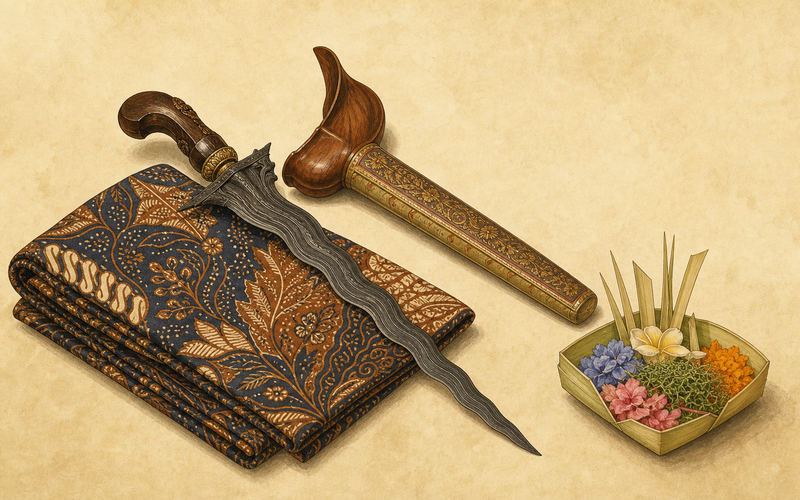
Sacred objects in Indonesian culture are not defined by age, rarity, or decoration alone. They become meaningful because people handle them within relationships: between ancestors and descendants, performers and audiences, households and deities, makers and inherited techniques. A keris may be a blade, a textile may be clothing, a mask may be carved wood, and an offering may be leaves and flowers. Yet within ritual practice, each can become a disciplined way of making unseen obligations visible.
This article looks at four broad categories: weapons, textiles, masks, and offerings. They do not belong to one uniform Indonesian system, and their meanings vary sharply across the archipelago. The purpose is not to flatten those differences, but to show how sacred value often emerges through use, care, placement, and transmission. A museum reading must therefore ask not only what an object is made of, but what kind of social and spiritual work it has been asked to perform.
In Cenderawasih Bay, korwar ancestor figures offer a specific example of carved objects associated with deceased relatives and ancestral presence.
Sacredness as Relationship
In museum cases, objects often appear still and complete. In the communities that made and used them, however, sacred things were frequently active. They were worn, wrapped, cleaned, carried, stored, offered, displayed, awakened, or retired according to rules that were learned over time. Sacredness was rarely a simple property embedded in the material. It was a relationship maintained through practice.
This distinction matters for Indonesian material culture because many ritual objects cross the boundary between practical use and spiritual significance. A cloth may protect, identify, bless, or mark status. A blade may be a weapon, heirloom, sign of rank, and focus of interpretation. A mask may belong to performance, temple ceremony, storytelling, and ancestral memory. An offering may be intentionally temporary, made to be presented rather than preserved.
Sacred objects also depend on context. Removing an object from its ritual setting can protect it physically while obscuring the actions that gave it meaning. For museums, the challenge is to restore context as evidence allows. Labels, photographs, oral histories, and careful comparisons can help viewers understand that the most important part of a sacred object may be the discipline surrounding it.
Weapons as Heirlooms and Spiritual Objects
The keris is the best documented Indonesian weapon for discussing sacred material culture. UNESCO describes the Indonesian kris as both a weapon and a spiritual object, noting its association with ceremonial dress, status, inheritance, and specialized craftsmanship. This layered identity is essential. The keris was not sacred because every blade was identical, or because every owner understood it in the same way. Its significance developed through form, metal patterning, lineage, handling, and the social world in which it appeared.
Many Indonesian communities recognize heirlooms as more than possessions. In Javanese and related palace traditions, the term pusaka can refer to treasured inherited objects whose importance exceeds market value. A keris preserved as an heirloom may be linked to family memory, court prestige, or ideas of protective power. Such meanings do not require the blade to be used in combat. In fact, restraint can heighten its authority. A blade kept, wrapped, and ritually cared for may speak more strongly as a sign of continuity than as a tool of violence.
Museum interpretation should therefore avoid presenting sacred weapons only as arms. The hilt, sheath, fittings, and condition of care can be as informative as the blade itself. A keris in a collection invites questions about makers, patrons, inheritance, ceremonial dress, and the ethics of display. It also reminds viewers that sacred objects can carry authority because their power is controlled.
Textiles, Protection, and Social Blessing
Indonesian textiles show another route by which material becomes sacred. UNESCO's description of Indonesian batik emphasizes that motifs and colors may express creativity, spirituality, and cultural identity, and that knowledge is transmitted through family and educational settings. Batik is only one part of Indonesia's wider textile world, but it demonstrates how cloth can hold meaning through pattern, technique, and inherited knowledge.
Across the archipelago, textiles may appear in rites of passage, weddings, funerals, healing contexts, and ceremonies of welcome. Batak ulos, Sumatran songket, eastern Indonesian ikat, Balinese textiles, and Javanese batik all belong to distinct histories, so they should not be treated as interchangeable. What they share is the capacity to mediate relationships. Cloth can be given as blessing, worn as identity, wrapped around the body at vulnerable moments, or displayed as a sign of family and community status.
The sacred value of textile traditions often lies in process as much as in appearance. Dyeing, tying, weaving, waxing, and patterning require training and patience. Motifs may be governed by regional convention, social occasion, or inherited preference. A museum visitor may first notice color and pattern, but a fuller interpretation asks who was allowed to make or wear a textile, when it was used, and what obligations came with giving or receiving it.
Masks, Performance, and Embodied Presence
Our article on Topeng masks of Java and Bali compares Cirebon, Malang, and Balinese traditions through their characters and performance settings.
Masks complicate the boundary between object and person. A carved mask may rest quietly in a collection drawer, but in performance it is animated by the dancer's body, music, gesture, and narrative. Indonesian mask traditions vary by region, with Bali and Java among the best documented in international museum collections. The Metropolitan Museum of Art's Balinese wayang topeng mask, for example, identifies a specific performance context rather than treating the mask as a generic face.
In ritual and theatrical settings, a mask can help transform the performer into a character, ruler, ancestor, comic figure, or other presence recognized by the community. The sacred dimension does not always mean solemnity. Some traditions combine humor, instruction, beauty, and spiritual seriousness. What matters is that the mask mediates between visible wood and performed identity. It makes transformation legible.
This is why masks should be interpreted with movement in mind. Shape, color, expression, and material are important, but they are incomplete without posture, music, costume, and audience knowledge. A mask may have been made to be seen from a distance or as part of a cycle of stories. Museum display can honor that history by connecting the carved surface to performance rather than isolating it as decoration.
Offerings and the Sacredness of Impermanence
Offerings show that sacred objects do not need to be permanent. In Bali, the small daily offering known as canang sari is widely recognized as part of Balinese Hindu devotional life. Saka Museum describes it as a common and simple type of banten, or offering. Its materials are deliberately arranged, presented, and then allowed to pass out of use. The offering's power lies in the act of making and presenting it, not in preserving it forever.
This impermanence challenges museum habits. Museums are built to conserve, but many offerings are created for a moment of relationship. Flowers wilt, leaves dry, food changes, and placement matters. To collect such an object can remove it from the cycle that made it meaningful. Documentation, photographs, community interpretation, and respectful explanation may sometimes communicate the practice better than preservation of the object itself.
Offerings also remind us that sacred material culture is not limited to rare elite objects. A daily act can be sacred. A small arrangement can express gratitude, balance, attention, and continuity. In this sense, offerings broaden the meaning of heritage. They show that cultural memory is sustained not only by palace heirlooms and museum treasures, but also by repeated domestic and community practices.
Reading Sacred Objects with Care
The greatest risk in interpreting sacred objects is overconfidence. Indonesia contains many religions, local traditions, languages, and historical experiences. A meaning documented for one community cannot automatically be assigned to another. Even within a single tradition, an object's significance may change by family, village, lineage, occasion, or historical period. Careful interpretation begins by admitting these limits.
At the same time, comparison is valuable when handled with restraint. Weapons, textiles, masks, and offerings all demonstrate that objects become sacred through relationships of care. Some are inherited and guarded. Some are worn or given. Some are animated through performance. Some are made to disappear after fulfilling their purpose. Together they show that sacred value can be durable or temporary, elite or everyday, visible or partly hidden.
For museums, this means interpretation should include makers and users, not only materials and styles. Sacred objects deserve labels that acknowledge practice, uncertainty, and community knowledge. They also deserve visual presentation that avoids spectacle. To display them well is to help visitors understand the forms of attention that once surrounded them, and in many cases still do.
Conclusion
Sacred objects in Indonesian culture ask us to look beyond the surface of things. A keris, a textile, a mask, or an offering may be beautiful, but beauty is only the beginning. Their deeper meaning lies in inherited care, ritual timing, skilled making, and the relationships they help sustain.
Seen this way, Indonesian sacred material culture is not a fixed category of exotic objects. It is a set of practices through which communities remember, bless, protect, perform, and give thanks. Museums can honor that world by treating objects not as silent curiosities, but as traces of living relationships.