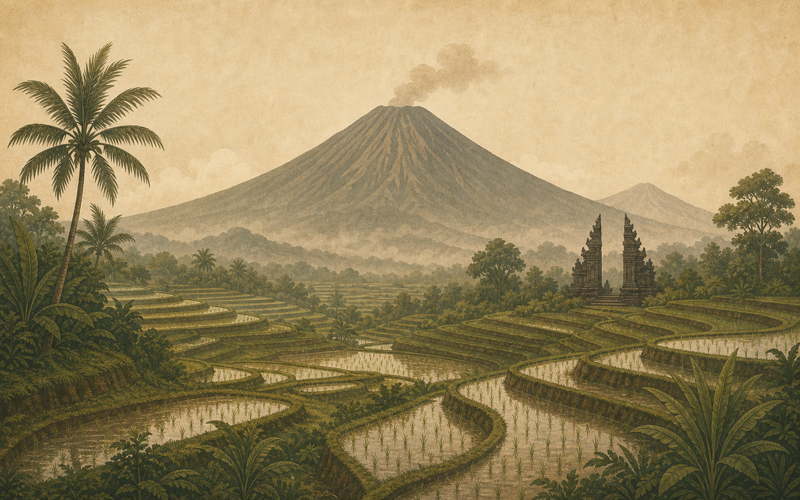
Mountains have long occupied a powerful place in Indonesian spiritual life. Their height, visibility, and relationship to clouds, springs, and volcanic force have made them more than geographic features. In many parts of the archipelago they have been treated as spiritually charged places where the human world comes into closer relation with ancestors, deities, or unseen powers. A museum perspective is valuable here because it helps explain that sacred mountains are not simply dramatic backdrops to ritual. They are active centers of meaning that shape settlement, pilgrimage, architecture, and everyday orientation in the landscape.
At the same time, no single mountain tradition represents all of Indonesia. The archipelago is home to many religious communities and local cosmologies, and mountain reverence appears in different forms across them. Some traditions emphasize mountains as the dwelling places of gods or ancestral beings. Others treat them as ritually potent sources of water, fertility, and order. A careful interpretation therefore avoids claiming one uniform doctrine. Instead, it recognizes a recurring Indonesian pattern: high places are often regarded as especially sacred, even when the surrounding religious vocabulary differs.
Why Mountains Become Sacred
Mountains are widely associated with sacred power in many parts of the world, and Britannica notes that high places are often understood as especially close to the heavenly realm. This broader pattern helps explain why mountains in Indonesia have repeatedly become sites of reverence. Their elevation makes them visually dominant, while their ecological role in producing water and shaping fertile land ties them directly to survival. In volcanic landscapes especially, mountains can appear both life-giving and dangerous, a combination that invites ritual respect.
This combination of awe and dependence is crucial. A mountain may provide springs, volcanic soil, and orientation in the landscape, yet it may also threaten nearby communities through eruption or landslide. Sacred meaning often emerges from this dual role. The mountain is not only admired for beauty; it is approached as a powerful presence that must be acknowledged, honored, or ritually negotiated. In this sense, reverence for mountains expresses a moral relationship with the environment as much as a theological one.
Local Belief and Layered Religions
Indonesian spiritual history is marked by layering rather than replacement. Britannica's overview of Indonesian religions emphasizes that local communities often adopted newer religions alongside earlier beliefs rather than simply abandoning older ritual frameworks. This point matters for understanding sacred mountains. A mountain may remain spiritually important even as the language used to explain it changes over time. Older ideas about ancestors, place spirits, or cosmic order can continue beneath Hindu, Buddhist, Islamic, or Christian forms.
Because of this layered history, sacred mountains should not be treated as relics of a purely premodern past. They remain intelligible within living religious worlds. In some cases, older mountain-centered ideas are absorbed into temple practice or pilgrimage. In others, they persist in ceremonial orientations, offerings, taboo zones, or stories of origin. Museums should therefore present sacred mountains as part of an ongoing cultural process in which communities reinterpret place without severing ties to inherited landscapes.
Bali and the Mountain as Cosmic Center
Bali offers one of the clearest documented examples of mountain-centered sacred geography in Indonesia. Mount Agung is described by Britannica not only as Bali's highest peak but also as an object of traditional veneration. Balinese myth links the mountain to divine presence and cosmic stability, and Britannica notes that it has been treated as the "Navel of the World." The mountain's spiritual prominence is also reflected in the location of Pura Besakih, Bali's mother temple, on its slopes.
This example is important because it shows how a mountain can structure an entire religious landscape. In Bali, the direction toward the mountain carries ritual significance, and sacred architecture is often oriented in relation to higher ground. The mountain is not merely a pilgrimage destination. It is a spatial principle that helps organize religious thought and daily practice. A museum interpreting Balinese culture should therefore treat the mountain not as a separate natural wonder but as a central axis in the ordering of sacred life.
Water, Agriculture, and Ritual Landscapes
Mountain reverence in Indonesia is not limited to dramatic myths or summit pilgrimages. It also shapes working landscapes. UNESCO's description of Bali's Cultural Landscape of the Subak System explains that the water temples are bound to a philosophy linking spirit, humanity, and nature. The Supreme Water Temple of Pura Ulun Danu Batur is especially significant because the crater lake of Batur is regarded as the ultimate source of springs and rivers. Here sacred geography is inseparable from irrigation and agriculture.
This relationship shows why mountains matter far beyond the summit itself. Their spiritual significance can flow downhill through channels, terraces, and ritual calendars. Farmers participate in mountain-centered systems not only through belief, but through coordinated practices of water management and ceremonial obligation. For museums, this is a powerful reminder that sacred mountains are not just symbols. They are part of lived ecological systems in which ritual helps organize the relationship between communities and life-sustaining resources.
Pilgrimage, Offerings, and Memory
Sacred mountains also function as destinations of movement. People travel toward them for worship, vows, offerings, seasonal ceremonies, or acts of remembrance. Even when access to the highest point is limited, the journey itself can be meaningful. Paths, temple complexes, resting sites, and designated viewing points become part of a larger ritual geography. In this way, mountain devotion is experienced through approach, not only through arrival.
Memory is deeply tied to these journeys. Families and communities often associate particular mountains with stories of origin, past disasters, divine protection, or inherited obligations. Volcanic mountains especially can become sites where danger and sanctity are remembered together. A museum can make this visible by treating pilgrimage routes, offerings, and commemorative practices as part of cultural heritage. The sacred mountain is not only the peak; it is the entire web of stories and actions organized around it.
Sacred Mountains Beyond One Island
Although Bali offers especially clear documentary evidence, sacred mountain traditions are not limited to Balinese Hinduism. Across the archipelago, mountainous places have often retained spiritual importance in communities shaped by diverse local beliefs. In some regions, upland interiors historically remained strongholds of local cosmology even as lowland centers became more fully integrated into world religions. Britannica's survey of Indonesian religions notes that many mountainous interiors long remained only partially touched by outside religious systems, a point that helps explain the durability of place-based ritual traditions.
That said, caution is important. Indonesia's mountain traditions are too varied to compress into one formula. Not every mountain is sacred in the same way, and not every community understands elevation through the same symbolic language. The value of the topic lies precisely in this diversity. Sacred mountains reveal a broad Indonesian tendency to invest landscape with spiritual meaning, while also reminding us that each mountain belongs to a specific history, community, and ceremonial world.
Interpreting Sacred Landscapes in Museums
Museums are especially well placed to interpret sacred mountains because they can connect physical geography with ritual practice. A mountain may be represented through maps, photographs, offerings, temple models, agricultural tools, or oral histories. Yet the most important task is interpretive: showing that landscape itself can be a cultural artifact. Sacred meaning is not added to a neutral mountain after the fact. It is produced through repeated relationships among place, memory, belief, and community practice.
This approach also helps avoid presenting spirituality as something abstract and detached from material life. In Indonesia, sacred mountains often shape architecture, farming, pilgrimage, settlement patterns, and ceremonial time. They are therefore ideal subjects for museum storytelling. Through them, visitors can see how environment becomes heritage and how belief is built not only into texts and temples, but into the very contours of the land.
Conclusion
Sacred mountains in Indonesian spiritual beliefs show how deeply landscape can be woven into religious thought. Across different regions and traditions, mountains have been treated as powerful places of orientation, reverence, fertility, and divine or ancestral presence. Their importance lies not only in height or dramatic appearance, but in the social and ritual worlds they organize.
From a museum perspective, sacred mountains matter because they reveal belief as something lived spatially. They connect temples to watersheds, myths to agricultural practice, and community memory to the natural environment. For that reason, the study of Indonesia's sacred mountains opens a wider understanding of how spirituality, ecology, and heritage meet in the archipelago.