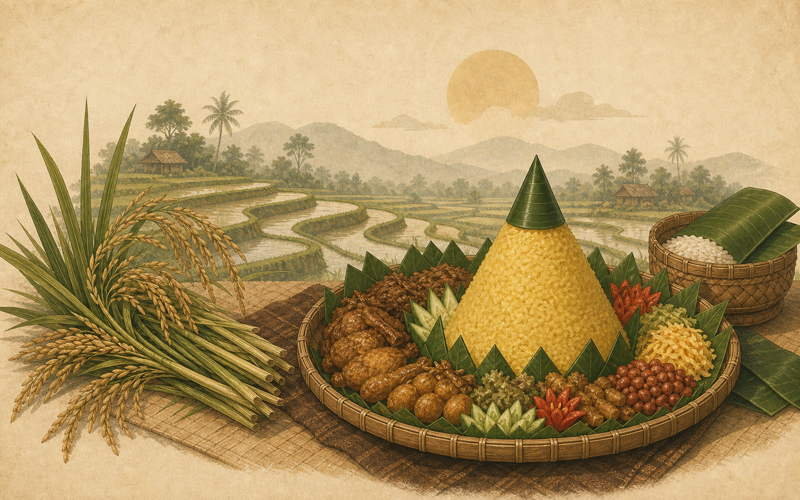
Rice has long been more than a staple crop in the Indonesian archipelago. In many communities, it has also been treated as a substance of life that demands respect, careful handling, and ritual attention. Farming was never understood only as a technical matter of irrigation and labor. It was often embedded in ceremonies, offerings, songs, and collective rules that linked human effort to fertility, seasonal order, and moral relations with the land.
For museums, this subject is important because agricultural ritual helps explain why tools, rice barns, manuscripts, offerings, and ceremonial textiles carry meanings beyond practical use. Objects associated with cultivation may look ordinary when removed from context, yet they once belonged to systems of belief and cooperation that shaped planting, harvest, and storage. A museum-style interpretation must therefore connect rice agriculture to cosmology as well as to material culture.
Rice as a Social and Sacred Substance
In many Indonesian agrarian settings, rice was understood as something that should not be treated casually. Communities developed rules about when fields should be planted, how harvest should be gathered, and how grain should be stored. Such rules helped organize labor and reduce conflict, but they also expressed the idea that fertility depended on proper relations among people, ancestors, deities, and the environment. Ritual was one way of making those relations visible.
This does not mean that all farming communities across Indonesia shared one uniform religious system. The archipelago has always been regionally diverse. Yet a recurring pattern can still be observed: the cycle of planting and harvest was often marked by ceremonies of permission, protection, thanksgiving, and renewal. These rites gave agricultural work a ceremonial rhythm and turned subsistence into a moral and communal practice.
Dewi Sri, Nyi Pohaci, and Regional Cosmologies
Among the best-known sacred figures associated with rice are Dewi Sri in Javanese contexts and Nyi Pohaci Sanghyang Sri in many Sundanese traditions. Scholarly work on Sundanese manuscripts and living customary communities shows that the rice goddess is not simply a decorative mythological figure. She appears within stories, mantras, and ritual acts that connect the growth of rice to feminine generative power, care, and the continuity of social life. In this sense, rice is imagined not as an impersonal commodity, but as a living trust.
At the same time, responsible interpretation requires regional precision. Dewi Sri should not be presented as a single pan-Indonesian goddess worshipped in exactly the same way everywhere. Different communities use different names, stories, ritual specialists, and ceremonial forms. Some practices emphasize offerings and recitations, while others place stronger weight on adat rules, ancestral obligations, or temple-centered ritual organization. The broader theme is shared reverence for fertility, but the forms remain local.
Ritual Across the Agricultural Cycle
Agricultural ritual often begins before planting and continues after harvest. Studies of Sundanese communities describe sequences of observances tied to preparing the land, blessing seed, protecting young rice, gathering the harvest, and storing grain in the barn. Offerings, spoken formulas, songs, and communal meals may all appear within this sequence. These actions help frame farming as a disciplined relationship with the land rather than a purely extractive activity.
Such rituals also carry social functions. They gather households into cooperative activity, affirm customary leadership, and transmit agricultural values from elders to younger generations. The ceremony is therefore not separate from farming knowledge. It helps communicate when to act, how to behave, and why rice should be handled respectfully. In museum interpretation, this is a crucial point: ritual is not an ornamental addition to agrarian life, but one of the ways agrarian life is organized and remembered.
Bali, Subak, and the Ritual Ordering of Water
Bali offers one of the clearest documented examples of agriculture, ritual, and ecology working together. UNESCO and Indonesian scholarship both describe the subak system not simply as irrigation engineering, but as a social and religious framework that coordinates water distribution, planting schedules, and temple obligations. Water temples and collective decision-making connect farmers to a larger philosophy of harmony between the spiritual realm, human communities, and the environment.
Within this system, ritual is inseparable from practical management. Ceremonies accompany agricultural stages, and the organization of water is treated as both a technical and sacred responsibility. This does not mean that every Balinese rice ritual is identical to Javanese or Sundanese devotion to Dewi Sri. Rather, it shows that Indonesian agricultural ritual can be expressed through multiple regional cosmologies. A museum should therefore compare these traditions carefully: not to flatten them into one model, but to show how different communities joined fertility, obligation, and landscape.
Manuscripts, Mantras, and Cultural Memory
Texts also play an important role in preserving agricultural ritual. Philological research on the Sundanese Melak Pare manuscript shows that farming mantras can combine older invocations of Nyimas Puhaci Sanghyang Sri with forms shaped by later Islamic devotional language. This is historically significant because it demonstrates continuity without stasis. Ritual traditions survive not by remaining unchanged, but by adapting to new religious and social environments while preserving older symbolic structures.
This layered history is especially useful for museums because it resists simplistic categories. Traditional agricultural ritual is not adequately explained as either “pure myth” or “pure religion.” It may include oral recitation, written texts, customary law, seasonal timing, and local ethics of care. When visitors encounter a manuscript, a granary object, or a ritual implement, they are seeing evidence of a knowledge system in which ecology, language, and belief were deeply intertwined.
Continuity, Change, and Museum Interpretation
Today, many agricultural rituals survive in transformed form. Some remain active in customary villages and ceremonial landscapes, while others are preserved through festivals, performances, or remembered narratives. Modernization, changing land use, tourism, and shifts in rural labor have altered the context in which many rites are practiced. Even so, the continued visibility of Dewi Sri imagery, harvest ceremonies, and ritual language shows that agrarian symbolism remains meaningful in cultural memory.
A museum should present this subject with care. It is tempting to romanticize rice ritual as evidence of an unchanging village past, but that would be misleading. Agricultural traditions have always evolved, and communities themselves reinterpret them in response to new pressures. The most responsible approach is to show ritual agriculture as a living historical system: one that linked food production to ethics, social cooperation, and reverence for forces larger than the individual farmer.
Conclusion
Traditional agricultural rituals and rice goddess worship in Indonesia reveal that farming has often been understood as a cultural and moral practice, not only as an economic one. Through figures such as Dewi Sri and Nyi Pohaci, through ceremonies surrounding planting and harvest, and through systems such as Bali’s subak, communities expressed the conviction that fertility depends on respectful relations among humans, nature, and the sacred.
For museum audiences, these traditions illuminate the deeper meanings of agrarian objects and landscapes. Rice barns, manuscripts, offerings, irrigation systems, and ceremonial performances all become more intelligible when seen as parts of one broader world of practice. Studied in that fuller context, Indonesian agricultural ritual is not a peripheral curiosity. It is a vital archive of how communities have understood sustenance, obligation, and the patterned life of the land.