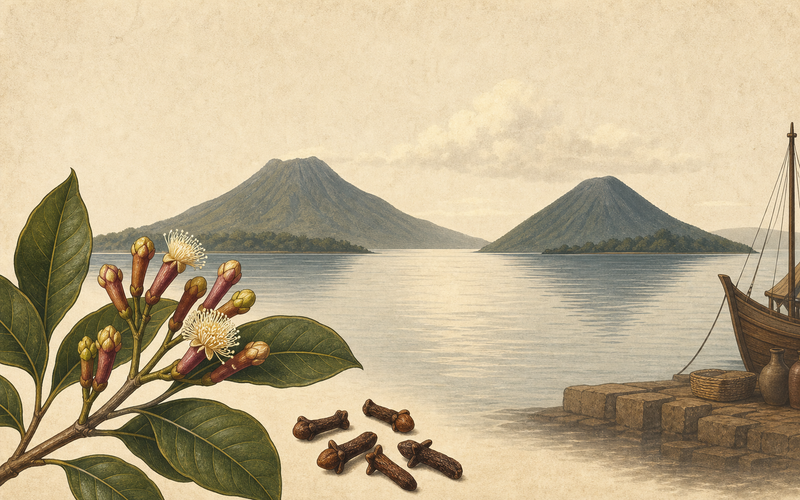
Ternate and Tidore are small volcanic islands, but their historical importance reaches far beyond their shorelines. Rising off the western side of Halmahera in North Maluku, they stood near one of the most prized botanical zones in the early modern world: the clove-producing islands of eastern Indonesia. Long before European powers tried to monopolize the spice trade, local rulers, merchants, sailors, and religious specialists had already turned this region into a dense political and commercial landscape.
For museums, the story of Ternate and Tidore is valuable because it brings together objects, routes, belief, and power. A clove, a court title, a mosque, a fort, a royal genealogy, or a diplomatic gift can each point toward the same larger history. These sultanates were not passive settings for foreign competition. They were active island courts that negotiated Islam, maritime trade, rivalry, and alliance in ways that shaped Maluku's place in Indonesian history.
Islands at the Center of the Clove World
The political rise of Ternate and Tidore cannot be understood without the ecology of cloves. The spice grew in a limited zone of Maluku, and its fragrance, preservative associations, and medicinal reputation gave it high value in Asian and later European markets. Geography made the northern Maluku islands into more than agricultural sites. They became points where growers, rulers, brokers, sailors, and foreign merchants met.
Ternate and Tidore were small, but they were well positioned. Their courts could build influence through access to cloves, control of harbors, tribute relations, and alliances with communities around Halmahera and beyond. Power did not depend only on occupying large territories. It also came from managing movement: boats, goods, people, and obligations moving through maritime space.
This helps explain why museum interpretation should avoid treating spice history as a simple story of Europeans arriving to discover valuable islands. Maluku was already connected to Muslim, Malay, Javanese, Chinese, and other trading networks. European arrival intensified competition, but it did not create the importance of the region. The clove trade had already made Ternate and Tidore visible within a wider Asian world.
Islam and the Language of Courtly Authority
Both Ternate and Tidore became known as Muslim sultanates, and Islamic identity became part of their courtly authority. Islamization in Maluku was not a single moment or a uniform process. It moved through trade, marriage, scholarship, diplomacy, and the prestige of rulers who adopted new religious titles and institutions. In this setting, Islam helped connect island courts to broader networks across the Indonesian archipelago and beyond.
The title of sultan mattered because it carried political and religious weight. It placed local rule within a larger vocabulary of Islamic kingship while allowing older patterns of lineage, alliance, and ritual authority to continue in adapted forms. Court culture could therefore be both local and cosmopolitan. A ruler might claim legitimacy through descent and sacred geography while also presenting himself within an Islamic diplomatic world.
For museum audiences, this layered authority can be difficult to see in a single object. A manuscript, weapon, seal, textile, or architectural fragment may show only one part of the story. Interpretation should connect such objects to the wider transformation of court life: new religious learning, mosque-centered ceremony, diplomatic correspondence, and changing ideas about lawful rule.
Rival Kingdoms and a Shared Political Landscape
Ternate and Tidore are often described as rivals, and that rivalry was real. Each court sought influence over clove-producing areas, neighboring islands, and maritime routes. Their competition helped organize alliances across North Maluku, including relationships with Bacan, Jailolo, communities on Halmahera, and territories farther east. Yet rivalry did not mean isolation. The two sultanates belonged to the same regional political world and understood each other through shared idioms of rank, diplomacy, and prestige.
This is why the word "rival" needs careful handling. It should not flatten the history into a simple pair of enemies. Rivalry could include warfare, marriage politics, tribute, negotiation, and shifting alliances. At times, one court might seek advantage through a foreign partner; at other times, local interests could produce coalitions that crossed earlier divisions. Political life in Maluku was flexible because maritime power depended on relationships as much as on fortifications.
In museum terms, Ternate and Tidore should be interpreted together without making one merely the shadow of the other. Their closeness across the sea made competition intense, but it also created a shared historical field. Visitors can better understand both courts when they see how each responded to the same pressures: spice wealth, Islamic legitimacy, regional alliances, and foreign intrusion.
European Intrusion and Local Strategy
The arrival of Portuguese, Spanish, Dutch, and other European interests changed the balance of power in Maluku, but local strategy remained central. European powers wanted access to cloves and tried to secure monopolies through forts, treaties, military pressure, and commercial control. Ternate and Tidore, however, were not simply absorbed into those plans. Their rulers used foreign alliances when useful and resisted them when they threatened court authority.
The rivalry between the two sultanates became entangled with European rivalry. Portuguese and later Dutch interests were often associated with Ternate, while Spanish influence became strongly linked to Tidore during parts of the early modern period. These alignments were never just imported conflicts. They were negotiated through local ambitions, grievances, and calculations about survival. Malukan rulers understood that foreign partners could provide weapons, prestige, and trade access, but also danger.
A museum display on this era should therefore do more than line up European flags and forts. Fortifications, cannon, ceramics, coins, or maps should be read beside local political agency. The question is not only what Europeans wanted from Maluku, but how Ternate, Tidore, and their allies managed the risks of a changing commercial world. That perspective gives island courts their proper historical weight.
Court Culture, Memory, and Material Heritage
The legacy of Ternate and Tidore survives not only in written history but also in places, ceremonies, and objects associated with royal authority. Palaces, mosques, heirlooms, regalia, and oral traditions continue to shape how communities remember the sultanates. These forms of heritage show that political history was also cultural history. Authority was performed through clothing, titles, processions, audience rituals, and the careful preservation of objects linked to royal descent.
Such materials invite museum interpretation beyond the theme of spice alone. Cloves explain much about the economic base of power, but courtly life cannot be reduced to trade. The sultanates also developed ideas of honor, Islamic learning, diplomatic etiquette, and regional responsibility. A ceremonial object from a court setting might therefore speak at once about status, devotion, memory, and political order.
The challenge is that some royal objects are still meaningful to communities, not merely historical specimens. Museums should avoid presenting them as relics from vanished kingdoms. Ternate and Tidore remain part of living regional identity in North Maluku. Responsible interpretation recognizes continuity, local custodianship, and the fact that royal heritage may carry ceremonial value as well as educational value.
Maluku in Indonesian and World History
Ternate and Tidore help connect Indonesian history to wider world history without removing Indonesian agency from the center. Their story includes Asian trade, Islamic expansion, European imperial competition, and local political creativity. It also shows how small islands could shape global demand. The geography of cloves drew distant powers to Maluku, but the region's own courts determined much of how those encounters unfolded.
This broader view matters because spice history is often told from the perspective of ships arriving from elsewhere. A museum-style account should begin instead from the islands themselves. Who controlled access to trees and ports? How did rulers make claims over communities and routes? How did Islam reshape court language? How did local rivalries influence international alliances? These questions restore complexity to a history too often simplified into a race for spices.
Ternate and Tidore also remind us that Indonesia's past was never confined to Java or Sumatra alone. Eastern Indonesia had its own centers of power, diplomacy, and cultural production. The sultanates of North Maluku belonged to an archipelagic world in which distance over water could become connection rather than separation.
Conclusion
The history of Ternate and Tidore is a history of small islands with large consequences. Through cloves, Islamic court culture, and maritime diplomacy, the two sultanates built influence that reached across Maluku and into wider trading worlds. Their rivalry sharpened political competition, but it also reveals a shared landscape of strategy, belief, and memory.
For museum audiences, these kingdoms offer a way to see Indonesian history through the eastern archipelago. Their heritage is not only a story of spices or European ambition. It is a story of local rulers and communities who shaped trade, religion, and power from within Maluku itself.