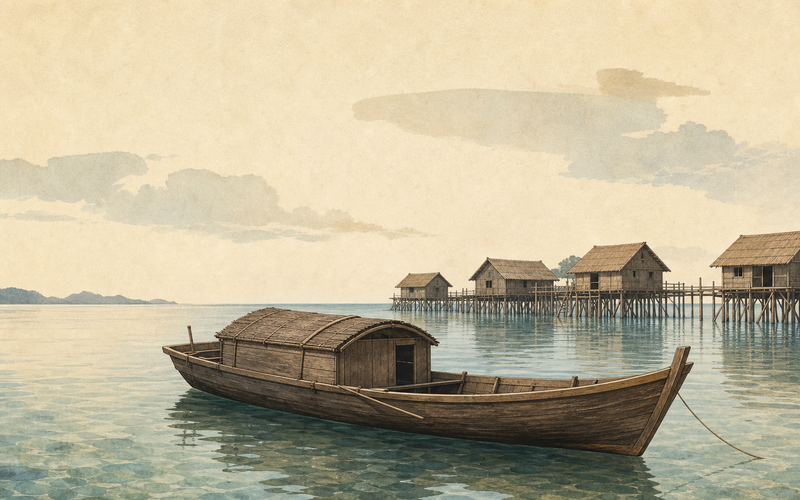
Across eastern Indonesia, the sea is not merely the space between islands. It can be a road, a workplace, a source of food, a field of memory, and the setting in which families learn how to belong. Sama-Bajau communities—often called Bajo in Indonesia—have developed especially close relationships with this maritime world. Their settlements are found along the coasts of Sulawesi, East Kalimantan, Maluku, and the eastern Lesser Sunda Islands, within a wider Sama-Bajau world that also reaches the southern Philippines and Sabah.
Popular descriptions often call the Sama-Bajau “sea nomads,” but the phrase can conceal as much as it reveals. Not every Sama-Bajau community lived aboard boats, and those that did were never isolated from markets, political authorities, or shore-based neighbors. A museum approach therefore begins with diversity. It asks how boats, tools, spoken knowledge, songs, and settlements recorded different ways of living with the sea—and how those ways have changed.
A Maritime World Larger Than One Label
Sama-Bajau is an umbrella term for related but varied communities. Historical and linguistic research describes a wide field of sea-oriented, coastal, and land-oriented groups rather than a single uniform population. Boat-dwelling families formed one distinctive part of this field. Others lived in pile houses above shallow water, in coastal villages, or in settlements with strong connections to both land and sea. Even communities sharing a language or name could differ in livelihood, religious practice, mobility, and political ties.
This diversity makes careful terminology important. “Sea nomad” may point to a history of movement, but it can also suggest that people wandered without purpose or existed outside history. In practice, movement followed knowledge: seasonal fishing areas, protected anchorages, trading relationships, family connections, and access to fresh water or supplies. Maritime mobility was an organized social practice, not an absence of home. Home could be made through people, routes, and remembered places as much as through fixed ground.
The Lepa as Dwelling, Vessel, and Working Space
In accounts of Indonesian Bajo life, the wooden boat called a lepa appears as more than transportation. For some families it was a dwelling in which daily life continued while moving between fishing grounds and anchorages. A compact vessel had to hold tools, cooking equipment, water, catches, and the possessions needed by a household. Space was limited, so each object earned its place through repeated use. The boat was simultaneously vehicle, workplace, storage space, and domestic interior.
To interpret a lepa in a museum is therefore to interpret a social space. Its hull and fittings can reveal woodworking knowledge, repair practices, and adaptation to local waters, while the arrangement of ordinary objects can suggest how a family organized sleep, food preparation, fishing, and travel. Yet no single preserved boat can stand for every community or period. Names and forms of vessels vary across the Sama-Bajau world, and boats changed as engines, new materials, market demands, and settlement patterns altered maritime work.
Reading Reefs, Weather, and Fishing Grounds
A boat becomes useful only through the knowledge that guides it. Bajo fishing traditions in Southeast Sulawesi include varied technologies designed for different species, depths, seasons, and marine environments. Nets, lines, spears, traps, and diving practices are not interchangeable tools. Each belongs to decisions about where to go, when to work, what conditions are safe, and how a catch will be consumed or exchanged. Skill lies not only in handling an implement but also in reading the living environment around it.
Such reading can involve currents, tides, winds, cloud formations, water color, reef shape, and the behavior of marine animals. This knowledge is learned through observation and participation rather than through a single written manual. Young people accompany experienced relatives, watch how routes are chosen, and gradually connect names and stories to particular places. The resulting mental map is both ecological and social: a fishing ground may also be linked to kin, past journeys, danger, exchange, or customary expectations.
Fishing, Trade, and Regional History
Sama-Bajau maritime life was never only a story of household subsistence. Historical studies place specialized fishers, divers, and carriers within larger trading systems. Marine products such as dried fish, sea cucumber, shell, and other reef resources connected mobile communities with coastal markets and political centers. In eastern Indonesia, Bajo voyaging intersected with Bugis and Makassar commercial networks and with the demands of regional states. Their expertise helped move resources through an archipelago whose economy depended on water routes.
These connections complicate romantic images of complete freedom at sea. Trade created opportunities, but it could also produce dependency, unequal patronage, and pressure on marine resources. Political borders later cut across older routes, while licensing, conservation rules, industrial fishing, and changing markets reshaped access to the sea. A responsible museum display should place fishing gear beside maps, trade goods, and records of regulation. Together they show that maritime skill always operated within economic and political conditions.
From Boat Dwelling to Coastal Settlement
Most Indonesian Bajo people today live in permanent settlements. The move toward stilt-house villages and shore-based homes developed through many pressures rather than one universal transition. Colonial and postcolonial administration favored populations that could be counted, schooled, taxed, and served in fixed locations. Access to clinics, markets, religious institutions, wage work, and formal education also made settlement desirable or necessary for many families. In some places, environmental decline and restrictions on fishing added further pressure.
Settlement did not simply end maritime identity. A house above shallow water can preserve direct access to boats, landing places, and neighboring households, while daily work may still follow fishing seasons and marine conditions. At the same time, living ashore changes domestic space, schooling, ownership, and the rhythm of travel. Contemporary communities occupy a broad continuum: some depend heavily on fishing, others combine marine work with trade or wage labor, and still others maintain cultural ties to the sea without relying on it for every livelihood.
Heritage Carried in Words, Sound, and Practice
Because mobile households could not carry large collections of objects, much Indonesian Bajo heritage has been transmitted in portable forms. Researchers describe strong traditions of song, spoken narrative, poetry, healing knowledge, and specialized vocabulary. The long sung narratives known as iko-iko are especially important examples of how history and cultural memory can travel through performance. Knowledge survives when people remember, repeat, adapt, and teach it.
This intangible heritage presents a challenge for museums. A boat displayed without voices may appear to be only a technical object, while a fishing tool separated from instruction can no longer show the judgment required to use it. Recordings, community interviews, place names, songs, and demonstrations can restore some of these relationships. Ethical interpretation also requires collaboration: Sama-Bajau people should be presented as contemporary knowledge holders, not as remnants of a vanishing maritime past.
Museums, Conservation, and Living Coastal Futures
Marine conservation is now part of the cultural story. Coral reefs, mangroves, and fisheries face pressure from destructive extraction, pollution, warming seas, and competition over coastal space. Bajo knowledge can contribute detailed observations of local environments, but it should not be romanticized as automatically uniform or perfectly conservationist. Communities respond to markets, poverty, regulation, and ecological change under different circumstances, just as other coastal populations do.
Museums can make these tensions visible without turning culture into accusation. A display might connect a lepa model, fishing implements, oral testimony, reef maps, and contemporary photographs of stilt settlements. It can ask who controls marine territory, whose knowledge informs policy, and how younger generations combine schooling with inherited skills. In this setting, heritage is not nostalgia. It is a resource for debating how cultural dignity and healthy seas might endure together.
Conclusion
The history of Sama-Bajau maritime knowledge in eastern Indonesia begins with boats but does not end there. The lepa brings together movement, household life, fishing, repair, and memory, while routes and anchorages reveal a geography built through experience. Coastal settlement transformed this world, yet it did not erase the cultural importance of the sea.
For museum visitors, the central lesson is that home need not be understood only as fixed land and walls. It can also be a practiced relationship among family, vessel, water, work, and story. Preserving Sama-Bajau heritage therefore means more than conserving an old boat. It means respecting the living knowledge that once guided it and continues to give maritime places meaning.