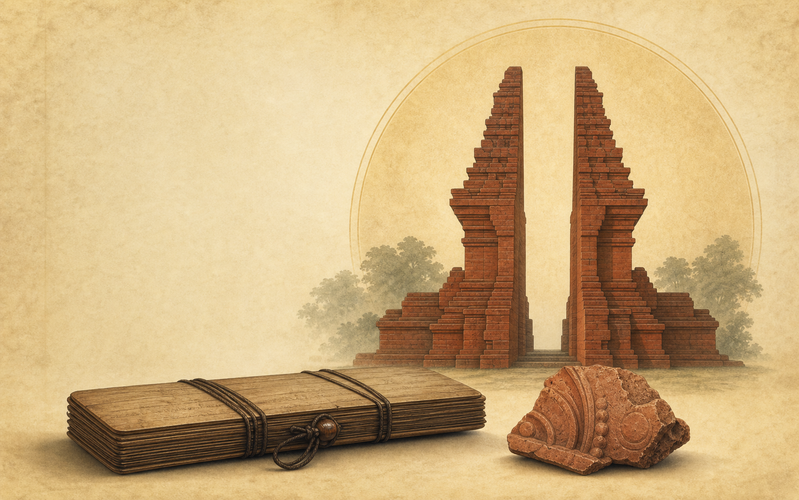
The Majapahit Empire occupies a powerful place in the historical imagination of Indonesia. Centered in East Java and usually dated from the late thirteenth century to the fifteenth, Majapahit is remembered not only as a political state but also as a cultural reference point. For museums, that distinction matters. Visitors often encounter Majapahit through scattered remains such as red-brick temple architecture, sculptures, ceramics, and manuscript traditions. Yet these materials gain meaning when they are understood as parts of a larger historical world shaped by trade, court ritual, literary production, and long afterlives in memory.
Majapahit is especially significant because its legacy has never belonged to a single object or monument. It survives through archaeological sites, Old Javanese texts, regional court traditions, and modern narratives about the Indonesian past. Some later interpretations have been highly symbolic, even idealized, but the empire's cultural importance does not depend on legend alone. It rests on the durable influence of a courtly civilization whose language, visual forms, and political memory continued to matter after imperial power declined.
Majapahit in Historical Context
Majapahit emerged in eastern Java during a period of shifting regional power after the fall of Singhasari. Over time, it became associated with a broad sphere of influence across parts of island Southeast Asia, though historians continue to debate the exact meaning of that influence and how directly it was exercised. For this reason, careful interpretation is important. Rather than imagining a modern territorial state, museums generally present Majapahit as a major court-centered polity whose prestige rested on alliances, trade, ritual authority, and control over strategic connections.
The empire is often linked with rulers and court figures such as Hayam Wuruk and Gajah Mada, whose names appear prominently in later historical memory. Literary works, including the fourteenth-century Nagarakretagama, offer valuable insight into how the court represented itself. Such texts do not function as neutral administrative records, but they are central to understanding how Majapahit articulated hierarchy, sacred geography, and royal legitimacy. In museum settings, manuscripts and inscriptions help explain that political authority was communicated through ceremonial language as much as through warfare or administration.
Court Culture and Political Imagination
One of Majapahit's most enduring legacies lies in the relationship between court culture and political imagination. The royal center was not simply an administrative capital. It was a place where status, cosmology, and power were made visible through architecture, ritual movement, dress, and controlled access to elite spaces. Archaeological remains at sites associated with the Majapahit period, especially around Trowulan, suggest an urban and ceremonial landscape in which red brick, gateways, bathing places, and religious compounds all contributed to a highly ordered environment.
This world mattered because courts did more than govern. They organized social meaning. Titles, protocols, and ceremonial obligations helped define political relationships, while visual and material culture expressed refinement and legitimacy. That pattern would have a long afterlife in Java, where later royal traditions continued to connect authority with etiquette, heirlooms, sacred space, and the disciplined performance of rank. Majapahit therefore matters not only as a vanished empire but also as a model of how courtly culture could shape ideas of order long afterward.
Religion, Art, and the Shared Visual Language of the Period
Majapahit art is often discussed through temples, sculpture, and decorative programs that combine local traditions with Hindu-Buddhist religious frameworks. Rather than treating these elements as separate categories, museums increasingly emphasize their interdependence. A temple complex was not merely an architectural shell. It was a setting for ritual practice, dynastic memory, and symbolic representation. Sculptures of deities, guardian figures, and royal-associated imagery belonged to a broader visual language in which religion and kingship could reinforce one another.
The material record of the Majapahit period also reveals skilled ceramic use, metalwork, terracotta production, and architectural ornament. Many surviving objects appear modest when removed from their original contexts, yet collectively they suggest a sophisticated environment of artisanship and ceremonial design. This is one reason Majapahit can be challenging to exhibit. Its legacy is not reducible to a single masterpiece. It is often the cumulative effect of bricks, reliefs, water structures, and ritual objects that allows visitors to imagine how an imperial center once functioned.
Texts, Memory, and the Survival of Majapahit After Empire
Majapahit did not survive only in ruins. It also survived in writing and in the transmission of historical memory. Old Javanese literary works, chronicles, and later retellings preserved the prestige of the empire even as political conditions changed. Texts associated with the Majapahit world became important for scholars because they record court ideals, ceremonial geography, and conceptions of kingship. At the same time, they remind us that historical memory is shaped by selection and interpretation. What later generations chose to preserve tells its own story.
This textual afterlife helped Majapahit remain culturally present long after its political fragmentation. In some regional traditions, the empire functioned as a remembered source of legitimacy. In modern Indonesia, it was often invoked as evidence that complex forms of political organization and cultural achievement existed in the archipelago long before colonial rule. Museums should present this carefully. The significance of Majapahit in nationalist memory is real, but it is also interpretive. The empire became a historical symbol because later readers, teachers, and institutions gave it renewed meaning.
Majapahit and the Idea of Cultural Continuity
When people speak of Majapahit's legacy, they often mean continuity. Yet continuity does not mean that every later Javanese or Indonesian tradition descends directly and unchanged from the empire. A stronger interpretation is that Majapahit became one of several important reservoirs of prestige, imagery, and historical reference. Later courts, literary communities, and cultural institutions could look back to it as a point of origin, comparison, or aspiration. That process of remembering is itself part of the legacy.
This is especially visible in the continued value attached to classical literature, court ceremony, and archaeological conservation. Sites associated with the Majapahit period became places where history could be materially encountered. Manuscripts became evidence of intellectual and literary continuity. Even the visual preference for certain gateways, rooflines, and red-brick forms could evoke a remembered classical past. Museums are well placed to show that such continuity is not automatic inheritance but active curation across generations.
Interpreting Majapahit in Museums Today
Modern museum interpretation benefits from presenting Majapahit as both a historical polity and a remembered cultural horizon. Doing so allows curators to balance archaeological evidence with later reception. A gallery might display temple fragments, terracotta figures, and maps of Trowulan, but it should also explain how texts such as the Nagarakretagama shaped later understanding of the empire. This approach helps visitors see that heritage is formed not only by what survives from the past but also by how societies continue to read the past.
Such interpretation also encourages caution against oversimplification. Majapahit was neither an exact blueprint for the modern nation nor merely a romantic legend. It was a historically grounded Javanese empire whose influence was significant, though interpreted differently across time. The most responsible museum narrative therefore joins evidence with humility. It highlights what archaeology, literature, and scholarship can show clearly while acknowledging where historians still debate scope, chronology, and meaning.
The cultural legacy of the Majapahit Empire endures because later generations never stopped returning to it. They found in Majapahit a language for discussing power, refinement, memory, and historical depth in the Indonesian archipelago. For museums, that enduring return is the real key. Majapahit remains important not simply because it existed, but because its objects, texts, and ruins continue to organize how people imagine the relationship between the past and cultural identity in the present.