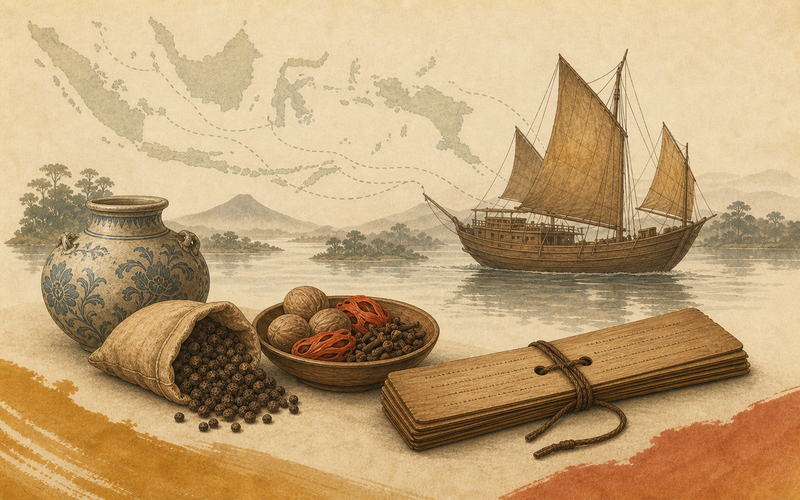
Ancient trade routes shaped Indonesian culture because the archipelago sits between major sea lanes of the Indian Ocean and the South China Sea. Long before modern borders, island communities traded with one another and with merchants from South Asia, China, mainland Southeast Asia, and the Middle East. These routes carried spices, forest products, ceramics, metals, textiles, religious ideas, scripts, and political models.
The impact was not a simple story of foreign influence arriving in passive islands. Indonesian communities were active participants. Port rulers controlled harbors, sailors understood monsoon winds, artisans adapted imported forms, and local societies gave new meanings to objects and beliefs. A museum-style interpretation should therefore treat trade as a process of exchange, selection, and localization.
Maritime Geography and Monsoon Routes
Indonesia's geography made maritime exchange essential. The archipelago is not a single landmass but a chain of islands, straits, ports, river mouths, and coastal settlements. Sailing knowledge mattered because movement depended on currents, seasonal winds, and safe harbors. Trade routes were therefore also knowledge routes, maintained by pilots, merchants, boatbuilders, and coastal communities.
The monsoon system helped structure long-distance sailing. Ships could move with seasonal winds, wait in ports, and continue when conditions changed. This rhythm encouraged the growth of harbor towns where merchants stayed long enough to exchange goods, learn languages, marry locally, or build religious connections. Culture changed not only through cargo, but through repeated human presence.
Spices, Forest Products, and Port Wealth
Search interest in Indonesian trade often begins with spices, and for good reason. Cloves, nutmeg, and mace connected eastern Indonesia to wider Asian and eventually global markets. Britannica describes the spice trade as ancient and economically significant, while UNESCO's spice-route material emphasizes the importance of maritime routes across the region. These spices were valuable partly because their production was geographically concentrated.
Yet spices were not the only trade goods. Forest products, resins, aromatic woods, textiles, metals, ceramics, and foodstuffs also moved through ports. The cultural impact of trade came from this variety. Imported ceramics could become prestige goods; cloth could enter systems of dress and exchange; metal goods could alter craft practice; and rare aromatics could become part of courtly and ritual life. For a focused version of this story, see the history and cultural role of Indonesian spice trade.
Indian Ocean Connections and Sacred Landscapes
Trade helped connect Indonesian societies to South Asian religious and intellectual worlds. Hindu and Buddhist ideas reached parts of the archipelago through long processes involving merchants, ritual specialists, courts, and local patronage. The result was not a simple copy of India. Indonesian rulers and artists adapted these traditions into local forms, visible in inscriptions, temple architecture, sculpture, and literature.
The cultural impact can be seen in early polities and sacred landscapes. Sanskrit inscriptions, Indian-derived scripts, and temple art show that trade routes also carried prestige languages and religious models. Over time, these models were localized in Java, Sumatra, Bali, and other regions. Readers interested in the written evidence can continue with precolonial writing systems of the Indonesian archipelago.
Srivijaya and Maritime Power
Srivijaya is one of the clearest examples of a polity shaped by maritime routes. Centered in Sumatra, it became influential through control of strategic waterways and connections with Buddhist learning and trade. Britannica identifies Srivijaya as an important maritime and commercial power. Its history shows that sea routes could support political authority, not just exchange between independent merchants.
A maritime power did not need to rule like a modern territorial state. Influence could depend on ports, river access, alliances, tribute, and religious prestige. This matters for museum interpretation because maps can be misleading if they imply hard borders. Trade-route power often worked through nodes and corridors: harbors, straits, estuaries, and courts that could attract and direct movement.
Chinese Ceramics and Material Exchange
Chinese trade left visible traces in Indonesian material culture, especially through ceramics found in archaeological and heirloom contexts. Imported ceramics could serve practical, decorative, and prestige functions. In some communities, foreign objects became localized possessions with meanings shaped by inheritance, ritual use, or display.
Chinese influence also operated through communities, not only goods. Over centuries, settlement, intermarriage, and urban life contributed to Peranakan traditions and other forms of cultural blending. For that social history, see the influence of Chinese culture on Indonesian traditions. The important point here is that trade routes created durable relationships as well as transactions.
Islam, Ports, and Coastal Culture
Islam spread through many parts of the archipelago in ways closely connected to trade, port cities, and local courts. Muslim merchants and teachers were part of wider Indian Ocean networks, but Islamization was not uniform or instantaneous. Different regions adopted Islamic institutions, law, art, and learning at different times and in different ways.
The coastal character of this process matters. Ports brought together merchants, scholars, rulers, and craftspeople. Mosques, manuscripts, gravestones, and court traditions show how Islamic culture became localized. Rather than replacing earlier traditions everywhere in the same way, Islam entered layered cultural landscapes where older artistic and social forms often continued in adapted form.
Trade Routes in Museum Interpretation
Trade routes are sometimes difficult to display because a route is not a single object. Museums can make them visible through maps, ship models, ceramics, inscriptions, coins, textiles, spices, manuscripts, and port archaeology. The strongest displays connect objects to movement: where an item was made, how it traveled, who used it, and how its meaning changed after arrival.
Good interpretation also avoids vague phrases such as "since ancient times" without explanation. It is better to identify periods and processes: early Sanskrit inscriptions, Srivijaya's maritime networks, the spice trade of Maluku, Islamic port cultures, or later European intervention. Each belongs to a different historical setting.
Conclusion
Ancient trade routes shaped Indonesian culture by linking island societies to wider worlds while also strengthening local creativity. They carried goods, but they also carried scripts, religions, artistic forms, technologies, and social relationships. Their impact can be seen in ports, temples, manuscripts, ceramics, court traditions, and everyday foodways.
For museum audiences, the most important lesson is that exchange did not erase Indonesian cultural specificity. It gave communities new materials and ideas to adapt. The archipelago's cultural richness grew from movement across water, but also from the choices made in each harbor, court, village, and workshop.