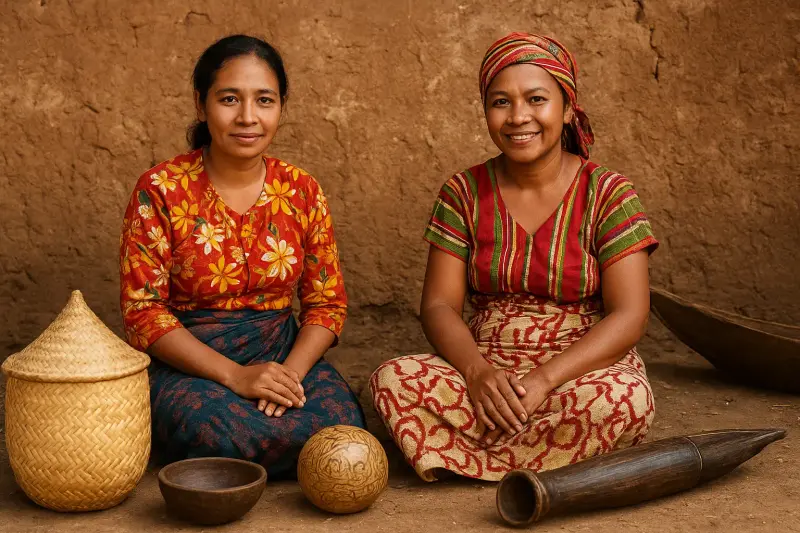
Few human stories are as fascinating as the connections between Indonesia and Madagascar. Separated by more than 7,000 kilometers, the two regions seem completely different geographically and culturally. Yet the language, traditions, and genetics of Madagascar’s population clearly show a deep Indonesian heritage, more than a thousand years old.
1. Introduction: an African island with an Asian soul
Madagascar is a huge African island in the Indian Ocean, near the coast of Mozambique. Its people, called Malagasy, have a culture that blends African and Asian elements. But even though the island lies only a few hundred kilometers from Africa, the origin of a significant part of its population - and especially its language - is found in the Indonesian archipelago, thousands of kilometers to the east.
This ancient connection has been confirmed by linguists, geneticists, and archaeologists, who uncovered convincing evidence of a major migration of Indonesian seafarers to Madagascar around the 5th–8th centuries AD.
2. Voyages across the Indian Ocean: sailors from the Sunda Islands
Since antiquity, Austronesian populations (living in today’s Indonesia, Philippines, and Malaysia) have been famous for exceptional seafaring skills. They invented the catamaran and outrigger canoes, light but stable vessels capable of crossing huge distances.
Historians consider that the first Austronesian populations to reach Madagascar most likely came from Borneo or Sulawesi, regions in what is now eastern Indonesia.
Through trade routes connecting East Asia, India, and the African coast, these sailors crossed the Indian Ocean. They may have stopped in the Maldives, Comoros, and on the Mozambique coast before settling in Madagascar.
3. Austronesian migration and genetic evidence
Modern genetic research confirms that the Malagasy population today is a blend of African and Indonesian genes, in almost equal proportions.
A study published in Nature Communications (2012) shows that the maternal line of many Malagasy (mitochondrial DNA) comes from populations on Borneo, especially the Ma’anyan ethnic group living in central Kalimantan.
This discovery reinforces the idea that a planned expedition from Borneo crossed the Indian Ocean about 1200–1500 years ago, bringing language, technology, and cultural traditions that would shape Madagascar’s identity forever.
4. Linguistic similarities between Malagasy and Indonesian languages
One of the clearest proofs of the link between Indonesia and Madagascar is the Malagasy language. It is part of the Austronesian language family, the same family that includes Bahasa Indonesia, Bahasa Malaysia, Tagalog, Javanese, Sundanese, and many others.
Examples of lexical similarities:
| Romanian | Malagasy | Indonesian | Meaning |
|---|---|---|---|
| apă | rano | air | water |
| foc | afo | api | fire |
| casă | trano | rumah | house |
| mâncare | sakafo | makanan | food |
| nume | anarana | nama | name |
| zi | andro | hari | day |
| a merge | mandeha | pergi | to go |
| mare / ocean | ranomasina | lautan | sea |
| piatră | vato | batu | stone |
| copil | zaza | anak | child |
These correspondences are not accidental. They indicate a shared linguistic root, word by word, between Malagasy and Indonesian, especially the dialects spoken in Borneo and Sulawesi.
For example, in both languages, the words for water ("rano" / "air") and fire ("afo" / "api") share the same phonetic and semantic structure.
Moreover, the grammatical structure of Malagasy, with verbs preceding the subject and object, is typical of Austronesian languages, not African ones. This shows that Madagascar’s linguistic base is profoundly Asian.
5. Shared cultural elements
The similarities between Madagascar and Indonesia go beyond language. They are also found in:
- Navigation and boatbuilding - Malagasy people traditionally use outrigger boats, almost identical to Indonesian ones.
- Agricultural systems - terraced rice cultivation, widespread in Indonesia, is also present in Madagascar’s highlands.
- Musical instruments - the valiha, made from bamboo, is similar to the sasando, a traditional instrument from the Rote Islands (Indonesia).
- Mythology and beliefs - the presence of ancestral spirits (razana in Madagascar, nenek moyang in Indonesia) and associated ritual practices are almost identical in symbolism.
These cultural parallels leave no doubt: migrants from Southeast Asia not only reached Madagascar, but also transmitted a significant part of their way of life.
6. How did Indonesians reach Madagascar - historical hypotheses
There are several theories about how Indonesians reached the East African coast.
a) The direct navigation hypothesis
Some researchers believe that a fleet of migrants crossed the Indian Ocean directly, guided by seasonal currents (monsoons). During the western monsoon, winds could carry Austronesian vessels from Sumatra or Borneo to East Africa.
b) The intermediate trade-route hypothesis
Another hypothesis suggests that Indonesian sailors were already involved in transoceanic trade with India and the Middle East. Along these routes, a group may have settled gradually in the Maldives, then in the Comoros, and finally in Madagascar.
c) The multi-wave migration hypothesis
There is evidence that migration was not a single event but a process over several centuries. Austronesian populations may have arrived in Madagascar in multiple stages, bringing with them cultures, plants, and animals (such as rice, coconut, and pig).
7. Archaeological and botanical evidence
Beyond language and DNA, Madagascar’s flora also provides evidence of Asian influence. Plants such as:
- banana,
- coconut,
- taro (colocasia esculenta) are of Asian origin, introduced by Austronesian settlers.
Likewise, the construction style of traditional Malagasy houses, with sloped palm-leaf roofs and bamboo walls, is almost identical to those found in Sumatra and Java.
8. Madagascar: a laboratory of the meeting between Asia and Africa
Madagascar became a bridge between two worlds. While the language and some traditions originate in Asia, African influence gradually became dominant in daily life, religion, and art.
The result is a unique hybrid culture: Malagasy people speak a language with Indonesian structure but live on an African continent and share African traditions.
For example, hiragasy ritual dances combine Asian elements (repetitive music, symbolic rhythms) with African influences (drums, group movements, vocal calls).
9. Indonesian heritage in modern Malagasy identity
Today in Madagascar, awareness of Asian origins survives in myths and genealogies. Many Malagasy say their ancestors came "by sea, from the east".
In coastal areas, terms reminiscent of Southeast Asia are still used, and boatbuilding and maritime festivals preserve solar and oceanic symbols similar to those of Indonesia.
Also, standard Malagasy contains hundreds of terms identical to those in Bahasa Indonesia, especially in the domains of nature, agriculture, and religion.
10. Cultural and spiritual similarities
Both cultures share a deep respect for ancestors. In Madagascar, the famadihana ritual - the reburial of ancestors’ bones - is an act of gratitude and spiritual communion.
In Indonesia, similar traditions exist in Sulawesi and Borneo, where communities periodically honor ancestors through ceremonies, songs, and sacred dances.
The belief in a balance between the forces of nature - between land, sea, and spirit - is also common to both worlds, a sign that Austronesian philosophy was transmitted intact across the ocean.
11. A link still visible today
In the 21st century, researchers continue to uncover new evidence linking Indonesia to Madagascar. Recent archaeological expeditions have found tools, vessels, and artifacts from the 6th–8th centuries with decorative patterns typical of Indonesia.
Modern collaborations between universities in Jakarta and Antananarivo aim to document shared heritage.
Even in gastronomy there are surprising similarities: the use of coconut, rice, and tropical spices echoes Indonesian cuisine.
12. Conclusion
The story of Indonesian influence in Madagascar is one of the most spectacular examples of migration, adaptation, and cultural survival in human history.
More than a thousand years after crossing the Indian Ocean, the Malagasy language remains a living testament to this link. Words like rano, trano, or zaza are not just everyday terms, but echoes of a past in which seafarers from the Indonesian archipelago set out on the longest journey of the premodern world, giving birth to a new civilization - a miraculous blend of Asia and Africa.
Madagascar today proves that oceans do not separate peoples, but connect them. And this bond between Indonesia and Madagascar remains one of the most beautiful cultural bridges in human history.