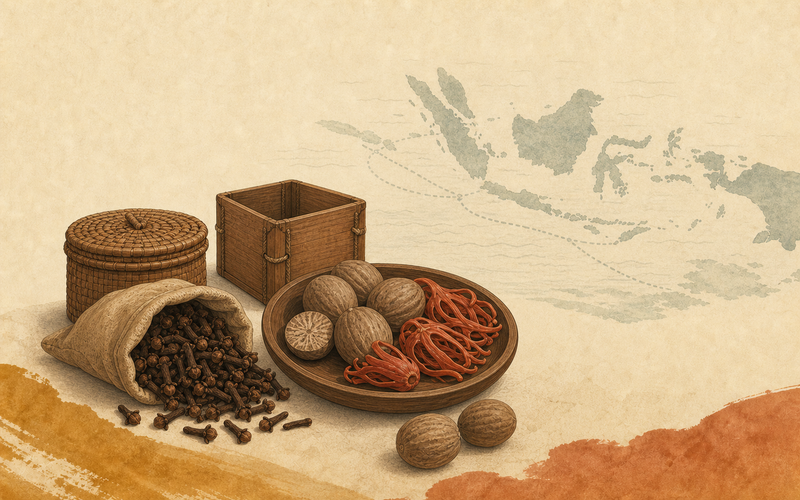
The history of Indonesian spice trade begins not with European ships, but with island environments and the societies that learned to cultivate, transport, and value highly aromatic plants. Cloves were historically associated with parts of Maluku, while nutmeg and mace became especially famous through the Banda Islands. Long before the sixteenth century, these products had already entered wider Asian exchange networks. Traders from different regions sought them because they were rare, fragrant, and useful in elite cuisine, medicine, and preservation.
From a museum perspective, the spice trade is important because it connects natural history, maritime technology, political change, and material culture in one story. Spices were never only commodities measured by weight and price. They were objects of taste, prestige, and ritual significance. Their movement encouraged the rise of ports, diplomatic alliances, and competing imperial ambitions, but it also shaped everyday practices in Indonesian homes and courts. A careful interpretation therefore treats spice as both an economic good and a cultural agent.
Island Ecologies and Precious Plants
The first key to understanding the trade is ecological specificity. Cloves and nutmeg did not grow everywhere across the archipelago in equal abundance. Their concentration in particular islands made Maluku globally important. Britannica describes the Moluccas, or Maluku, as the historical Spice Islands known to Indian, Chinese, and Arab traders. That reputation depended on local ecological knowledge as much as on geography. Farmers and communities in these islands worked within volcanic landscapes, seasonal rhythms, and inherited techniques of cultivation and harvesting.
This ecological concentration increased the symbolic and economic value of the spices. A product that could not be sourced from every port became a marker of rarity. In museum galleries, this is one reason spice history should be displayed alongside maps, botanical information, and local agricultural practice. The story is not simply that outsiders discovered valuable plants. Rather, particular Indonesian landscapes had long produced materials that local societies already understood and managed, and those environments gave the trade its historical power.
Networks Before European Expansion
The spice trade was embedded in Asian maritime exchange before Portuguese and Dutch intervention. UNESCO's description of the spice route emphasizes that the sea lanes linked different islands and coastal centers across the region during the thirteenth to eighteenth centuries. Indonesian spices moved through a wider commercial world that included merchants, ship routes, and port settlements extending well beyond one island group. This means the trade should not be narrated as a sudden beginning triggered by Europe.
That earlier network matters culturally because it placed Indonesian islands within long traditions of encounter. Ports connected producers, sailors, interpreters, religious communities, and courts. Goods, languages, and ideas traveled together. When a museum presents spice only as a prelude to colonial conquest, it misses this earlier phase of regional agency. The Indonesian spice trade had already helped create cosmopolitan maritime worlds in which local rulers and merchants participated actively, negotiating access, protection, and exchange.
Sultanates, Ports, and Political Authority
Control of spices was closely tied to political authority. Britannica notes that Ternate became an important sultanate from the fifteenth to the seventeenth century. Such polities were not passive observers waiting for foreign influence. They were central actors in organizing trade, negotiating alliances, and protecting routes. Spices could strengthen a ruler's position because they attracted merchants and linked island courts to broader networks of wealth and diplomacy.
Ports and sultanates also shaped the cultural role of the trade. Courts used imported goods, ceremonial exchange, and prestige objects to display status, while local authority depended partly on managing access to coveted products. In this setting, spice was a political resource. It could support royal households, draw military interest, and influence treaty making. A museum narrative should therefore show that the spice trade was not abstract commerce alone. It was part of the lived structure of governance, hierarchy, and inter-island diplomacy.
Competition, Monopoly, and Colonial Violence
The arrival of European powers intensified competition over a trade that was already profitable and symbolically charged. Britannica records that Portuguese visitors reached Ternate in 1512 and later built a fort there. It also notes that after conflict and treaty making, the Dutch were granted a spice monopoly. This shift reveals how the trade moved from negotiated participation in regional exchange toward more coercive systems of control. Monopoly was not a neutral commercial arrangement. It relied on force, restriction, and unequal power.
The Banda Islands provide an especially stark example of that transformation. UNESCO's tentative listing for the historic and marine landscape of Banda highlights the islands' major place in the history of nutmeg and the global struggle to command its production. In museum interpretation, Banda makes clear that spices linked beauty and violence in the same historical process. Nutmeg and mace traveled as prized luxuries, yet the effort to dominate them produced conquest, displacement, and systems designed to limit cultivation in order to protect profit.
Spices in Food, Medicine, and Social Life
The cultural role of Indonesian spices cannot be reduced to export statistics. Aromatic products gained importance because people valued them in daily and ceremonial life. Cloves and nutmeg entered cuisines as flavoring agents, but their significance went further. In many parts of Asia and beyond, spices were associated with warming, fragrance, health, refinement, and hospitality. Their portability helped them circulate widely, but their cultural authority came from the meanings attached to them in kitchens, courts, and healing traditions.
Within Indonesia, this broader cultural value helps explain why spice history still resonates in public memory. The trade was not only about foreign demand; it was also about local cultivation, household use, and regional identity. A museum may display spice containers, trade ceramics, shipping imagery, or botanical specimens, yet the most effective interpretation reconnects these objects to sensory life. The smell of cloves or nutmeg, the preparation of food, and the prestige of rare ingredients all help audiences understand why spices mattered so much to historical communities.
Cultural Exchange Across the Archipelago
Because spices moved through maritime routes, they also encouraged cultural exchange across Indonesian and regional ports. UNESCO's broader spice-route framing points to an interconnected seascape rather than an isolated chain of transactions. Ships carried people as well as goods: merchants, sailors, religious teachers, and officials. As they traveled, they contributed to multilingual encounters and to the circulation of techniques, stories, and beliefs. Ports involved in the trade became places where local and foreign influences were constantly being negotiated.
This exchange is part of the reason the spice trade belongs in museum interpretation of Indonesian cultural history rather than only in economic history. Maritime trade affected urban life, architecture, diplomacy, and collective memory. It tied eastern Indonesian islands to Java, Sulawesi, and wider Asian waters, while also attracting global competition. The result was not a single uniform culture, but a layered history of connection. Spice routes helped create the conditions under which communities met one another and redefined their place in a larger world.
Memory, Heritage, and Museum Interpretation
Today, the Indonesian spice trade remains powerful as heritage because it offers a way to connect local landscapes with global history. Heritage work around the Banda Islands and the wider spice route shows that the past is preserved not only in texts, but also in ports, forts, agricultural zones, oral memory, and maritime landscapes. Museums can use this subject to teach that a plant can reshape settlement patterns, diplomatic relations, and international rivalry across centuries.
At the same time, responsible interpretation must resist nostalgia. The spice trade generated prosperity for some communities and rulers, but it also became tied to exclusion and colonial violence. Presenting both sides is essential. When visitors encounter Indonesian spice history through artifacts, maps, and environmental context, they should come away with a balanced understanding: spices connected the archipelago to the world, yet those connections carried unequal consequences. That tension is precisely what makes the subject historically rich and culturally significant.
Related Reading
For broader context, see ancient trade routes and their impact on Indonesian culture. For a focused botanical and regional story, read the cultural history of clove and nutmeg in Maluku, and for earlier maritime power see the maritime kingdoms of early Indonesia and their trade networks.
Conclusion
The Indonesian spice trade was one of the great maritime stories of the premodern and early modern world. Rooted in the ecologies of Maluku and Banda, it linked local producers to Asian merchants, regional sultanates, and eventually European empires. Its history shows how rare plants could shape diplomacy, shipping, warfare, and political ambition on a global scale.
For museums, however, the deepest value of the subject lies in its human texture. Spices were ingredients, medicines, prestige goods, and symbols of place. They belonged to households and courts as much as to ships and warehouses. Reading the trade in that fuller way allows Indonesian spice history to appear not only as commerce, but as cultural history preserved in landscapes, objects, and memory.