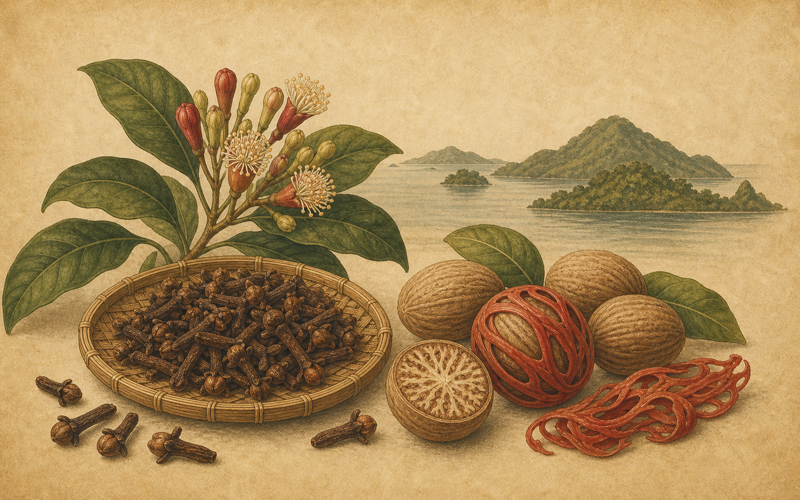
Clove and nutmeg occupy a special place in the cultural history of Maluku because they are both everyday plants and world-historical substances. In museums, visitors often encounter them as examples of the spice trade, a shorthand for long-distance commerce and European expansion. That interpretation is important, but it is incomplete on its own. In Maluku, these spices have also belonged to local ecologies, village labor, inherited cultivation knowledge, and regional identity.
A museum perspective benefits from holding these scales together. Clove and nutmeg can be studied as botanical specimens, as traded goods, and as historical agents that altered political life. They connected Maluku to merchants from Asia, the Middle East, and Europe, yet they also remained rooted in island landscapes and community practice. Their cultural history is therefore not just a story of global demand. It is also a story of how Malukan places and people lived with plants that the wider world treated as precious.
Plants of Place and Local Knowledge
Although clove and nutmeg are often mentioned together, their historical geographies within Maluku are not identical. Nutmeg is especially associated with the Banda Islands, which were for a long time the world’s only significant source of nutmeg and mace. Cloves, by contrast, are commonly linked with other islands in the Moluccas, especially Ternate, Tidore, and Ambon. Keeping this distinction matters because it prevents the Spice Islands from being treated as a vague backdrop rather than as a set of specific island environments.
Before these spices became symbols of global commerce, they were plants known through local cultivation and use. Communities observed when trees flowered, how buds or fruits should be harvested, and how different parts of the plant could be processed. Nutmeg offered more than one valuable product, since both the seed and the aril surrounding it entered trade. Cloves were valued in the form of dried flower buds, which required careful timing in harvest. Such knowledge belongs to environmental history as much as to economic history.
Maritime Exchange Before Colonial Monopoly
Long before European powers attempted to dominate the spice trade, Maluku was already part of wider Asian commercial networks. Traders from different regions moved through island routes that linked eastern Indonesia with larger circuits across the archipelago and beyond. In this earlier context, clove and nutmeg were not isolated curiosities. They were high-value goods exchanged through relationships that depended on navigation, diplomacy, and port-to-port contact.
This older history is important because it recenters Maluku as an active participant in exchange rather than as a passive point of extraction. A museum label that begins only with Portuguese or Dutch arrival risks suggesting that history started when Europeans appeared. In fact, the fame of Malukan spices rested on systems of trade that were already in motion. European merchants entered a preexisting world of routes, brokers, rulers, and negotiated access.
Scarcity, Power, and Colonial Violence
The extraordinary global value of clove and nutmeg encouraged increasingly aggressive attempts to control production. Portuguese, then Dutch, and at times British interests competed for access to spice-growing islands. In the seventeenth century, Dutch monopoly policies became especially consequential in the Banda Islands, where nutmeg production was reorganized under coercive plantation arrangements. Historical writing on Banda cannot avoid the violence that accompanied this process, including the devastating assault on Bandanese society in 1621.
Museums today have a responsibility to explain that spice wealth did not circulate innocently. Clove and nutmeg generated profit, but they also helped finance imperial systems built through force, displacement, and tightly managed trade. Colonial power in Maluku relied not only on ships and forts but also on regulating where trees could grow, who could sell the harvest, and which communities could participate in commerce. The history of spices is therefore inseparable from the history of controlled landscapes and unequal power.
From Commodity to Household and Ritual Life
Even so, the meaning of these spices in Maluku cannot be reduced to colonial archives. Clove and nutmeg also entered household economies, foodways, small-scale processing, and local forms of value. Nutmeg, for example, has long been used not only as an exported spice but also in processed products made in Banda, including preserved sweets that continue to carry historical associations with place. Such uses remind us that spice plants persist after empire not merely as symbols, but as lived resources.
This is where a museum can widen its interpretive frame. Instead of displaying spices only as trade samples, exhibitions can connect them to everyday material culture: tools of drying and storage, memories of harvesting, local culinary practice, and regional craft or market life. These dimensions may appear modest compared with the drama of international rivalry, yet they are essential. They show how global commodities remain embedded in ordinary social worlds.
Memory, Landscape, and the Idea of the Spice Islands
The phrase "Spice Islands" is famous, but it can flatten Maluku into a romantic image. For local communities, the landscape is not a mythic abstraction. It is made of named islands, family histories, gardens, coastal routes, and sites marked by both prosperity and trauma. Banda in particular carries layered memory: it is remembered for nutmeg, for colonial fortifications, for forced reorganization of production, and for the survival of communities whose history exceeds the colonial record.
Heritage work increasingly treats these islands as cultural landscapes rather than as isolated monuments. This approach is valuable because it links ecology, agriculture, settlement, and historical architecture. A clove tree or nutmeg grove is not only an economic asset. It can also be a witness to generations of labor and to major historical change. Reading the landscape in this way helps museums avoid separating natural history from human history.
Interpreting Spice History in Museums Today
For museums in Indonesia and beyond, clove and nutmeg present both an opportunity and a challenge. The opportunity lies in their ability to connect local collections to world history in a way that visitors immediately grasp. The challenge is to avoid repeating old narratives that admire exotic commodities while neglecting the people who cultivated them and endured the consequences of monopoly. Responsible interpretation should move beyond fascination with rarity and ask who benefited, who suffered, and how memory has been preserved.
Strong exhibitions on Maluku’s spice history often work best when they combine several kinds of evidence: botanical information about the plants themselves, maps of maritime circulation, colonial documents, oral history, and contemporary community knowledge. Such an approach makes room for nuance. It allows visitors to see clove and nutmeg as biological species, trade goods, objects of imperial competition, and continuing elements of Malukan heritage. That fuller picture is ultimately closer to the reality museums are trying to convey.
Related Reading
For the broader trade network, read the history and cultural role of the Indonesian spice trade. For North Maluku courts, see Ternate and Tidore. The wider clusters are Food Heritage and History and Exchange.
Conclusion
The cultural history of clove and nutmeg in Maluku is significant because it joins island knowledge with global consequence. These spices emerged from specific ecologies and local systems of cultivation, yet they reshaped trade routes, imperial strategy, and historical memory far beyond eastern Indonesia. Their story is one of connection, but also of inequality and loss.
In museum interpretation, the most meaningful approach is to keep Maluku at the center of that story. Clove and nutmeg should not appear only as commodities that changed the world. They should also be understood as part of the lived history of Malukan communities whose landscapes, labor, and memories gave those spices their meaning in the first place.