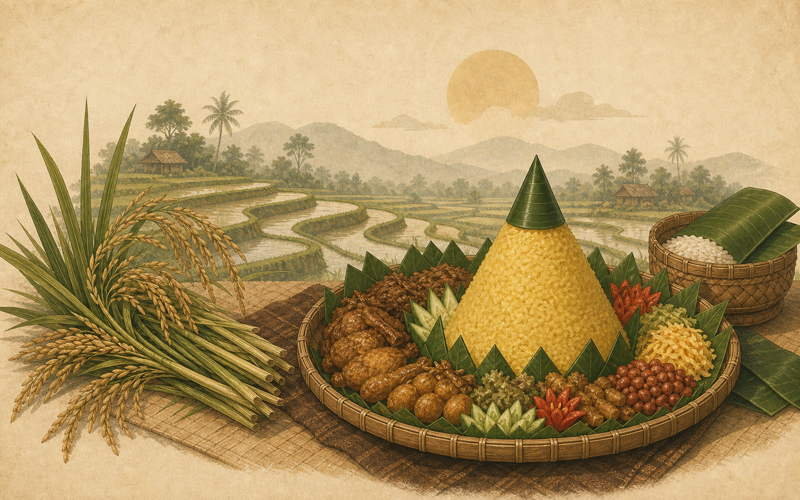
Traditional Indonesian culinary heritage is best understood as more than a collection of regional dishes. In many communities across the archipelago, food carries ceremonial meaning and serves as a visible expression of gratitude, hierarchy, kinship, and memory. A museum approach to Indonesian food therefore pays attention not only to flavor and ingredients, but also to the occasions on which foods are prepared, presented, and shared.
This perspective is especially important in ritual contexts. Certain foods are associated with harvest celebrations, Islamic holidays, communal feasts, ancestral remembrance, village ceremonies, or life-cycle events such as births and weddings. Although no single ritual menu represents all of Indonesia, recurring patterns can still be observed: ingredients reflect local ecologies, forms of presentation convey symbolic meaning, and shared meals reinforce social relationships. Ritual food is thus a valuable entry point into Indonesia's cultural history.
Food, Ceremony, and Social Meaning
In Indonesian societies, food often operates as a social language. The act of preparing and serving a ceremonial dish can signal respect for guests, acknowledge divine blessing, or affirm the bonds that hold a community together. Recipes matter, but so do sequence, display, and participation. A food prepared for ritual use is rarely just a private meal; it is embedded in a social setting where meaning is collectively recognized.
From a museum standpoint, this is why culinary heritage belongs beside textiles, musical instruments, and ceremonial objects. Ritual foods are part of a larger cultural system. They draw on inherited knowledge about when crops are planted and harvested, how ingredients are processed, which households or specialists prepare them, and what kinds of occasions call for them. Even when the edible object itself is temporary, the knowledge around it is durable and transmissible.
Tumpeng and the Symbolism of Offering
One of the best-known ceremonial foods in Indonesia is tumpeng, a cone-shaped rice dish commonly associated with thanksgiving and communal celebration, especially in Java. Tumpeng is often surrounded by side dishes that create a complete ceremonial presentation rather than an isolated serving of rice. Its visual form is central to its meaning: the conical shape has often been interpreted in relation to ideas of elevation, reverence, and ordered harmony, though meanings can vary by context and community.
Modern Indonesians encounter tumpeng in many settings, from village ceremonies to institutional commemorations and family events. That wide circulation makes it easy to treat tumpeng as a generic national symbol, but museums should resist flattening its history. Its significance comes from repeated use in specific ceremonial situations, where the preparation and distribution of the dish help organize collective participation. In that sense, tumpeng is not only a food item. It is also a performance of gratitude, hierarchy, and togetherness.
Ketupat, Islamic Festivity, and Seasonal Time
Ketupat, rice cooked in a woven palm-leaf pouch, is another widely recognized ceremonial food in Indonesia and is especially associated with Eid al-Fitr in many Muslim communities. The preparation of ketupat links food to festive time, household labor, and social exchange. The woven container is itself part of the heritage object, because it reflects craft knowledge as well as culinary technique. As a result, ketupat demonstrates how ritual food can unite agriculture, handwork, and religious observance in a single form.
Ketupat is also a good reminder that ritual foods often gain strength from repetition. Its importance is renewed through annual cycles, visits among relatives and neighbors, and the expectation of shared meals after fasting. While the exact accompaniments differ by region, ketupat is widely embedded in the social atmosphere of celebration and reconciliation. Museums studying such foods should therefore pay attention to calendars and lived rhythms, not only to recipes or ingredients.
Regional Staples and Local Ecologies
Ritual food in Indonesia cannot be reduced to rice alone. The archipelago contains varied ecologies, and ceremonial foodways have long reflected regional staples such as sago, maize, cassava, and tubers alongside rice. In eastern Indonesia, papeda, a sago-based preparation, is an important example of how food heritage is rooted in specific environmental conditions. Its significance lies not only in its taste or texture, but in its relationship to the sago palm and to long-standing local subsistence knowledge.
This diversity matters because it reminds us that ritual food traditions emerge from place. Agricultural conditions shape what can be grown, stored, and shared in ceremonial settings. A museum display that focuses only on nationally familiar foods may unintentionally obscure the depth of regional variation across Maluku, Papua, Sulawesi, Bali, Java, Sumatra, and other parts of Indonesia. Culinary heritage becomes more historically accurate when it is presented as a map of local ecologies and not as a single standardized tradition.
Communal Labor, Gendered Knowledge, and Transmission
Ritual foods are seldom produced by accident or by isolated individuals. They commonly depend on communal labor, advance planning, and practical knowledge transmitted within households and neighborhoods. Washing rice, weaving palm leaves, grating coconut, grinding spices, steaming, wrapping, and arranging food for presentation all require learned skills. In many communities, these tasks have historically been structured by age, experience, kinship, and gendered divisions of labor, though practices continue to change over time.
For museums, these processes are just as important as the finished dish. If an exhibition shows only the final ceremonial meal, it may miss the collaborative work that gives the meal its social meaning. Culinary heritage lives in preparation techniques, serving etiquette, and intergenerational teaching. Older family members and community specialists often play an important role in transmitting this knowledge, allowing ritual foodways to endure even as ingredients, tools, and social conditions evolve.
Change, Continuity, and Museum Interpretation
Indonesian ritual food traditions are not frozen in the past. Urbanization, migration, catering industries, tourism, and digital media all influence how ceremonial foods are prepared and displayed today. Some dishes once associated mainly with local ritual use now appear in state events, restaurants, and heritage festivals. This broader visibility can help recognition, but it can also detach foods from the social settings that gave them meaning in the first place.
Museum interpretation works best when it holds continuity and change together. Rather than asking whether a ritual food is still "authentic" in a narrow sense, museums can ask how communities adapt inherited forms while preserving core meanings. They can document recipes, tools, photographs, oral histories, and ceremonial contexts as parts of one heritage system. In doing so, they show that Indonesian culinary heritage is neither static folklore nor mere consumption. It is an active field of cultural memory sustained through repeated acts of making and sharing.
Conclusion
Traditional Indonesian culinary heritage reveals how food can operate as ritual expression, regional history, and social memory at once. Ceremonial dishes such as tumpeng and ketupat, together with regionally specific staples like papeda, show that foodways across Indonesia are shaped by environment, belief, and communal practice rather than by taste alone.
For museums, the study of ritual food opens a rich interpretive space. It connects agriculture, craft, religion, household labor, and public ceremony, helping visitors understand that heritage is often carried in practices as much as in objects. When Indonesian ritual foods are interpreted in this wider way, they become powerful evidence of how communities remember, celebrate, and sustain their worlds.