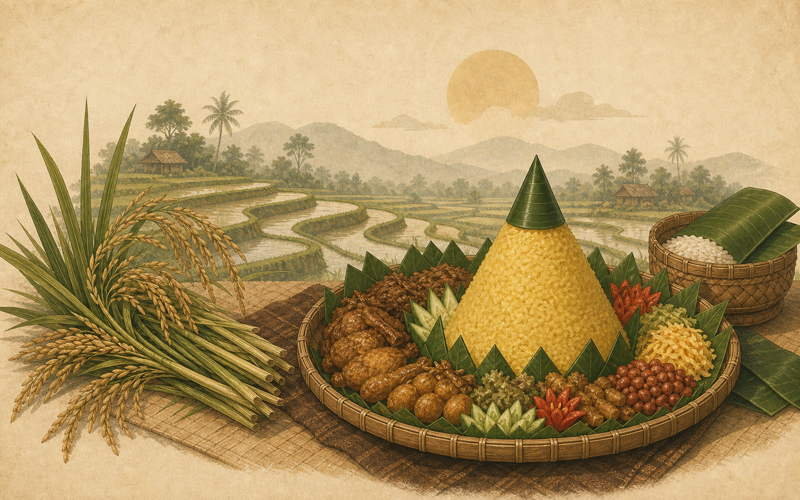
Tumpeng is one of the most recognizable ceremonial food presentations in Indonesia. At first glance it is a striking cone of rice surrounded by arranged side dishes, but its importance lies in more than appearance. Tumpeng belongs to a social world in which food is used to mark gratitude, honor important transitions, and gather people into a shared ritual moment. For a museum reader, it is best understood not merely as cuisine, but as a cultural form in which symbolism, hospitality, and collective memory meet.
The tradition is strongly associated with Java and with communal meals often linked to selamatan or syukuran, yet it has long moved beyond one narrow setting. Today tumpeng may appear at village ceremonies, religious observances, public anniversaries, school events, office celebrations, and family milestones. That broad presence makes it historically interesting. It shows how a ceremonial form can remain recognizable even as the occasions around it change. The meaning of tumpeng therefore lies both in continuity and in adaptation.
A Ceremonial Dish Rather Than an Ordinary Meal
Tumpeng is not simply rice served in a festive shape. Its conical arrangement signals that the dish has been prepared for a special social purpose. The meal is usually presented whole before being portioned and shared, which gives the act of serving a ceremonial quality. In many contexts, the presentation itself matters as much as the ingredients. The dish announces that the gathering is not routine, but marked by thanksgiving, remembrance, blessing, or commemoration.
That distinction is important for museum interpretation because ceremonial foods often organize social relationships. They identify hosts and guests, indicate the seriousness of an occasion, and structure the transition from prayer or speech into communal eating. Tumpeng does this visibly. Before the meal is distributed, people see a complete, ordered arrangement centered on the rice cone. After distribution, that ordered whole becomes a shared meal. The passage from display to sharing is part of the meaning.
The Symbolism of the Cone
The most discussed feature of tumpeng is its pointed form. Many descriptions interpret the cone through mountain symbolism, a reading that is especially persuasive in Indonesian cultural history because mountains have long held sacred and cosmological associations. The meal's vertical shape gives the rice a monumental quality. It turns staple food into a symbolic centerpiece and encourages viewers to see nourishment, reverence, and ceremony as connected rather than separate.
Scholarly writing on tumpeng also notes that its meanings have been explained in several ways over time. Some accounts connect it to pre-Islamic cosmological ideas, while others emphasize the later embedding of tumpeng within Islamic thanksgiving practices and everyday communal celebrations. A careful museum-style reading does not force these interpretations into a single origin story. It is enough to say that the cone has been treated as a meaningful form for centuries and that its symbolism has remained flexible enough to survive changing religious and social settings.
Gratitude, Blessing, and Social Harmony
Tumpeng is frequently associated with expressions of gratitude. This is one reason it appears at thanksgiving meals, inaugurations, birthdays, harvest-related observances, and community events that ask for well-being or commemorate success. The dish makes gratitude visible. Rather than remaining a private feeling, thanks are materialized in a carefully arranged offering-like meal that is then shared with others. The act of preparing tumpeng is therefore also an act of social communication.
Its communal role matters just as much as its symbolism. Ceremonial food in Indonesia often reinforces togetherness through shared participation, and tumpeng fits that pattern clearly. People gather around one arrangement, wait through the formal part of the event, and then take part in collective eating. This rhythm supports social harmony because it joins hierarchy and fellowship. There may be a host, an elder, or an honored guest who begins the serving, but the meal ultimately affirms the group as a whole.
Side Dishes and the Order of the Feast
Although the rice cone is the visual center, tumpeng is not complete without its accompanying dishes. These often include vegetables, eggs, tempeh, meat, sambal, and other items arranged around the cone. The variety matters because tumpeng is not meant to express abundance through excess alone. It presents a balanced ceremonial table in which staple food and side dishes create a complete field around the central peak. The layout turns the meal into a composition.
This surrounding arrangement also helps explain why tumpeng is so effective in exhibition photographs and cultural memory. It is legible at a glance. Even viewers unfamiliar with the ritual can see that the cone is central and that the dishes around it are ordered rather than random. In curatorial terms, tumpeng is a strong example of how food can become an artifact of social design. It is edible, but it is also staged, patterned, and intended to be read before it is consumed.
From Local Ritual to National Recognition
The history of tumpeng is not a story of static preservation. Its ceremonial associations remain strong, yet the dish now circulates in settings that include state institutions, corporate events, urban celebrations, and public culture. This wider use does not automatically empty it of meaning. Instead, it suggests that tumpeng has become one of the formats through which Indonesians publicly perform gratitude and togetherness across different scales of life, from the household to the civic stage.
At the same time, local ceremonial contexts remain essential. Official cultural writing still describes tumpeng in relation to ritual and symbolic occasions, and examples such as selamatan practices show that the broader ceremonial framework has not disappeared. A museum should therefore avoid presenting tumpeng either as a purely ancient survival or as a generic party dish. It is better understood as a living ceremonial form that can move between sacred, communal, and modern commemorative spaces without losing its recognizable structure.
Why Tumpeng Matters to Museums
Museums increasingly treat food not only as domestic history but as material culture. Tumpeng deserves that attention because it brings together utensils, ingredients, arrangement, etiquette, ritual timing, and ideas about social order. It also reminds us that many meaningful cultural objects are temporary. Unlike a bronze vessel or carved mask, tumpeng is made to be dismantled through sharing. Its impermanence is part of its significance, because the ceremony culminates not in preservation but in distribution.
Interpreting tumpeng in a museum context also broadens the way ceremonial life is explained. The tradition shows that Indonesian heritage is not expressed only through textiles, architecture, manuscripts, or regalia. It is also expressed through prepared foods that structure relationships and mark important passages in life. When museums present tumpeng as a ceremonial system rather than as a decorative dish, they help viewers see how everyday ingredients can become carriers of philosophy, etiquette, and collective memory.
Conclusion
The meaning of tumpeng lies in its ability to transform a meal into a ceremonial statement. Its cone shape, surrounding dishes, and shared serving practices communicate gratitude, respect, and social cohesion. This is why tumpeng continues to appear at events that matter deeply to communities, whether those occasions are intimate family observances or larger public commemorations.
From a museum perspective, tumpeng is valuable because it makes visible the cultural life of food. It shows that nourishment can also be symbolism, that presentation can carry historical memory, and that a communal feast can be read as a carefully shaped form of heritage. For that reason, tumpeng remains one of the clearest examples of how Indonesian ceremonial culture joins material practice with shared meaning.