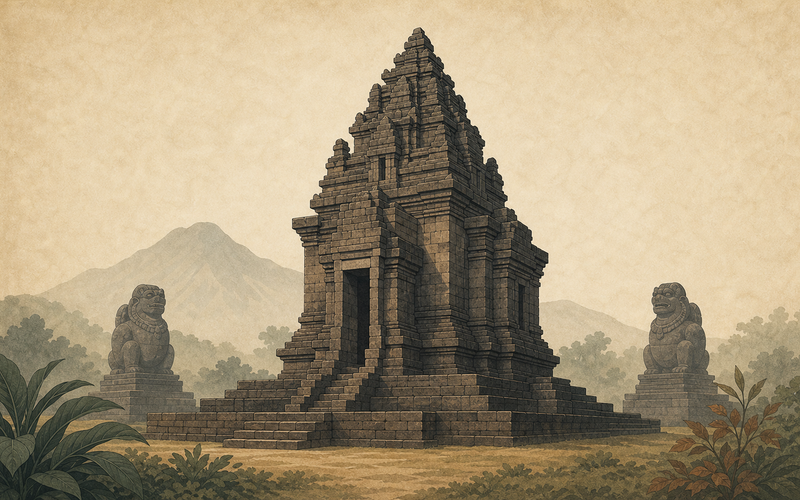
Singhasari belongs to one of the most dynamic moments in Indonesian history: the rise of East Java as a political and cultural center in the thirteenth century. Its story is remembered through inscriptions, later court literature, temple remains, royal genealogies, and local landscapes around Malang. These sources do not always speak with one voice, but together they show a kingdom that changed the balance of power in Java.
For museum interpretation, Singhasari is valuable because it stands between worlds. It inherited older Javanese ideas of royal authority, sacred landscape, and Hindu-Buddhist court culture, yet it also points toward Majapahit, the later kingdom that became one of Indonesia's most powerful historical symbols. To understand Singhasari is to see East Java gathering force before Majapahit gave that force a wider name.
From Tumapel to Royal Ambition
Singhasari grew from the region of Tumapel in East Java, near present-day Malang. The political setting was not simple. Earlier power had been associated with Kediri, while local rulers and regional elites competed for influence across eastern Java. Later traditions connect the rise of Singhasari with Ken Angrok, a figure whose life is described in stories that mix politics, violence, destiny, and moral warning.
The remembered turning point came in the early thirteenth century, when Tumapel challenged Kediri and began to stand as a kingdom in its own right. Historians treat the legendary details carefully, especially because texts such as the Pararaton were composed after the events they describe. Even so, the larger historical movement is clear: East Java's political map was changing, and Singhasari became the strongest expression of that change.
This rise was not only a matter of battle. It involved controlling fertile lands, religious centers, local chiefs, marriage alliances, and routes through the Brantas River world. A court could not survive on military skill alone. It needed ritual legitimacy, administrators, religious specialists, and the ability to turn regional loyalties into royal authority.
Kingship, Genealogy, and Sacred Power
Singhasari rulers presented power as more than command. Like other Javanese courts, they drew on Hindu-Buddhist ideas in which kingship, cosmic order, ancestry, and ritual merit could reinforce one another. Temples, statues, and posthumous honors helped transform deceased rulers into sacred presences. This made politics durable by placing royal memory into stone, ceremony, and sacred geography.
Genealogy also mattered. Claims to rule were strengthened by linking families, territories, and older royal lines. In the thirteenth-century Javanese world, a king's authority depended partly on how convincingly he could present himself as the rightful center of competing inheritances. Singhasari's rulers did this through courtly marriage, conquest, religious patronage, and commemoration.
Museum objects from this period are often fragmentary: a statue, a damaged temple relief, an inscription, or a guardian figure. Yet fragments can be eloquent. They show that power was staged visually. Royal authority appeared in the posture of a deity, the placement of a shrine, the guarding presence of a fierce stone figure, and the careful use of Sanskritized or Old Javanese court language.
Kertanagara and a Wider Horizon
The most famous Singhasari ruler was Kertanagara, who ruled in the second half of the thirteenth century. He is remembered as ambitious, learned, and politically daring. His reign expanded the scale of Singhasari's imagination beyond local rivalry. Court power in East Java began to look outward, toward Bali, the Malay world, and the wider networks of maritime Southeast Asia.
One major episode associated with his reign is the Pamalayu expedition, often interpreted as an effort to extend influence toward the Malayu region in Sumatra. The details and motivations are debated, but the episode shows that Singhasari's court was thinking about sea routes, diplomatic relationships, and regional prestige. East Javanese power was no longer only inland or island-bound.
Kertanagara's reign also entered the larger Asian political record through his confrontation with Mongol demands. Kublai Khan's envoys sought submission from distant rulers, including Java. Javanese resistance to those demands became part of the dramatic end of Singhasari and the beginning of Majapahit. The story is famous because it places East Java inside a much broader thirteenth-century world of imperial diplomacy and military reach.
Temples and the Memory of a Court
Singhasari's political world survives most visibly through sacred architecture. Candi Singosari, near Malang, is closely associated with Kertanagara and the memory of the kingdom's final phase. Nearby sites such as Candi Jago, Candi Kidal, and Candi Jawi are also tied to the wider Singhasari period and to the commemorative practices of East Javanese royalty.
These temples were not simply buildings for worship in the modern narrow sense. They were places where royal identity, religious devotion, and dynastic memory met. A temple could honor a deceased ruler, associate that ruler with a divine form, and give later generations a physical focus for remembering political legitimacy. Stone made memory public.
The artistic language of Singhasari and early East Java often combines Hindu and Buddhist elements in ways that resist rigid separation. This does not mean religious traditions were vague or careless. It means courts used a rich ritual vocabulary in which Shiva, Buddha, ancestors, guardians, and royal figures could all belong to the same political landscape.
Conflict, Collapse, and the Majapahit Opening
Singhasari's end came suddenly. In 1292, Kertanagara was killed during a rebellion associated with Jayakatwang of Kediri. The event revealed a persistent truth of Javanese politics: royal power could appear grand and sacred while still depending on fragile alliances. A court that looked outward could remain vulnerable to rivals nearer home.
The collapse of Singhasari did not produce a simple return to the old order. Raden Wijaya, Kertanagara's son-in-law, maneuvered through the crisis and later founded Majapahit. The Mongol expedition that arrived in Java shortly after Kertanagara's death became entangled in these local struggles. What began as imperial punishment from abroad ended in a new Javanese kingdom.
This transition is one reason Singhasari matters so deeply. It was not a historical dead end. Its royal line, political networks, enemies, ritual models, and territorial ambitions all fed into the emergence of Majapahit. In cultural memory, Singhasari became both predecessor and warning: a court of impressive power whose fall helped make a greater kingdom possible.
Reading Singhasari in a Museum
A museum gallery on Singhasari should avoid presenting the kingdom as only a list of rulers and battles. Its importance lies in the relationship between material culture and political imagination. A temple stone, a map of East Java, a royal genealogy, and a discussion of Mongol diplomacy can all help visitors see how a regional court became part of a larger Asian story.
The kingdom also teaches caution. Many popular accounts rely on later literature, especially stories around Ken Angrok and court intrigue. These narratives are culturally important, but they are not the same as direct contemporary records. Good interpretation can honor the stories while explaining how historians compare texts, inscriptions, archaeology, and foreign accounts.
Singhasari therefore invites visitors to think like historians. What can a temple prove? What can a later chronicle preserve? What might a royal inscription hide? These questions make the kingdom more interesting, not less. They show that the past is assembled from evidence, memory, and interpretation.
Conclusion
Singhasari's history is brief compared with the long memory it left behind. From Tumapel's rise to Kertanagara's wide ambitions, the kingdom helped make East Java a center of military, ritual, and diplomatic power. Its temples and stories preserve a world where kingship was fought over in battle and sanctified in stone.
The kingdom's fall in 1292 closed one chapter but opened another. Majapahit did not emerge from nowhere; it grew from the tensions, inheritances, and ambitions that Singhasari had gathered. Seen in this light, Singhasari is not merely a prelude. It is one of the keys to understanding how East Javanese power rose, remembered itself, and shaped Indonesia's historical imagination.