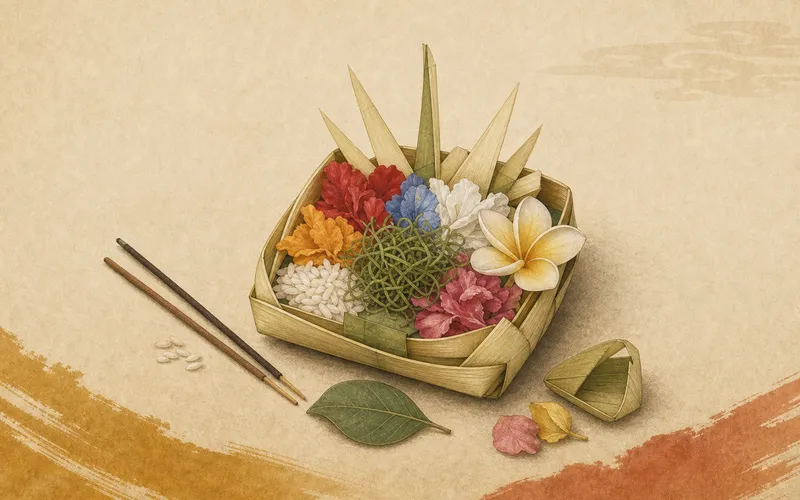
Balinese Hindu offerings, broadly known as banten, are prepared presentations of materials used in worship. Canang sari is one familiar small offering, usually recognized by its leaf base and flowers; it is not the name for every Balinese offering. Making and placing offerings connects prayer with household care, shrines, workplaces, and temple ceremonies.
Their meaning depends on the kind of offering, the occasion, and local practice. A flower tray alone cannot tell us its intended recipient or the full sequence of prayers. The useful starting points are what it contains, who prepared it, and where it was placed.
Banten and Canang Sari: Materials and Symbolic Interpretation
The Buleleng office of the Ministry of Religious Affairs distinguishes several forms of canang by their use, shape, and components, including canang sari, canang genten, and canang meraka. This classification matters: a description of one form should not become a recipe for every household or ceremony. Ministry of Religious Affairs, Buleleng.
A ministry explanation of porosan identifies betel leaf, areca nut, and lime as its constituents and discusses them as sacred elements brought into relationship. This is a named religious interpretation, not a universal dictionary in which every material always has one meaning. Flowers and leafwork are visible; their devotional significance needs a practitioner's explanation. Directorate General of Hindu Community Guidance.
Leaf bases, flowers, and other perishable ingredients make offering preparation a form of skilled work. A museum can document folding, arranging, and assembly without turning a locally taught practice into a rigid checklist. The retained illustration introduces the materials; it is not documentation of a particular ceremony.
Household Offerings and Temple Ceremonies
Small offerings used in domestic routines and more elaborate ceremonial arrangements belong to related practices but are not interchangeable. During larger ceremonies, preparation can involve wider family and community cooperation. Size alone does not identify an offering's ritual category, purpose, or recipient.
Place also matters. A shrine, courtyard, or entrance provides context that a detached tray cannot preserve. Avoid a simple rule that every offering above ground is for one kind of being and every offering below is for another: identify the actual rite and local explanation before making that claim.
For the wider landscape, UNESCO describes water temples and cooperative irrigation through Tri Hita Karana. That source supports the relationship between religion, community, and agriculture; it does not establish a symbolic meaning for each flower in a canang sari. UNESCO: Bali cultural landscape.
Daily Devotion Beyond Festival Time
Balinese ritual life is sometimes presented through major ceremonies because festivals are visually impressive and easier for outsiders to recognize. Daily offerings reveal a different scale of religious commitment. They show that devotion is not reserved for exceptional occasions. Instead, it accompanies ordinary mornings, domestic cleaning, opening a business, preparing a family shrine, or beginning the workday. In this sense, offerings matter because they keep religious attention active within the most familiar rhythms of life.
This regularity gives offerings a moral weight that outsiders may overlook. They remind practitioners that reverence is sustained through discipline rather than through occasional intensity. A society's values are often clearest in repeated small acts, and Balinese offerings belong to that category. Their modest size should not be mistaken for lesser significance. Precisely because they recur so often, they help turn devotion into a durable habit that links individual intention to communal expectation.
Offerings and the Mapping of Sacred Space
Balinese offerings also matter because they make visible that space is not experienced as neutral. Different locations call for different forms of attention. A family shrine, a household courtyard, a market entrance, a crossroads, or a vehicle used for daily travel may each become a site where respectful acknowledgment is required. The placement of offerings marks these distinctions. It signals that human movement unfolds within a landscape understood to include sacred relationships as well as practical functions.
For museums, this is an important interpretive lesson. An offering taken out of context and placed in a display case can appear self-contained, but in lived practice it belongs to a spatial system. It refers to where it was placed, why that place mattered, and how people moved around it. Exhibitions that explain offerings only as objects risk flattening this dimension. A stronger presentation shows that offerings help map the island's religious geography at the scale of everyday life.
The Work of Making as Religious Knowledge
The significance of Balinese offerings does not begin when they are set down. It begins in the work of preparation. Leaves are shaped, flowers are arranged, rice is placed, and incense is readied according to forms recognized within local custom. These actions require attention, memory, and bodily skill. The offering is therefore both an object and the result of a sequence of learned practices. Its meaning cannot be separated from the labor that brings it into being.
This process matters educationally as well as religiously. Younger family members often learn through observation and participation, gradually understanding that correct preparation expresses care and respect. The making of offerings becomes one way ritual knowledge passes between generations. Museums that explain only finished form miss this pedagogical dimension. The offering is not merely a product to be admired. It is evidence of repeated instruction, embodied memory, and the continued transmission of religious practice.
Household Responsibility and Shared Obligation
Offerings matter in everyday life because they are tied to household responsibility. They are not only personal expressions of belief. In many contexts they are part of shared family routines that help organize the day and distribute obligations across members of the household. Through these routines, devotion becomes social. The work of preparing and placing offerings reinforces the idea that religious life is maintained collectively and that care for shrines and sacred spaces is part of proper domestic order.
This social dimension expands during larger ceremonies, but it is already present in daily practice. Even the smallest offering can point to wider networks of family cooperation, neighborhood knowledge, and inherited expectations. That is one reason museums should resist treating offerings as isolated ritual curiosities. They are better understood as traces of social organization. Their presence indicates a community in which devotion is sustained through labor, repetition, and mutual awareness rather than through private feeling alone.
Why Offerings Matter to Museum Interpretation
Museums have a strong reason to explain Balinese offerings carefully: they are among the clearest entry points into understanding how religion operates through ordinary life. Offerings show that ritual meaning is carried not only by monumental architecture or rare ceremonial objects, but also by small items made for immediate use. They invite visitors to see devotion as something enacted through repetition, domestic labor, and spatial awareness. This can broaden how audiences think about religious heritage more generally.
At the same time, museum interpretation has limits that should be stated honestly. Once an offering is removed from its place and ritual sequence, much of its lived meaning is no longer directly present. The museum cannot fully reproduce prayer, timing, smell, gesture, or renewal. What it can do is clarify that absence. The most responsible interpretation uses labels, photographs, and contextual explanation to show that an offering's importance lies in its role within a living practice, not in detached display alone.
Read the wider context in Beliefs and Rituals and Bali and Lombok. Compare how place and occasion shape coastal offerings.