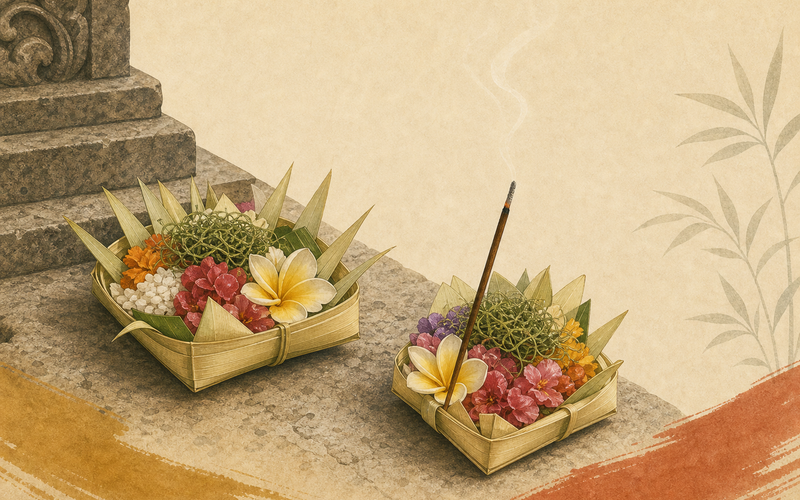
Balinese offerings are among the most recognizable elements of the island's ritual life, yet they are often misunderstood when seen only in passing. Visitors may notice small woven trays set on sidewalks, family shrines, market stalls, or temple courtyards and read them simply as decorative signs of religiosity. A museum perspective asks for a slower interpretation. Offerings matter not only because of their appearance, but because they are part of a disciplined daily practice through which households express respect, maintain relationships with sacred spaces, and participate in a larger moral order.
That wider order is important. Balinese Hindu life is shaped by ritual repetition, household obligation, temple calendars, and ideas of balance linking the divine, the human community, and the environment. Offerings belong to that field of practice. They are not isolated objects with one fixed symbolic code. Their meanings emerge through making, carrying, placing, blessing, and replacing them over time. For museums and cultural interpreters, this means the most useful question is not merely what an offering represents, but how it works in everyday devotional life.
Offerings as Daily Religious Practice
In Bali, religion is woven into domestic routine as much as into festival spectacle. Small offerings, often recognized today under forms such as canang sari, are part of the repeated acts by which people acknowledge deities, ancestors, and the unseen forces that inhabit particular places. The scale may be modest, but the act is not casual. Preparing and presenting offerings belongs to a rhythm of obligation, gratitude, and attentiveness. It reminds practitioners that spiritual life is sustained through repeated care rather than only through occasional grand ceremony.
This daily rhythm helps explain why offerings appear in so many settings. They may be placed at household shrines, family compounds, crossroads, shops, vehicles, or workplaces, depending on local custom and circumstance. Their presence marks the fact that ritual life is not limited to temple interiors. Sacred attention extends through built space and everyday movement. A museum that explains offerings only within the walls of a formal temple risks missing the distributed nature of Balinese devotion, where ritual practice accompanies ordinary labor, commerce, travel, and domestic life.
Materials, Form, and the Discipline of Making
Balinese offerings are visually striking, but their significance lies in more than color and arrangement. Flowers, leaves, rice, incense, and other components are assembled with care into forms that are legible within local practice. The offering is therefore both material and procedural. What matters is not only what objects are present, but how they are gathered, ordered, and placed. Repetition gives this process educational force. Children learn by watching elders, assisting in preparation, and gradually recognizing that ritual precision is one way of cultivating respect.
This is one reason museum displays should resist presenting offerings merely as examples of attractive craft. The woven container, the floral arrangement, and the balanced composition are important, but they do not exhaust the meaning of the object. The labor of preparation matters as much as the finished form. An offering is the endpoint of a sequence of actions involving time, knowledge, and bodily practice. When museums restore that sequence through interpretation, photographs, or contextual labels, they move closer to showing offerings as living ritual work rather than detached design.
Household Devotion and Social Responsibility
Although offerings are frequently discussed in religious terms, they are also social acts. In many Balinese households, the preparation of offerings is tied to routines of care, intergenerational teaching, and shared responsibility. The work may be ordinary, but it is not insignificant. It helps structure the day, assigns duties, and reinforces the idea that devotion is maintained collectively rather than individually alone. Ritual life is thus sustained by repeated household effort, not only by priests or ceremonial specialists.
That social dimension becomes even clearer during larger temple festivals and life-cycle ceremonies, when offering preparation expands in scale and complexity. Community members gather, coordinate tasks, and contribute labor, materials, and expertise. The result is not simply a more elaborate offering but a visible expression of social organization. Museums can learn from this by interpreting offerings as evidence of collective practice. Even a small offering seen in a gallery or photograph may point to broader networks of family obligation, neighborhood cooperation, and inherited knowledge.
Balance, Space, and Relations with the Unseen
Offerings also matter because they help order relationships between people and the spaces they inhabit. Balinese ritual life does not treat all places as neutral. Homes, shrines, temple courtyards, gateways, roadsides, and agricultural landscapes may carry different ritual expectations. The placement of offerings acknowledges those differences and recognizes that human life unfolds in relation to powers not always visible. In this sense, offerings help map sacred attention across the landscape.
This broader idea of balance resonates with well-known Balinese philosophical frameworks that connect the spiritual realm, human society, and the natural environment. UNESCO's interpretation of Bali's cultural landscape highlights the importance of Tri Hita Karana in linking those domains, especially in relation to water temples and shared agricultural systems. Daily offerings should not be reduced to a simple illustration of that philosophy, but they do participate in the same wider concern with maintaining proper relations. Their scale may be intimate, yet they belong to a much larger cosmological and social imagination.
Offerings Beyond Tourist Familiarity
One challenge for museum interpretation is that Balinese offerings are already highly visible in travel imagery. Because visitors encounter them so frequently, they can be mistaken for picturesque background details of island life. This familiarity creates a risk of superficial reading. The more recognizable an object becomes, the easier it is to strip it of difficulty and treat it as self-explanatory. In reality, the offering's apparent simplicity conceals a dense world of devotional habit, spatial knowledge, and inherited interpretation.
Responsible interpretation therefore requires moving beyond tourism's quick glance. A tray with flowers and incense is not meaningful only because it is beautiful or emblematic of Bali. It is meaningful because it is placed by someone who has entered a ritual sequence and acknowledged an obligation. Museums can help correct flattening interpretations by situating offerings alongside information about domestic shrines, temple calendars, household compounds, and the practical repetition of devotional life. Doing so returns agency to the practitioners and restores time to the object.
What Museums Can Show, and What They Cannot
Museums are well suited to explaining the historical and material dimensions of offerings. They can document forms, compare regional variations, discuss the role of religion in Balinese social life, and connect offerings to architecture, festivals, and agricultural landscapes. They can also show how objects that appear ephemeral are central to durable systems of memory and practice. This is especially valuable for visitors who might otherwise assume that ritual significance belongs only to monumental sculpture or permanent temple structures.
At the same time, museums face limits. An offering displayed in a case no longer participates in the cycle of preparation, dedication, and renewal that gives it much of its meaning. Interpretation must therefore be honest about partiality. The goal is not to claim that the museum reproduces ritual life fully, but to help viewers understand what has been removed from view: smell, gesture, prayer, timing, and the social relations that surround the act. The strongest museum interpretation acknowledges that offerings are living devotional practices first and collectible forms only second.
Conclusion
Balinese offerings are best understood as daily acts of care that join material form to ritual discipline. They express gratitude, mark sacred relations, teach household responsibility, and extend devotional attention across homes, shrines, and public space. Their importance lies not in ornament alone, but in the repeated practice of making and placing them within an ongoing religious life.
For museums, this means that offerings should be interpreted through context, sequence, and social meaning. When seen only as beautiful objects, they are diminished. When placed back into the rhythms of Balinese devotion, they become far more intelligible as carriers of memory, obligation, and lived religious practice.