Ritual dance in eastern Indonesia belongs to a broad ceremonial world in which movement, music, costume, and sacred speech are inseparable from social life. In the islands stretching from Flores and Sumba to Maluku and Papua, dances have marked transitions between seasons, affirmed relations with ancestors, accompanied rites of healing or thanksgiving, and expressed the authority of customary law. Although each community has its own vocabulary and history, many of these performances share a central principle: dance is not merely display, but action with consequences in the ritual order.
Museum collections and ethnographic records show that eastern Indonesian dance traditions are deeply embedded in local cosmologies. Drums, gongs, textiles, weapons, and body ornaments are not neutral stage properties; they often carry inherited meanings and may be used only in prescribed contexts. At the same time, the twentieth and twenty-first centuries have transformed many ritual forms. Christianization, state cultural policy, migration, and tourism have all altered when, where, and for whom dances are performed. Understanding their sacred functions therefore requires attention both to older ceremonial structures and to the modern settings in which these traditions continue.
Ritual Dance and Sacred Space
In many eastern Indonesian societies, ritual dance is tied to place. Village plazas, megalithic compounds, clan houses, church forecourts, and ancestral graves can all become performance grounds, but they are not interchangeable. A dance performed before a sacred house or at a stone tomb may activate relationships with founding ancestors and lineages, while the same movements transferred to a civic festival may carry a different meaning. The location helps define whether a performance is devotional, commemorative, protective, or representational.
This connection to sacred space is especially visible in communities where ceremonial architecture remains central to social organization. In parts of Sumba, for example, ritual life has long been associated with ancestral villages, megalithic tombs, and houses linked to clan identity. Dance in such settings may accompany funerary observances, alliance-making, or calendrical rites. The performance is therefore part of a larger ceremonial sequence involving offerings, speech, exchange, and the presence of ritual specialists.
The sacred function of dance also depends on timing. Some dances belong to agricultural cycles, especially periods of planting and harvest, while others are associated with life-cycle events or annual communal festivals. In Christian regions of eastern Indonesia, older performative structures have sometimes been incorporated into church feasts or local commemorations without losing all of their customary significance. Rather than a simple division between "traditional" and "religious," many communities maintain layered meanings in which dance can honor both ancestral heritage and present-day faith.
Caci of Manggarai: Contest, Fertility, and Communal Order
One of the best-known ritual performances of eastern Indonesia is caci, practiced among the Manggarai of western Flores. Caci is a whip-fighting performance in which paired male participants engage in stylized combat using a whip and shield. The event is accompanied by music, song, and formalized costume, including horned headgear and textiles. Although caci is now often presented for visitors and public festivals, it has documented roots in ceremonial life and has been associated with post-harvest celebrations, communal gatherings, and the affirmation of social ties.
Scholars and reference works have noted that caci has been linked to fertility symbolism and to the ritualized management of aggression. The controlled striking of opponents, the public endurance of pain, and the exchange between host and guest groups all place the performance within a framework of honor and reciprocity rather than uncontrolled violence. In this sense, caci can be understood as a ceremonial contest that transforms memories of warfare into a regulated social event.
Its sacred dimension lies not only in symbolism but in context. Historically, caci was connected to thanksgiving after the agricultural cycle and to the strengthening of relations between communities. The performance could accompany larger ritual occasions in which the well-being of land and people was at stake. Even when staged today as cultural heritage, caci still carries the prestige of ancestral custom, and local participants often distinguish between performances that are primarily touristic and those embedded in customary ceremony.
For a closer account of the equipment, music, and named community settings, see Caci of Manggarai: ritual combat and community in Flores.
Sumba: Dance, Ancestors, and the Ceremonial Village
In Sumba, dance has long formed part of a ceremonial system shaped by ancestral religion, exchange, and rank. The island is especially known for practices associated with Marapu, a term used for indigenous ancestral belief systems and ritual traditions. Within this framework, movement, chant, sacrifice, and processional display can all contribute to communication with the unseen world. Dances performed during funerals, house ceremonies, or seasonal observances are therefore not isolated artistic acts but components of a larger ritual economy.
Group dances in Sumba often involve coordinated stepping, circling, and the carrying of weapons or ritual objects. Men’s performances may emphasize martial identity, while women’s participation can be linked to textile display, choral movement, and the ceremonial presentation of lineage wealth. Such distinctions should not be reduced to simple gender roles; rather, they reflect the structured participation of different social groups in public ritual. The dance ground becomes a place where hierarchy, alliance, and ancestral legitimacy are made visible.
Funerary contexts are particularly important. Sumba is internationally recognized for its megalithic tomb traditions, and major funerals can involve extensive ceremonial performance. Dance in these settings helps honor the deceased, gather dispersed kin, and reaffirm obligations among lineages. The sacred function is therefore both spiritual and social: the dead are commemorated, but the living also renew the relationships that sustain the community.
Maluku: War Dances, Collective Memory, and Protection
Across the Maluku islands, a number of dance traditions have historically drawn on the imagery of warfare. Sword-and-shield performances, processional formations, and vigorous group movement can be found in different local variants. These dances should not be read simply as survivals of combat technique. In ceremonial settings, they often express collective memory, readiness to defend the community, and respect for ancestors whose authority is linked to the founding of settlements and the protection of territory.
In some Malukan contexts, war dances have been performed during welcoming ceremonies, village anniversaries, or religious festivals. Their sacred function lies in the invocation of communal strength and the public enactment of solidarity. Weapons used in dance may be heirlooms or symbolically charged objects, and the choreography can mark the boundary between ordinary social time and ceremonial time. The performers do not merely represent warriors; they embody a moral history of courage, discipline, and obligation.
The history of Maluku also includes centuries of contact, trade, Islam, Christianity, and colonial intervention. As a result, ritual dance traditions have often adapted to changing religious and political environments. Some performances once tied to local ritual cycles are now integrated into state-sponsored cultural events or interfaith celebrations. Yet the persistence of martial symbolism shows how dance continues to mediate between past conflict, present identity, and the desire for communal protection.
Papua and the Asmat Region: Performance, Ancestors, and Ceremonial Renewal
In Papua, ritual performance is extraordinarily diverse, and no single dance tradition can stand for the whole region. Among the Asmat of southwestern Papua, however, ethnographic and museum documentation has long emphasized the close relationship between carving, ceremony, and ancestral presence. Dances performed in conjunction with major rituals have historically involved masks, body adornment, drumming, and collective movement that activated carved objects and ceremonial spaces.
Asmat ritual life has been described as deeply concerned with relations between the living and the dead. In this context, dance can help make ancestors present, accompany the display of ritual art, and contribute to the renewal of social life after loss. The performance is not separate from material culture: shields, drums, canoes, and carved poles may all participate in a ceremonial complex in which visual art and bodily movement are mutually reinforcing.
Because Papuan ritual traditions have undergone profound change through missionization, state administration, and market circulation of art, many older ceremonies are no longer practiced in the same way. Even so, museum interpretation must recognize that the objects collected from Papua were often created for performative and sacred settings. To display them without reference to dance, song, and ritual action would be to remove them from the very system of meaning that gave them force.
Music, Costume, and the Efficacy of Performance
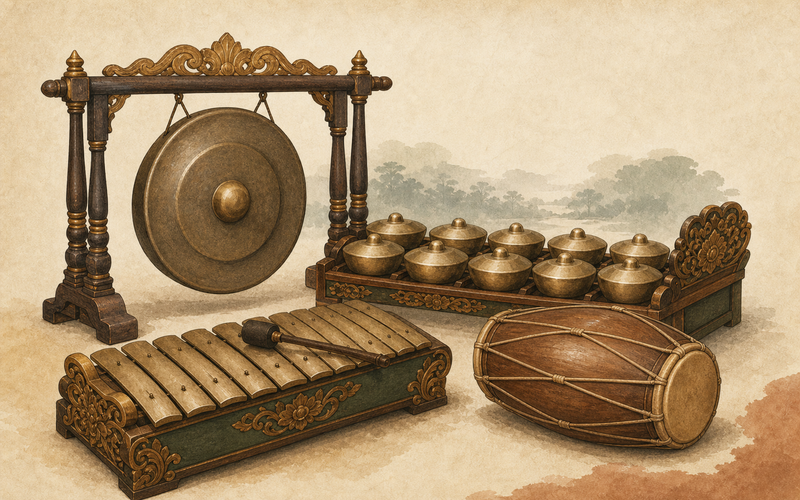
The sacred function of dance in eastern Indonesia depends on more than choreography. Music is often essential, especially drums and gongs that regulate movement and create a sonic environment appropriate to ceremony. Repetitive rhythms can coordinate group action, intensify emotional focus, and mark the transition into ritual time. In some communities, vocal performance, invocations, or responsorial singing are equally important, linking dance to oral tradition and sacred speech.
Costume and adornment also carry ritual significance. Handwoven textiles, shell ornaments, feathers, metal jewelry, and body paint may indicate clan affiliation, ceremonial status, or gendered roles within the performance. Weapons, too, are often more than props. A sword, spear, or shield can materialize ancestral authority and connect the dancer to a remembered history of defense, migration, or alliance. The efficacy of the dance depends in part on the correct combination of these elements.
For this reason, museum interpretation must avoid treating ritual dance as a detachable spectacle. A textile from Flores, a shield from Maluku, or a drum from Papua may have been meaningful precisely because it was used in movement, sound, and ceremony. When these objects enter collections, curators face the challenge of presenting them not as isolated artifacts but as parts of living or once-living ritual assemblages.
Continuity, Change, and Heritage in the Present
Today, ritual dances of eastern Indonesia exist in multiple registers. Some remain closely tied to customary ceremonies and are performed only on specific occasions. Others have entered school programs, regional festivals, church celebrations, or tourism circuits. This does not automatically mean that sacred meaning has disappeared. Rather, communities often negotiate which elements may be shown publicly and which remain restricted or context-dependent.
The language of cultural heritage has brought both opportunities and tensions. Public recognition can support transmission, local pride, and economic benefit, especially where younger generations are encouraged to learn songs, movements, and costume traditions. At the same time, repeated performance for outside audiences may simplify complex ceremonial meanings or detach dances from the ritual obligations that once governed them.
An institutional approach should therefore emphasize community knowledge and local authority. The most responsible interpretation of eastern Indonesian ritual dance begins by asking who has the right to perform, who may witness, and what the community itself says the dance is for. Sacred function is not an abstract category imposed from outside; it is defined through practice, memory, and customary understanding.
Conclusion
Ritual dances of eastern Indonesia reveal how performance can bind together religion, social order, memory, and place. Whether in the whip-fighting ceremonies of Manggarai, the ancestral settings of Sumba, the martial traditions of Maluku, or the ceremonial worlds of Papua, dance has served as a means of making relationships visible and effective.
For museums and readers alike, the central lesson is clear: these dances are best understood not as decorative survivals, but as historically grounded forms of sacred action. Their continued presence in contemporary Indonesia testifies to the resilience of local knowledge and to the enduring power of movement in communal life.