Introduction
In the vibrant cultural tapestry of Bali, the practice of making offerings, known as "banten," holds a central place in the daily lives of its Hindu population. These offerings are not merely religious obligations but are deeply embedded in the social and cultural fabric of Balinese society. This article delves into the symbolic structure and cultural significance of these offerings, exploring how they reflect the intricate relationship between the Balinese people and their spiritual beliefs.
The Role of Offerings in Balinese Hinduism
Offerings in Balinese Hinduism serve as a medium of communication between humans and the divine. They are presented to gods, spirits, and ancestors as a form of respect and gratitude. The act of making offerings is a daily ritual that reinforces the Balinese concept of "Tri Hita Karana," which emphasizes harmony between humans, nature, and the spiritual realm.
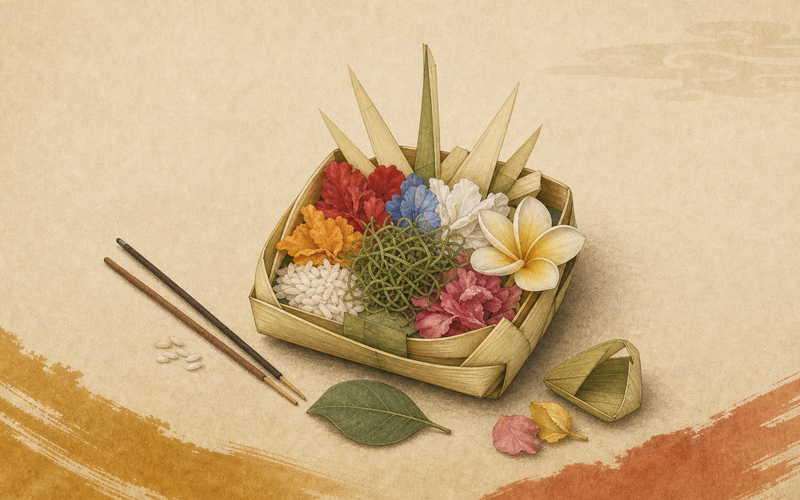
The offerings vary in complexity, from simple arrangements of flowers and rice to elaborate constructions involving fruits, cakes, and incense. Each component of an offering has a specific symbolic meaning, representing different elements of the universe and aspects of life. This symbolic language is a testament to the rich cultural heritage of Bali and its unique interpretation of Hinduism.
Symbolic Elements of Balinese Offerings
The materials used in Balinese offerings are carefully chosen for their symbolic significance. Flowers, for instance, are a common element, symbolizing beauty and the impermanence of life. Rice, a staple in Balinese diet, represents sustenance and prosperity. The use of colors is also significant; each color corresponds to a specific deity and direction, reflecting the Balinese cosmological view.
The arrangement of these elements is not arbitrary. The structure of an offering is meticulously planned to reflect the balance and harmony that the Balinese seek to achieve in their lives. This attention to detail underscores the importance of offerings as a form of artistic expression and spiritual devotion.
Cultural Significance of Offerings
Beyond their religious function, offerings play a crucial role in maintaining social cohesion within Balinese communities. The preparation of offerings is often a communal activity, bringing together families and neighbors in a shared expression of faith. This collective effort fosters a sense of belonging and reinforces social bonds.
Offerings are also integral to various ceremonies and festivals, marking important life events and seasonal changes. These occasions provide opportunities for the community to come together, celebrate, and reaffirm their cultural identity. In this way, offerings serve as a bridge between the spiritual and social dimensions of Balinese life.
The Evolution of Offerings in Modern Bali
While the core principles of Balinese offerings remain unchanged, the practice has evolved in response to modern influences. The increasing pace of life and the impact of tourism have led to changes in the way offerings are made and perceived. Some Balinese have adapted by simplifying their offerings, while others have embraced more elaborate designs to cater to tourists' expectations.
Despite these changes, the essence of the offerings as a symbol of devotion and cultural identity endures. The resilience of this tradition highlights the adaptability of Balinese culture and its ability to integrate new influences while preserving its core values.
Conclusion
Balinese Hindu offerings are a profound expression of the island's spiritual and cultural heritage. They embody the Balinese worldview, which seeks harmony between the material and spiritual realms. As both a religious practice and a cultural tradition, offerings continue to play a vital role in the lives of the Balinese people, reflecting their enduring connection to their ancestors and the divine. Through these offerings, the rich tapestry of Balinese culture is woven anew each day, preserving its unique identity for future generations.