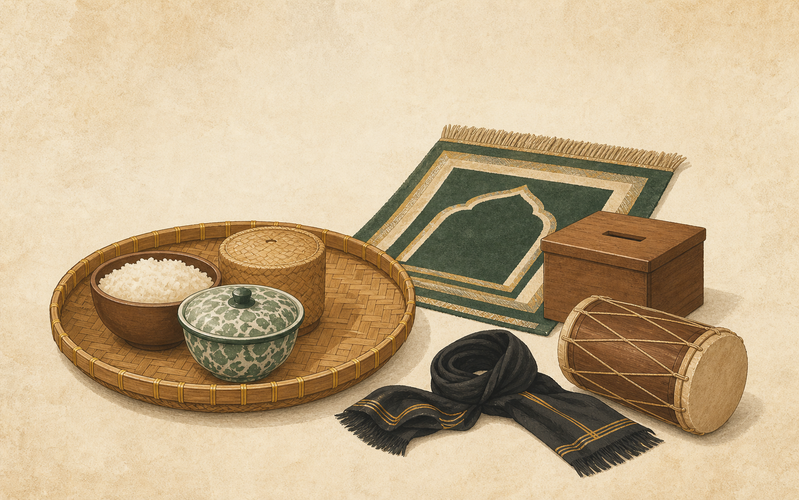
Bekasi is often introduced as a modern city on the edge of Jakarta: roads, commuter routes, industrial work, malls, schools, and neighborhoods that grow quickly. Yet this practical image does not exhaust the city's cultural life. Beneath the movement of a metropolitan day are repeated ceremonies, prayers, food exchanges, martial practices, and acts of mutual help connecting residents to West Java's cultural landscape.
Traditional rituals in Bekasi should not be described as a single preserved village system. The city sits within West Java while also belonging to Greater Jakarta's social and economic orbit. Its communities include long-established local families, Sundanese and Betawi cultural influences, Muslim neighborhood institutions, and migrants from many parts of Indonesia. For a museum, that mixture is not a problem to tidy away. It is the historical reality that makes Bekasi a useful place to study how ritual adapts in urban life.
Bekasi Between West Java and Greater Jakarta
Britannica identifies Bekasi as a city in West Java and places the province itself in the western part of Java, beside Jakarta. This geography matters because ritual life in Bekasi is shaped by both regional inheritance and metropolitan pressure. Residents may work in Jakarta, study in Bekasi, visit relatives in other parts of West Java, and join neighborhood events close to home. Culture moves along the same roads as workers, goods, and family obligations.
West Java is often associated with Sundanese language and cultural traditions, but its urban areas are not culturally uniform. Bekasi's local identity has also been shaped by its nearness to Jakarta and by long-standing Betawi influence in the western Java coastal zone. A wedding, circumcision celebration, religious gathering, or neighborhood meal may therefore contain several layers of practice at once. The result is not confusion, but a local habit of blending.
This blended setting matters for interpretation. Museums sometimes present ritual as if it belongs only to remote villages or formal temples. Bekasi suggests a different view: ritual also lives in alleys, mosque courtyards, rented halls, school fields, family houses, and neighborhood streets temporarily closed for a celebration.
Life-Cycle Ceremonies and Family Belonging
Many of the most visible rituals in Bekasi are life-cycle events. Birth, circumcision, engagement, marriage, death, and memorial prayer gather relatives and neighbors around moments when a person changes social status or a family asks the community to witness an obligation. These events are not merely private. They create public memory through invitation cards, food preparation, recitation, dress, seating arrangements, music, and the careful management of guests.
In a fast-growing city, life-cycle ceremonies help families remain socially legible. A household may live in a housing estate, a dense kampung, or a rented room near work, but ritual gatherings still declare kinship and neighborhood membership. The act of inviting, attending, contributing, and helping with food or chairs keeps relationships active. People become visible to one another through repeated obligation.
For museums, the objects of these ceremonies are often modest: envelopes, woven trays, serving plates, prayer books, microphones, tents, chairs, batik cloth, and banners. Their value lies not in rarity, but in use. They show how families turn private milestones into shared occasions.
Islamic Rhythm and Neighborhood Time
Islamic practice gives much of Bekasi's community life a recurring rhythm. Daily prayer, Friday prayer, Ramadan meals, Qur'an recitation, halal bihalal gatherings after Eid, and memorial prayers can structure social time across households, schools, workplaces, and neighborhood associations. These practices are not identical in every community, but they provide a widely recognized language of respect, charity, purification, and remembrance.
The mosque and prayer room often serve as more than worship spaces. They can become centers for announcements, teaching, donation collection, youth activity, mourning, and holiday coordination. In this sense, ritual time also becomes neighborhood time. A call to gather may organize people who otherwise pass one another only on the way to work or school.
This rhythm complicates a purely secular image of urban modernity. Bekasi may be industrial and commuter-oriented, but the day is still shaped by pauses, greetings, shared meals, and moral obligations. A museum display about contemporary Bekasi would miss something essential if it collected only work uniforms and transport cards while ignoring prayer mats, charity boxes, food containers, and neighborhood announcements.
Mutual Help as Practical Ritual
Mutual help is often discussed in Indonesia through the language of gotong royong, a broad idea of cooperative labor and shared responsibility. In Bekasi, this spirit may appear in neighborhood cleaning, wedding preparation, funeral support, security posts, mosque maintenance, disaster response, or informal assistance. These activities seem practical, but their repetition gives them ritual force.
The ritual quality lies in expected participation. People know that certain events require presence, contribution, or labor. A neighbor may lend a canopy, cook rice, arrange chairs, collect donations, direct traffic, or help clean a lane after a gathering. The work is useful, but it also expresses belonging. To help is to confirm that one is part of the social field.
Urban life can weaken some older forms of mutual obligation, especially when residents commute long distances or move frequently. Yet it can also create new forms of coordination through chat groups, neighborhood committees, school parents' networks, and mosque announcements. The material culture of cooperation now includes both brooms and smartphones, both donation boxes and digital transfers.
Pencak Silat and Embodied Heritage
Pencak silat offers another way to understand ritual and community in West Java and Indonesia more broadly. UNESCO describes the traditions of pencak silat as an Indonesian intangible cultural heritage that includes techniques, moral teaching, artistic expression, and relationships among people, God, and nature. In local settings, martial practice may appear in training yards, school activities, demonstrations, weddings, festivals, or youth organizations.
In Bekasi, pencak silat should not be reduced to sport alone. Like many embodied traditions, it can teach posture, discipline, respect for teachers, controlled movement, music, costume, and social hierarchy. A performance may entertain, but it can also mark identity. It tells the community that strength should be disciplined and that skill belongs within an ethical order.
For museums, pencak silat is challenging because movement cannot be locked inside a display case. Still, objects can help: uniforms, belts, drums, gongs, training weapons, photographs, certificates, and video recordings. These materials point beyond themselves to bodies in practice and to teachers who transmit knowledge through repetition.
Harvest Memory in an Urban Region
Bekasi's contemporary landscape is urban and industrial, but West Java's ritual imagination cannot be separated from agriculture. Scholarly work on the Seren Taun ceremony in West Java, including research hosted by Universitas Indonesia, shows how harvest ritual can preserve cultural values and community memory. Bekasi itself is not best represented as a timeless agricultural village, yet many residents still carry memories of rural origins, rice meals, seasonal ideas, and family ties to less urban areas.
This matters because ritual often survives through memory even when the landscape changes. A household in Bekasi may no longer farm, but rice remains central to hospitality, prayer meals, offerings of respect, and daily food security. Regional harvest traditions remind us that urban residents do not abandon older symbolic worlds completely. They reinterpret them through family stories, festive foods, and visits to ancestral places.
Museums can use this connection carefully. Rather than claiming that all Bekasi residents perform the same harvest ceremony, an exhibition might show how West Javanese agricultural memory informs urban food rituals. Rice baskets, cooking pots, communal meals, and stories of village return can become evidence of continuity under changed conditions.
Street Space, Sound, and Temporary Community
Ritual changes the city physically. A street may become a wedding venue. A mosque courtyard may become a distribution point for food. A school field may host a performance. A neighborhood lane may be decorated for Independence Day or a religious celebration. These temporary changes reveal how public and semi-public spaces are negotiated through trust.
Sound is part of this transformation. Drums, recitation, amplified announcements, children's rehearsals, greetings, and motorcycle traffic can occupy the same urban soundscape. Ritual does not remove the noise of the city. It organizes it for a while around a shared purpose.
This temporary community is especially important in places where residents may not share the same origin. Ritual events allow people to learn how to live together: when to help, when to be quiet, when to contribute, when to visit, and how to show respect. In this way, ceremony becomes a form of civic education.
Conclusion
Traditional rituals in Bekasi and West Java reveal culture as a living practice rather than a fixed inheritance. Bekasi's ceremonies, prayers, martial traditions, food exchanges, and mutual-help routines show how people build belonging inside a fast-moving urban environment.
For museums, this subject expands the meaning of heritage. The most revealing objects may not be rare treasures, but the everyday materials that help a neighborhood gather: mats, plates, drums, invitation cards, uniforms, banners, donation boxes, and shared meals. Through them, Bekasi's local culture becomes visible as a continuing act of community life.