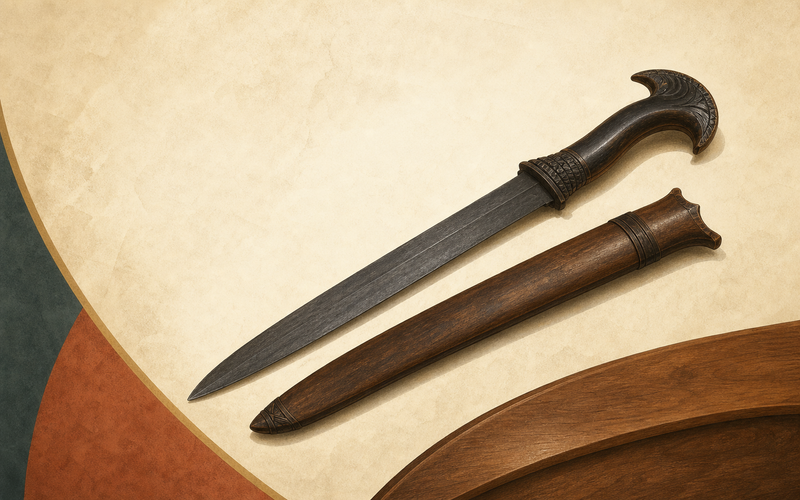
The Piso Gaja Dompak belongs to a Batak world in which a blade could carry far more than a cutting edge. Its name is often discussed in relation to authority, leadership, and the material presence of power around the Toba Batak region of North Sumatra. For a museum audience, the object is valuable not because every detail of its early history can be reduced to a simple document, but because it shows how weapons, prestige, and memory can become bound together in a single form.
That broader reading is important. Batak societies were never uniform, and the word Batak covers several related peoples with distinct histories, languages, and local traditions. Still, across North Sumatra, material objects such as houses, textiles, manuscripts, staffs, ornaments, and blades helped make rank and responsibility visible. A Piso Gaja Dompak should therefore be approached as part of material culture: an object made by skilled hands, carried or remembered in social life, and interpreted through ideas of protection, dignity, and leadership.
A Blade within the Batak World
The Batak peoples are associated above all with the highlands and interior regions of North Sumatra, including the cultural landscapes around Lake Toba. Historical sources describe Batak communities through agriculture, clan organization, ritual specialists, trade links, and changing relations with neighboring powers. This setting matters because a blade such as the Piso Gaja Dompak did not stand apart from society. It belonged to a world where objects could participate in adat, lineage memory, and public authority.
Museum interpretation should begin with that context before asking what the blade "did." A weapon can defend, threaten, or fight, but a prestige weapon also communicates. It tells viewers that its owner has status, that the object has been cared for, and that it may carry a story older than the person holding it. In the Batak case, this helps explain why blades are often discussed beside other signs of rank, ritual knowledge, and ancestral connection rather than only beside battlefield technology.
Form, Name, and Cautious Interpretation
The name Piso Gaja Dompak invites attention. Piso is commonly used for knives or blades in Batak and Indonesian contexts, while gaja evokes the elephant. The exact interpretation of dompak should be handled with caution in a museum article, because popular explanations do not always come with the same level of documentation. What can be said safely is that the name gives the object a memorable identity and links it to a symbolic vocabulary larger than ordinary utility.
This is where museum writing must resist two temptations. One temptation is to turn every named blade into a fixed ancient myth with no uncertainty. The other is to strip away local meaning and describe the object only as metal, wood, and horn. The responsible path lies between them. A Piso Gaja Dompak can be presented as a named Batak prestige blade whose meanings have been preserved through cultural memory, while the details of particular examples, owners, and dates should be tied to specific provenance whenever possible.
Leadership and the Language of Raja Authority
In many Batak settings, the word raja referred not only to kings in a European sense but also to leaders, chiefs, or figures whose authority depended on lineage, alliance, ritual position, and public recognition. A blade associated with such authority did not merely decorate the body. It helped make leadership visible. The owner appeared as someone able to protect, judge, and represent a community, and the object condensed that expectation into a form that could be seen.
The Piso Gaja Dompak is especially remembered in relation to Batak ideas of power and sovereignty. Modern discussions often place it near the symbolic world of the Sisingamangaraja lineage, whose memory remains important in North Sumatra. In that setting, a blade can stand for more than force. It can speak of liberation, moral order, and the burden placed on a leader. Whether displayed as a physical object or represented on a banner, the sword becomes a public sign of authority disciplined by responsibility.
Material Culture and Controlled Force
Prestige weapons often work because they contain a tension. A blade is dangerous by definition, yet a ceremonial or status blade presents danger under control. Its value depends not on random violence but on the social order that surrounds it. The more carefully the blade is mounted, named, inherited, or displayed, the more it suggests that power should be governed by rules.
This pattern appears across many Indonesian weapon traditions, from the keris to the rencong, kujang, mandau, and badik. The Piso Gaja Dompak belongs to that broader archipelagic logic without becoming interchangeable with those other forms. It is Batak in its associations and should be read through North Sumatran histories of rank, memory, and local authority. The comparison helps visitors see a shared principle: weapons can become cultural objects when communities teach people how to read them.
Craft, Display, and the Owner's Presence
Even when the surviving documentation is limited, the physical logic of a prestige blade still matters. The blade, hilt, sheath, fittings, and surface all shape how the object appears. Materials such as horn, wood, metal, and possible decorative fittings do more than protect the hand or cover the edge. They frame the blade as something meant to be seen, handled with care, and understood as worthy of attention.
For a leader or noble owner, such display was not empty ornament. It was a visual discipline. A person carrying a valued blade had to appear composed enough to deserve it. The object could strengthen authority, but it could also judge the owner by implication: power should be steady, protective, and accountable. This is why a museum label should not treat decoration as secondary. In prestige weapons, decoration is part of the language of authority.
Memory, Sisingamangaraja, and Public Symbolism
The memory of Sisingamangaraja XII, the Toba Batak leader who resisted Dutch colonial expansion and died in 1907, gives modern audiences one important route into the symbolism of Batak power. Public memory around Sisingamangaraja often uses emblems, banners, graves, monuments, and named institutions to connect the past with regional identity. Within that symbolic field, a sword can stand for resistance and moral leadership as much as for combat.
This does not mean every Piso Gaja Dompak in a collection can automatically be assigned to a specific historical figure. Provenance matters. But the association helps explain why the form remains meaningful. Objects become powerful when they are repeatedly used to tell stories about what a community values. In this case, the blade can point toward courage, lawful authority, protection of the weak, and the dignity of Batak historical memory.
Reading the Object in a Museum
A museum display of the Piso Gaja Dompak should ask visitors to slow down. The first question may be, "What kind of weapon is this?" but the better follow-up is, "What kind of authority did it make visible?" That question opens the object outward. It connects blade-making to leadership, leadership to community expectation, and community expectation to later remembrance.
This approach also helps avoid romantic exaggeration. A responsible display can acknowledge that some meanings come from oral tradition, later symbolism, or regional memory rather than from a complete written archive. Such honesty does not weaken the interpretation. It strengthens it, because it shows visitors how cultural heritage actually survives: through objects, stories, public symbols, scholarly caution, and local pride working together.
Conclusion
The Piso Gaja Dompak matters because it gathers power into material form. It can be understood as a blade, but it is more revealing as a prestige object linked to Batak authority, public memory, and the ethics of controlled force. Its importance lies not only in sharpness or age, but in the meanings that communities attached to carrying, naming, displaying, and remembering it.
For museums, the object offers a compact lesson in Indonesian material culture. Weapons are never only technical things when people turn them into heirlooms, emblems, and signs of leadership. Read carefully, the Piso Gaja Dompak shows how Batak power could be made visible through an object that was at once dangerous, disciplined, and deeply symbolic.