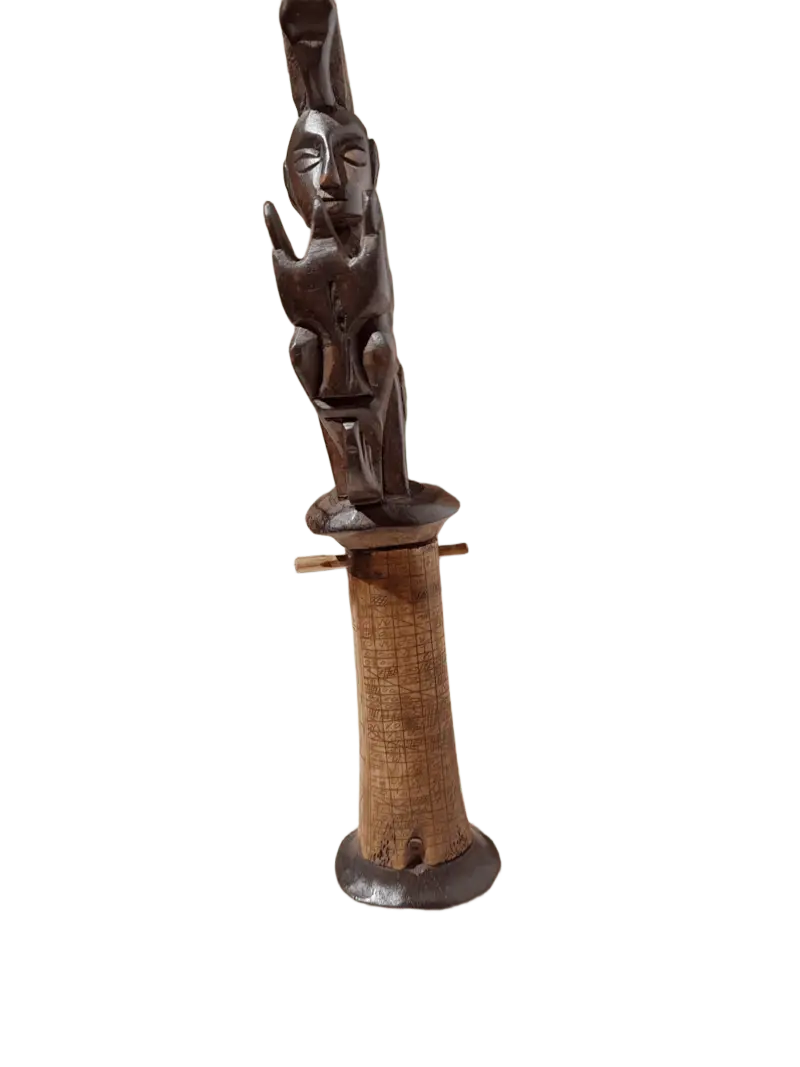
A Batak Porhalaan Medicinal Plant Container in Buffalo Bone and Wood
Among the ritual objects associated with the Batak peoples of North Sumatra, few are as intellectually intriguing as the porhalaan. In the Batak context, the term porhalaan refers to a calendrical system used by ritual specialists to determine auspicious days and to guide ceremonial and medicinal practices. Objects bearing this calendar were closely connected to the knowledge of the datu, the ritual expert or priest who combined healing, divination, and spiritual authority.
The object described here is a medicinal plant container constructed from carved buffalo bone, fitted with a wooden base to stabilize it and a carved wooden top depicting a human figure riding a singa. Its form and decorative program place it within the broader category of Batak ritual containers often associated with healing substances, protective materials, and esoteric knowledge.
Buffalo Horn and Ritual Materiality
Water buffalo held deep symbolic and economic importance in Batak societies. Beyond their agricultural role, buffalo were central to ritual exchange, sacrifice, and status display. Buffalo horn, therefore, carried more than practical value. It was a material embedded in cosmological and social meaning.
Batak ritual containers for medicines, sometimes referred to as naga morsarang in museum literature, were frequently made from buffalo horn. These containers held potent mixtures prepared by a datu, including medicinal herbs and magical substances. While terminology can vary in scholarship, horn containers were clearly associated with ritual healing and protective practices.
In this object, the bone body is carved with a Batak calendar. The Batak calendar is a complex divinatory system traditionally used to determine favorable and unfavorable days. It does not function as a solar or lunar calendar in the modern sense but rather as a ritual guide. The calendar helped the datu decide when to conduct ceremonies, initiate healing rites, or undertake significant communal actions.
The carving of such calendrical information onto an object is significant. It suggests that the container was not merely a storage vessel but also a portable instrument of ritual knowledge.
The Wooden Foot and Structural Stability
The addition of a carved wooden foot to stabilize the horn body reflects both functional and symbolic considerations. Horn containers are naturally curved and tapering, making them unstable when placed upright. A wooden base allows the object to stand securely during ritual use.
In Batak art, carved wooden supports often carry additional symbolic motifs. Although specific iconographic details can vary, elongated and curved forms frequently echo mythological creatures, including the singa. The integration of bone and wood in a single object demonstrates the Batak tradition of combining organic materials into unified ritual tools.
The Human Figure Riding a Singa
The carved wooden top depicting a human riding a singa adds another layer of meaning. In Batak art, the singa is a composite mythological creature. It does not correspond directly to a lion in the zoological sense. Instead, it is a protective and powerful being, often combining attributes of multiple animals and sometimes incorporating human-like features.
The singa appears widely in Batak architecture, ritual objects, and protective carvings. It is frequently associated with guardianship and supernatural force. The depiction of a human figure riding such a being suggests mastery, alliance, or spiritual authority.
In Batak cosmology, ritual specialists mediated between the human world and the spirit realm. The imagery of a human mounted upon a powerful mythological creature may symbolize the datu’s ability to harness protective forces or to travel metaphorically between realms. While interpretations must remain cautious, the combination of calendrical carving and protective imagery strongly aligns with the ritual context of medicinal practice.
Porhalaan and Ritual Knowledge
The Batak calendar system was not merely a way of marking time. It structured ritual life. The porhalaan guided agricultural decisions, ceremonial timing, and healing practices. Knowledge of the calendar was specialized and transmitted within certain lineages.
Objects inscribed with calendrical systems reflect the deep integration of cosmology and daily life in Batak communities. Healing, divination, and timekeeping were interconnected domains. A medicinal container bearing the calendar suggests that healing substances were prepared and administered according to ritually appropriate days.
Scholarly research on Batak ritual art emphasizes that many of these objects were not decorative in a purely aesthetic sense. Their carvings, materials, and forms were integral to their function. The visual complexity of the porhalaan container underscores the intellectual and spiritual sophistication embedded in Batak ritual traditions.
Cultural and Historical Context
Batak ritual objects entered museum collections during the nineteenth and early twentieth centuries, often through colonial encounters.
Today, porhalaan-bearing objects are studied as material expressions of indigenous knowledge systems. They offer insight into how time, healing, cosmology, and artistic expression were interwoven.
This buffalo bone medicinal plant container stands as a testament to Batak craftsmanship and ritual thought. Its carved calendar encodes a worldview structured around auspicious timing and spiritual balance. Its human rider and protective singa reflect a cosmology in which ritual specialists engaged directly with powerful unseen forces. Together, these elements transform a functional container into a compact embodiment of Batak intellectual and spiritual heritage.
Note: The object illustrated in this article is part of the author's private collection.