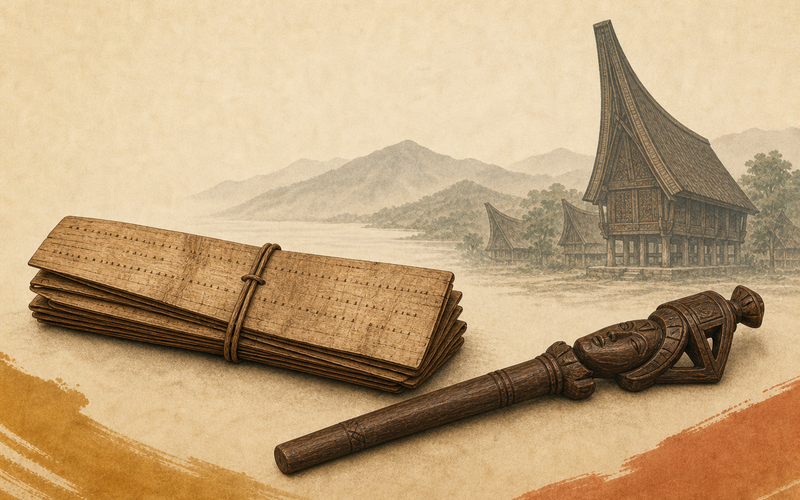
The Batak peoples of North Sumatra are often described in broad ethnographic terms, yet their religious life deserves a more careful view. "Batak" is a collective label for several related groups, including the Toba, Karo, Simalungun, Pakpak, Angkola, and Mandailing. They share historical ties to the highlands around Lake Toba, related languages, and overlapping customary structures, but they have never formed a single uniform religious community. For that reason, any museum-style account of Batak belief must begin with caution. It is more accurate to speak of related indigenous belief systems than of one fixed Batak religion.
Even so, common themes are visible across the historical record. Older Batak belief placed human communities within a living cosmos populated by ancestors, spirits, and powerful divine beings. Ritual specialists mediated between visible and invisible worlds, while kinship and adat gave those relationships social form. These ideas did not disappear when Christianity and Islam spread through the region. Instead, many older concepts survived in ceremonial life, in sacred geography, in music, and in community memory. Museums therefore study Batak religion not as a vanished curiosity but as a key to understanding North Sumatran cultural history.
A Religious World Shaped by Diversity
Britannica notes that the Batak are made up of several closely related groups rather than a single homogeneous people. That distinction matters because religious practice also varied by region, local leadership, and historical circumstance. Some communities retained older ritual forms longer than others, and some combined them with newer religious commitments in different ways. A responsible interpretation must therefore avoid the false impression that every Batak village once followed an identical theology.
What can be said with confidence is that the indigenous religious landscape was deeply social. Belief was not primarily a private matter of personal confession. It was embedded in marriage exchanges, funerary observances, communal feasts, house symbolism, and clan relationships. Religious ideas were therefore inseparable from adat, the customary order that governed obligations among kin groups and shaped public ceremony. In Batak contexts, spirituality was lived through social structure as much as through doctrine.
Cosmos, Divine Power, and Ancestors
Scholarly work on Parmalim, one of the best-known surviving Batak indigenous religious traditions, identifies Mulajadi Nabolon as a central divine power in Batak theology. This does not mean that every Batak group described the sacred in exactly the same terms, but it does show that older Batak cosmology included a high divine source rather than only local spirits. Around that higher order stood a wider spiritual world in which ancestors and unseen beings remained active in human affairs.
Britannica summarizes the older religious pattern by noting that ancestors, plants, animals, and even inanimate objects were understood to possess souls or spirits. Such a view made the world densely inhabited and morally charged. Ancestral presence was especially important because kinship lay at the center of Batak society. The dead were not imagined as wholly absent from the living community. Rather, they could remain significant through memory, ritual obligation, and the continuing authority of lineage. This is one reason museums frequently interpret Batak carvings, ancestral figures, and ritual objects in connection with kinship rather than as isolated works of art.
Ritual Specialists and Ceremonial Mediation
Historical descriptions of Batak religion emphasize the role of ritual specialists who mediated contact with spiritual forces. Britannica notes that male priests could address or influence spirits, while female mediums might enter trance states to communicate with the dead. These roles suggest a ritual system in which specialized knowledge mattered greatly. Access to the sacred was not entirely informal; it often depended on individuals recognized for particular ceremonial capacities.
This mediation was practical as well as symbolic. Ritual specialists were involved in moments of danger, healing, divination, and communal transition. Their work helped interpret misfortune, regulate offerings, and mark occasions when the ordinary social order required sacred confirmation. For museums and historians, this is important because many objects in Batak collections were not simply decorative possessions. Containers, staffs, textiles, musical instruments, and architectural features could all participate in a ritual system that linked material culture to expert action and spoken formulae.
Adat as the Social Frame of Belief
Batak indigenous religion cannot be understood apart from adat. Cambridge scholarship on Batak ceremonial music describes adat as the traditional code governing relations among major kinship groups, while research on Angkola ritual shows that adat includes ceremonial life, kinship norms, and political thought together. In other words, adat did not sit beside religion as a separate institution. It created the public framework through which belief was enacted, remembered, and transmitted.
This helps explain why marriage and funerary rites carried such religious weight. Ceremonies were not only family events. They were moments when kin groups, hierarchy, exchange, and moral obligation became visible before both the living and the ancestral world. Gifts, speeches, music, seating arrangements, and ritual sequence all expressed a larger cosmological order. When museums display Batak heirlooms without that context, viewers may see impressive objects but miss the relationships that once gave them force. Adat restores those relationships to the interpretive picture.
Sacred Sound, Place, and Collective Memory
Batak religion also lived in sound and landscape. Artur Simon's study of gondang ceremonial music argues that older religious beliefs continued to be important in adat ceremonies even after Christianity and Islam had become prominent. Music in this context was not mere accompaniment. It helped structure ceremonial communication among humans, ancestors, and other sacred powers. A performance could organize movement, emotion, and collective attention in ways that made ritual efficacy socially recognizable.
Place carried similar significance. Britannica's entry on Samosir notes that Dolok Pusubukit was believed to be the home of the mythical first Batak ancestor and that ancestor worship remained important there even in a largely Christian context. That combination of sacred topography and later religious change is especially revealing. It shows how indigenous belief could remain anchored in remembered places even when formal affiliation shifted. For museums, maps, house models, and landscape references are therefore not background details. They are part of the spiritual history of Batak communities.
Change, Conversion, and Survival
By the modern period, most Batak had become Protestant Christians or Muslims, and older local religion no longer represented the majority pattern. Yet conversion did not produce a complete break with the past. Older ritual concepts persisted in customary life, in the language of ancestry, and in some ceremonial forms. Studies of Parmalim further show that an indigenous Batak religious tradition has continued into the present by adapting to changing social conditions while retaining a recognizable theological core.
This historical layering is one of the most important lessons for interpretation. Indigenous belief systems should not be treated as a sealed pre-Christian chapter followed by a wholly separate modern era. Batak history is better understood as a sequence of encounters, adaptations, and selective continuities. Communities adopted new religious identities, but they also carried forward older understandings of kinship, sacred authority, and ancestral memory. A museum that presents only rupture misses the complexity of lived history.
Why These Beliefs Matter in Museum Interpretation
Objects associated with Batak communities often enter museum collections as carvings, ritual containers, musical instruments, textiles, architectural elements, or prestige heirlooms. Without religious context, such works can appear purely aesthetic or ethnographic. With that context, they become evidence of how a community organized relations between humans and the unseen world. The meaning of an object may depend on who used it, in which ceremony, under what customary authority, and with what expectations about ancestors or spiritual presence.
That is why indigenous belief systems matter so much to curatorial practice. They help museums move beyond surface description toward social interpretation. They also remind viewers that the Batak past should not be imagined as frozen. Religious objects and practices belonged to living communities that debated, transformed, and sometimes preserved older ideas under new historical conditions. Interpreted in that fuller way, Batak material culture reveals not only artistic skill but also a sophisticated religious imagination rooted in kinship, place, and ceremonial order.
Conclusion
The indigenous belief systems of the Batak people were diverse, socially embedded, and historically durable. They joined divine power, ancestral presence, ritual specialists, music, sacred places, and adat into a connected moral world. Although later religious change altered that world significantly, it did not erase its influence. For museums, Batak belief remains essential because it explains how objects, ceremonies, and communities once belonged to the same sacred landscape.