Introduction
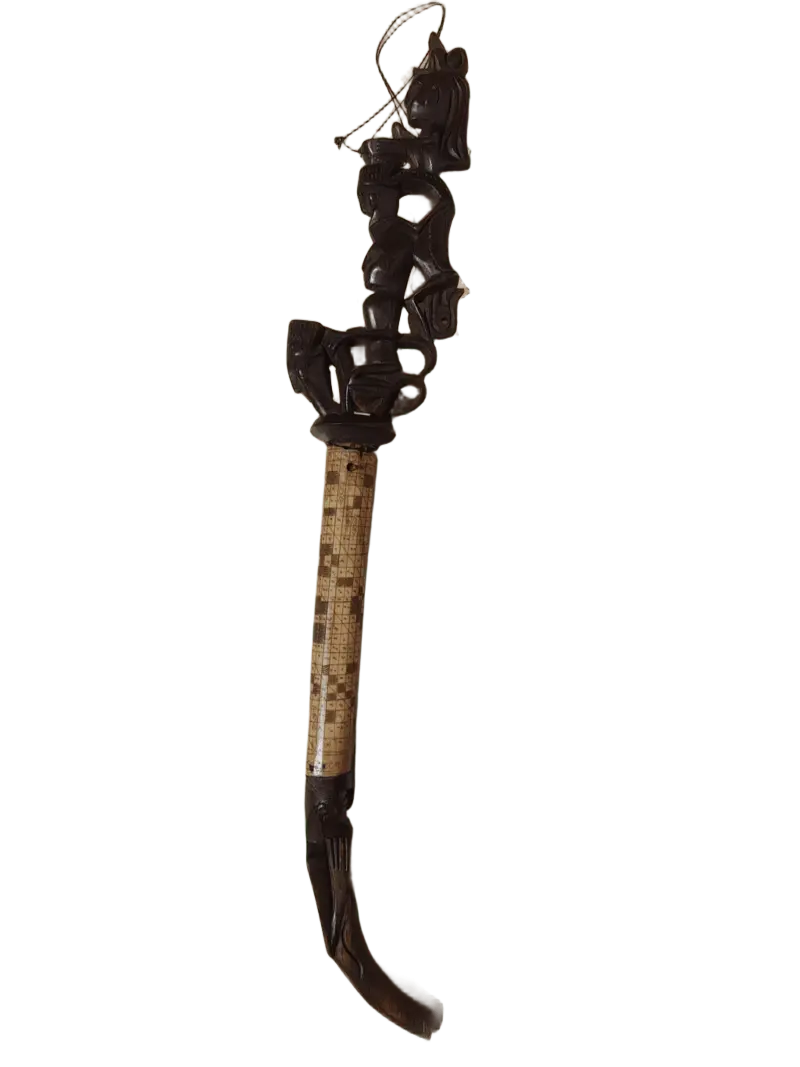
Among the Batak peoples of northern Sumatra, material culture often reflects a dynamic interplay of practical function and rich symbolic language. One object embodying this intersection is the porhalaan, a container associated with medicinal plants, amulets, and other substances utilized in traditional healing practices. The piece examined here was acquired in Indonesia and consists of a buffalo bone body, a detachable carved wooden top, and a carved wooden bottom part attached to the bone. The horn itself is carved with symbols resembling the porhalaan calendar, an indigenous Batak astrological system used to determine auspicious times and to guide healing and ritual activities.
This article explores the general background of porhalaan, its cultural context, the specific iconography on the present object, and the broader significance of the motifs found on Batak material culture.
Porhalaan in Batak Worldview
The term porhalaan refers to a traditional Batak calendar system rather than a specific object type. It is a cyclical almanac used by the Batak to track days, months, and seasons. Batak shamans (datu) and healers historically used the porhalaan to determine propitious moments for ceremonies, marriages, healing, and agricultural activities. The porhalaan system is unique to Batak cosmology and reflects an indigenous worldview where time, celestial patterns, and human activity are deeply interwoven.
Because the porhalaan itself is essentially a calendrical chart, often depicted as a grid or sequences of symbols representing lunar and solar relationships, the term has at times been applied to objects that bear such calendrical inscriptions or symbolic representations. These inscriptions were not simply decorative; they conveyed structured knowledge about time, ritual pathways, and the rhythm of life.
Scholars of Batak culture, including early ethnographers, documented the use of porhalaan charts in divination and ritual planning. They found that Datuks would study porhalaan inscriptions carved on wood, bone, or horn as a guide to favorable or unfavorable timings for a range of life events. While porhalaan charts could be depicted in simple manuscripts (pustaha), their appearance on portable objects suggests a close integration between worldview and everyday tools.
Function: Container for Medicinal Plants
Containers for medicinal plants and herbal mixtures played an important role in Batak healing traditions. These containers could hold bark, roots, powders, or other botanical materials gathered for remedies and treatments. Among Batak healers (datu), the storage and presentation of such materials was not purely utilitarian: it also engaged symbolic and cosmological frameworks. An object that combined calendrical markings with carved figures and mythic beings would situate the healing materials within a broader symbolic context, reinforcing the practitioner’s connection to cosmological guidance.
The present object’s buffalo bone body suggests durability and a link to an animal that held economic and ritual importance in Batak life. Buffalo were often used in agricultural labor and feasts, and their material byproducts (such as horn and bone) were valued for tools and carved objects.
Iconography: Calendar, Singa, and Riders
Porhalaan Calendar Carving
The carved motifs on the body of the horn resemble porhalaan calendar markings. While the exact meanings of specific symbols would require field comparison with documented porhalaan charts, the presence of calendrical markings indicates that this container may have held not only medicinal contents but also cosmological significance. The calculus of timing, which porhalaan encodes, was central to Batak rituals and could inform when particular remedies should be gathered or administered.
Singa and Anthropomorphic Figures
The detachable wooden top features pairs of singa-like heads and anthropomorphic figures riding creatures that appear to combine elements of the singa and a horse. In Batak iconography, the singa motif, distinct from the zoological lion, symbolizes protective power and often appears on carved house beams, ritual objects, and amulets. The presence of anthropomorphic riders suggests a narrative dimension, possibly representing mythic intermediaries or empowered figures participating in a protective cosmology. The hybrid mounts extend the protective motif, connecting the container to realms of power beyond the mundane.
Elongated Singa on the Bottom
The carved wood bottom part attached to the bone features an elongated singa motif, its form curved in a dynamic line. This stylistic elongation recalls gorga-like ornamentation, the swirling, energetic patterns common in Batak and neighboring artistic vocabularies. It also reinforces the protective and cosmological aura of the object. A container with such embellishment is less likely a simple utilitarian vessel and more of a crafted cultural object embedding healing materials within a symbolic universe.
Cultural Context and Ritual Practice
Batak healing practices were historically conducted by datu, specialists who combined herbal knowledge with cosmological understanding. They consulted porhalaan calendars to determine auspicious times for remedies, divination, and rituals intended to restore balance and health. The presence of porhalaan markings on a container may indicate that the container itself acted as a material locus for time-oriented ritual knowledge.
Ethnographic records underline that Batak containers for ritual and medicinal use were often decorated with symbolic motifs, not merely to beautify but to activate spiritual relationships. Singa figures, cosmological charts, and other symbols created visual mnemonics that connected the practitioner to the Batak metaphysical register.
While it is not possible to assign specific ritual protocols to the present object without documented lineage, its form and decoration situate it clearly within a network of symbolic associations prominent in Batak material culture.
Conclusion
The Batak porhalaan container, composed of a buffalo bone body with calendar carvings, a carved wooden top with singa and anthropomorphic riders, and a carved bottom with an elongated singa, exemplifies how practical objects in Batak culture can carry layered symbolic meaning. Likely used to store medicinal plants or remedies, it integrates calendrical, protective, and cosmological motifs rooted in Batak traditions.
The convergence of porhalaan calendar markings with powerful mythic imagery underscores the holistic worldview in which healing, timing, and spiritual protection are inseparable. In its craftsmanship and iconography, this object reflects the rich material culture of the Batak people, combining utility with symbolic resonance documented in ethnographic literature and museum collections.
Note: The object illustrated in this article is part of the author's private collection.