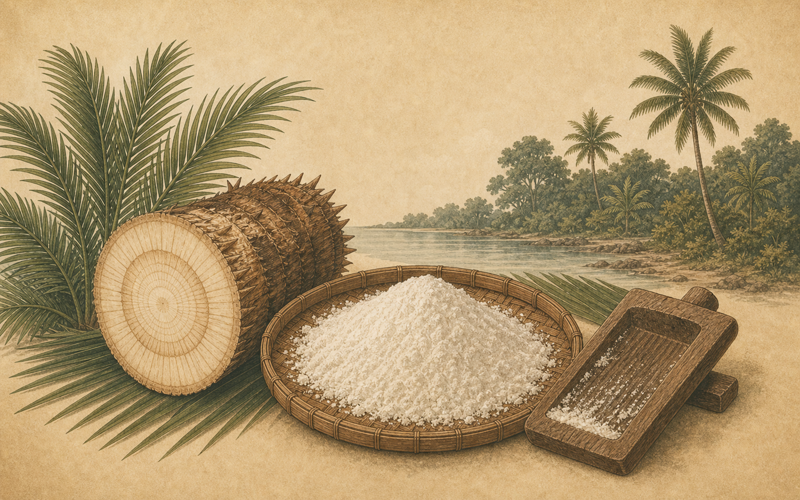
Sago is one of eastern Indonesia's most important heritage foods because it links landscape, labor, and identity in a single material. The starch comes from the pith of the sago palm, especially Metroxylon sagu, a plant associated with lowland wetlands and freshwater environments. In regions where sago has long been processed, the palm is not simply a crop. It is part of a wider cultural ecology that includes forest access, family knowledge, food preparation, and ideas about belonging to place.
For museums, sago offers a way to interpret food heritage beyond finished dishes. A bowl of papeda or a cake made from sago flour points backward to palms, waterways, cutting tools, washing troughs, and hands trained by experience. It also points outward to the social worlds in which people gather to eat, exchange food, and remember older ways of living. Sago's significance therefore rests not only in what it feeds, but in what it records.
Wetland Palms and Regional Food Worlds
Eastern Indonesia's food history cannot be understood through rice alone. Papua, Maluku, and nearby island regions contain ecological zones where wetland palms, tubers, fish, and forest products have shaped local diets over long periods. In these settings, sago provided a carbohydrate source well suited to humid lowland environments. It could be processed into starch, stored, traded locally, and prepared in forms that matched local tastes and available side dishes.
The sago palm also changes how we imagine agriculture. Unlike a rice field that is planted and harvested in seasonal cycles, a sago landscape may include palms at different stages of growth, forest paths, water channels, and customary knowledge about when a trunk is ready to cut. This knowledge is practical and environmental at once. It requires attention to maturity, starch quality, access rights, and the physical effort of processing a heavy palm into edible food.
Museum interpretation can use sago to show that food heritage is always regional. National narratives often emphasize rice because it is politically and culturally prominent across Indonesia today. Sago reminds visitors that Indonesian food cultures are plural, and that eastern Indonesian communities developed food systems in conversation with wetlands, rivers, coastal exchange, and forest margins.
Harvesting, Processing, and Skilled Labor
Traditional sago processing begins long before the starch reaches a kitchen. A mature palm must be selected, felled, split, and worked so the pith can be scraped or pounded. The crushed pith is then washed, strained, and settled so starch separates from fibrous material. Each step involves judgment: how to recognize a useful palm, how to move water through the starch, how to handle tools safely, and how to store the product.
These processes are demanding, and they reveal why heritage food should not be reduced to recipes. Much of sago's cultural value lies in embodied knowledge. Older workers teach younger relatives through practice, correction, and repetition. People learn the feel of wet starch, the timing of washing, and the signs that the material is clean enough for cooking. The food is therefore also a record of apprenticeship.
Communal labor matters as well. Sago processing can involve households, kin groups, or neighbors, depending on local circumstances. Work may be divided by age, strength, experience, or gender, and the finished starch may circulate through gifts, sales, or shared meals. In this sense, sago is both a food and a social process. It turns a palm into nourishment while also renewing relationships among the people who work with it.
Papeda and the Table
One of the most recognizable sago dishes in eastern Indonesia is papeda, a soft, translucent preparation often associated with Maluku and Papua. It is made by mixing sago starch with hot water until it thickens into an elastic, gelatinous form. Because its taste is relatively neutral, papeda is commonly eaten with strong accompaniments, especially yellow fish soup seasoned with ingredients such as turmeric, citrus, lemongrass, or chili.
Papeda is important for heritage interpretation because it makes texture central. Many museum visitors think first about flavor, but papeda asks them to notice consistency, movement, and serving technique. The food is often lifted and transferred with special care, then eaten together with broth and fish. The meal becomes a study in coordination: starch, soup, side dishes, utensils, and shared timing all matter.
The dish also carries regional memory. For people from sago-eating areas, papeda may evoke family kitchens, coastal markets, village gatherings, or journeys between islands. For others, it can become an introduction to eastern Indonesian foodways that differ from rice-centered assumptions. In both cases, papeda helps make sago visible as a living heritage rather than an abstract ingredient.
Sago, Identity, and Food Security
In recent decades, scholars and local advocates have discussed sago in relation to food security. Indonesia has extensive sago-growing areas, with particularly strong associations in Papua and Maluku. Researchers have noted that sago can be resilient in local environments and may reduce dependence on imported or transported staples. Such arguments do not treat sago as a nostalgic object. They present it as part of practical conversations about local resources and sustainable diets.
At the same time, sago heritage exists within changing food preferences. Rice has become more dominant in many parts of eastern Indonesia through markets, state programs, schools, and everyday aspirations. For some households, rice may signal convenience, modernity, or access to national food systems. For others, sago remains valued as ancestral food, local food, or a food that suits particular bodies and landscapes.
Museums should present this shift carefully. It would be too simple to claim that one food has replaced another everywhere, or that tradition and modernity stand on opposite sides. Many people combine rice and sago in flexible ways. The historical question is how choices are shaped by infrastructure, taste, labor demands, health concerns, prices, and social prestige. Sago's heritage value becomes clearer when these pressures are shown rather than hidden.
Objects, Tools, and Museum Display
Sago can be interpreted through many kinds of museum objects. Cutting tools, wooden or bamboo implements, baskets, containers, cooking vessels, photographs, oral histories, and food models can all help visitors understand the work behind the starch. A display might also include maps of sago-growing regions, diagrams of palm processing, or recordings of people explaining how they learned to prepare sago foods.
The challenge is that the central object, starch, is ordinary and easily overlooked. It may appear as powder, wet sediment, cooked paste, or dry flour. Museum interpretation must therefore connect the material to process. Visitors need to see that a plain white starch can carry environmental knowledge, customary practice, food memory, and regional pride. The modest appearance of sago is part of its interpretive power.
Exhibitions can also avoid presenting sago as a relic. Contemporary cooks, farmers, researchers, and community organizers continue to adapt sago for household meals, packaged products, local businesses, and cultural events. Showing both traditional processing and present-day innovation helps museums avoid a frozen picture of eastern Indonesia. Heritage is not only preservation. It is also the ability of communities to keep using inherited knowledge under new conditions.
Continuity in a Changing Food Landscape
The future of sago depends on more than cultural admiration. Land-use change, market access, labor availability, education, and government food policy all affect whether sago remains central in daily life. If young people see sago processing as difficult work with limited economic reward, knowledge may weaken. If wetlands are converted or neglected, the ecological base of sago heritage becomes fragile.
Yet sago also has renewed possibilities. Interest in local food systems has encouraged people to reconsider indigenous starches, regional dishes, and food resilience. Sago-based foods can appear in restaurants, festivals, household kitchens, and educational programs. These settings may not reproduce older village practices exactly, but they can keep the memory and usefulness of sago in public view.
For museums, the most responsible approach is to present sago as both old and current. It belongs to deep regional histories, but it also belongs to present debates about nutrition, land, identity, and sustainability. A heritage food is not valuable because it is untouched. It is valuable because people continue to argue for it, cook it, teach it, and recognize themselves through it.
Conclusion
Sago as heritage food in eastern Indonesia reveals the intimate relationship between environment and culture. From wetland palms to papeda, from skilled processing to questions of food security, sago records how communities turn local landscapes into nourishment and meaning.
Its museum value lies in this layered story. Sago is starch, meal, memory, labor, and regional identity at once. To understand it is to see eastern Indonesia not as a margin of national food history, but as a center of knowledge with its own materials, techniques, and cultural imagination.