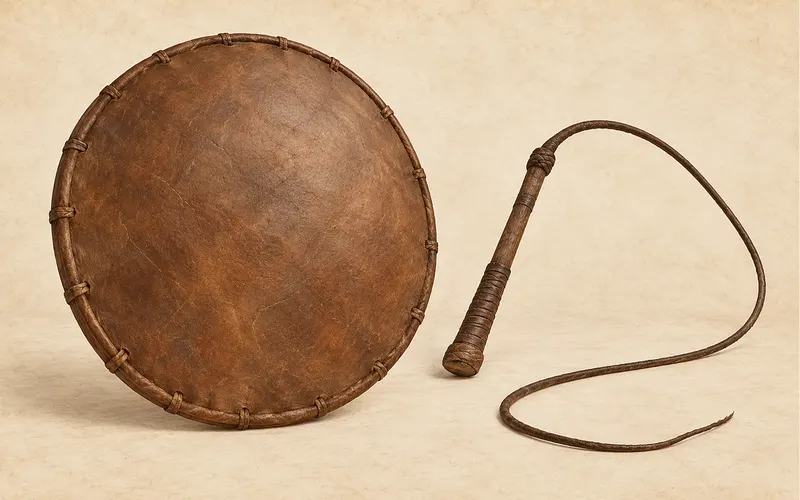
Caci is a ceremonial whip-and-shield contest performed by Manggarai men in western Flores, East Nusa Tenggara. Two participants face one another: the attacker carries a larik, or whip, while the defender uses an nggiling, or shield. Manggarai's cultural and tourism office describes it as both a war dance and a communal game, performed at harvest thanksgiving, hang woja, and other major customary occasions. Manggarai cultural office.
Caci brings actual physical risk into a public performance of movement, music, and social encounter. It belongs within the museum's music and dance collection and the wider account of ritual dances in eastern Indonesia, while its equipment and customary setting deserve a closer look.
Whip, shield, and alternating roles
The paki strikes; the ta'ang parries. In the description assembled by Hironimus Jampi and colleagues in their 2019 study, participants alternate attacking and defending, and groups representing hosts, ata one, and visitors, ata peang, meet in the contest. Their account restricts strikes to the body above the waist. These conventions place individual skill within an organized exchange between communities. Jampi, Nawir, and Hadisaputra.
The material contrast is striking. Buffalo hide provides both the flexible whip and the protective shield, while an additional rattan parrying implement, agang, assists defense. A university cultural description identifies the panggal as a hide headpiece resembling buffalo horns. The combination makes protection visible, but leaves the encounter demanding: timing, movement, and the ability to read an opponent matter alongside the equipment. Universitas PGRI Kanjuruhan Malang.
Harvest thanksgiving in Ngkiong
A specific occasion helps anchor the tradition. AMAN journalist Rhonal Apolo reported Caci at Ngkiong, in Dora Ngkiong village, East Manggarai, on 7 September 2024. Customary leader Rofinus Hatul connected the performance with harvest thanksgiving and celebrations of the customary house. Performer and customary elder Mikael Ane emphasized accepting the possibility of wounds and defeat. AMAN's Ngkiong report.
The ceremonial surroundings extend beyond the duel. Erna Mena Niman's 2022 research on penti, Manggarai thanksgiving, examines how ritual locations connect understandings of nature with relationships among people, and how norms and prohibitions organize social life. That study helps explain why a performance's place within a celebration matters as much as its visible action. Niman on penti.
Music, dress, and participation
In Apolo's Ngkiong account, white trousers are wrapped with Manggarai songke cloth; bells tied behind the waist sound with the dancer's movement. The report calls movement to gong-and-drum rhythms lomes and the performed verse paci. These details connect the striking and parrying to a larger sequence of sound and bodily display. AMAN.
Research by Martinus Aristo, Dedy Setiawan, and Ferdinandus Bate Dopo at Wongko Lema, Golo Lebo village, East Manggarai, likewise treats gong-and-drum accompaniment as a means of bringing people together in adat, customary life. The wider gathering also includes people who do not duel: Manggarai's cultural office describes male and female elders performing danding, moving in a circle between contests. Wongko Lema music study, Manggarai cultural office.
An opponent as a social partner
Fransiskus Sailtus and Pius Pandor offer a philosophical interpretation grounded in observation in their 2024 study. They describe attacker and defender as people who recognize each other's identity and role and face one another with respect. Their argument makes mutual recognition central to the encounter. It is a scholarly reading of the relationship, rather than an account of Caci's historical origin. Sailtus and Pandor.
For a museum reader, this shifts attention from the blow alone to the exchange that permits it. A useful comparison is Sumba's horseback martial culture, where ceremonial contests also frame physical risk. The comparison concerns social setting; each tradition has its own equipment, participants, and ritual calendar.
Change within customary life
Hendrikus Lanur's 2019 undergraduate thesis on Wudi village documents changes beginning in the 2000s in participation, equipment and materials, ritual processions, and women's ceremonial dress. Responses differed: some residents accepted shortened sequences or ready-made headcloths, while others objected. This local study shows people actively negotiating the form of their tradition. Lanur on Wudi.
Reading Caci through these named places avoids presenting every performance as an identical survival from an undated past. Its history is approached here through documented practice and local accounts, without assigning an unsupported founding date.
Bringing performance into the museum
A shield in a display case records only part of Caci. Its interpretation becomes more informative when paired with the maker's and user's names, the community and occasion, descriptions of the accompanying music, and participants' accounts of the encounter. A photograph or recording can connect the stationary object to its movement and social setting.
The museum's article on Moluccan salawaku shields and parang offers another route into the relationship between defensive equipment and performance. Caci's plain hide shield has its own form and context. The illustration accompanying this article presents a generalized equipment type; the cited community testimony supplies the people, occasions, and relationships that an image alone cannot convey.