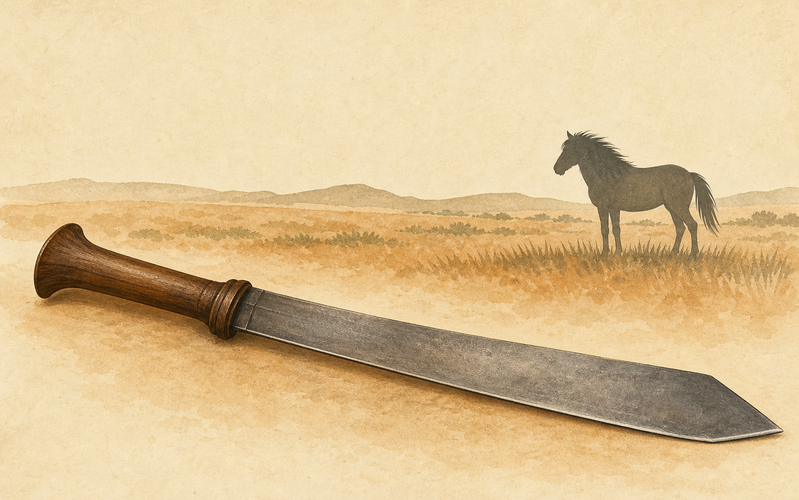
Sumba's martial heritage is best read as a relationship between bodies, animals, objects, and ritual time. The island is widely known for horses, megalithic tombs, ikat textiles, and Marapu-oriented ancestral traditions, but its weapons also belong in that same cultural field. A sword was not only a sharpened tool. A horse was not only transportation. Together, they helped make courage, rank, obligation, and memory visible in public life.
This is especially clear in the contrast between the kabeala, a Sumbanese parang or sword form, and Pasola, the famous mounted spear-throwing event of western Sumba. One is a carried blade, close to the body and often read through dress and status. The other is a collective spectacle of speed, risk, and seasonal renewal. Seen together, they show how martial culture on Sumba moved between the intimate scale of the waist-borne weapon and the open field of horseback ceremony.
Sumba as a Martial Landscape
Sumba lies in eastern Indonesia, within the Lesser Sunda world, where dry seasons, open savanna, and livestock keeping shaped daily life. Horses became unusually important here compared with many other Indonesian islands. They carried people across difficult ground, marked wealth, and appeared in ritual obligations such as marriage exchange and funerary practice. This landscape encouraged forms of skill that were practical and social at the same time.
Martial display was therefore not isolated from ordinary life. Riding, herding, ceremonial exchange, and public gathering all trained people to read movement, posture, and possession. A man on horseback, a blade at the waist, or a spear thrown in a ritual field could communicate more than readiness for conflict. These signs belonged to a social grammar in which bravery, discipline, and ancestral accountability were publicly evaluated.
The Kabeala and the Carried Blade
The kabeala, also spelled in several related forms, is associated especially with Sumba and is often described as a parang or golok-like weapon. Published descriptions identify a blade that is straight-backed, broadens toward the tip, and carries weight forward through a convex cutting edge. Its hilt may be made of horn or wood, while the wooden scabbard is commonly held together with binding. These features place it among the robust cutting weapons of the Indonesian archipelago, but its local meaning depends on more than shape.
In Sumbanese settings, a blade could be part of how a person appeared before others. The kabeala's visibility at the body made it a sign of readiness, gendered presence, and sometimes rank. Ethnographic references connect a black kabeala with the dress of a male papanggang in funerary contexts, where objects and roles helped stage social order around death. A museum reading must therefore ask not only how the weapon cut, but when it was carried, by whom, and under what ceremonial expectations.
Horses, Status, and Mobility
The Sumba or Sandalwood pony has become one of the island's strongest cultural images. Small, hardy horses were suited to local terrain and became important in transport, work, racing, ceremony, and display. Contemporary reporting on Sumba repeatedly describes horses as embedded in local identity, not merely as picturesque animals for visitors. Their value lies in their usefulness, but also in the way they stand for household capacity, masculine skill, and inherited custom.
In a martial context, horses changed the scale of public action. Mounted movement made courage visible from a distance. It required balance, timing, and a trusted relationship between rider and animal. These skills mattered in work and competition, but they also carried symbolic weight. A galloping horse could become an image of authority because it joined control and danger in one moving form.
Pasola and Ritualized Combat
Pasola is often introduced as a mounted spear-fighting competition, but that description is only a doorway. In western Sumba, riders form opposing sides and throw wooden spears while galloping across a field. The event is associated with the agricultural season and is traditionally timed through signs such as the arrival of sea worms, though contemporary scheduling also responds to public administration and tourism. Its force comes from the combination of danger, ritual, and collective memory.
The spears used in Pasola are not the same as a kabeala, yet both belong to a wider martial vocabulary. Pasola makes conflict ceremonial rather than private. The field becomes a place where risk is contained inside customary form, watched by a public, and interpreted through older ideas about fertility and ancestral balance. Accounts often mention that blood, in ritual understanding, has been linked with hopes for agricultural prosperity. Careful interpretation should avoid romanticizing injury, but it should recognize that the event turns controlled violence into a social and seasonal sign.
Marapu, Ancestors, and Public Order
Many discussions of Sumba refer to Marapu, the ancestral religious system that continues to shape cultural life, even as many Sumbanese identify formally with Christianity or Islam. Marapu-oriented practice links houses, tombs, offerings, and ceremonial obligations to relationships between the living and the ancestral world. Martial objects and horseback rituals should be placed within this broader concern for balance, not treated as secular performance alone.
This matters because weapons and horses often appear at charged moments: funerals, exchanges, competitions, and public ceremonies. They help communities stage relationships between living households, remembered ancestors, and future prosperity. A sword worn in a funerary role or a horse ridden in Pasola does not speak by itself. Its meaning emerges because local people understand the occasion, the lineage, the obligations, and the risks being displayed.
Museum Interpretation and the Problem of Spectacle
Sumbanese martial culture can be tempting to present as spectacle: dramatic horsemen, flying spears, sharp blades, and open fields. Museums should resist stopping there. Spectacle is real, but it is not the whole story. The deeper interpretation asks how public danger is given form, how a blade becomes a marker of social presence, and how animals participate in human status systems.
Objects also need careful language. A kabeala should not be reduced to a generic "tribal sword," and Pasola should not be flattened into exotic sport. Both belong to historically specific communities with changing relationships to tourism, state regulation, religion, and heritage preservation. The best display would place a blade, a horse image, textile patterns, and ritual context together, showing that martial identity on Sumba was woven through many materials rather than stored in one object type.
Change, Tourism, and Living Heritage
Sumbanese martial traditions continue to change. Pasola is now watched by visitors, promoted as cultural heritage, and managed under modern safety concerns. Horses remain culturally important, but local breeding and ownership face economic pressures. Blades may appear today as heirlooms, ceremonial objects, collectibles, or symbols of regional identity rather than everyday fighting tools. These changes do not make the traditions inauthentic. They show that heritage survives by being reinterpreted.
For museums and cultural writers, the challenge is to honor continuity without freezing Sumba in the past. The kabeala and Pasola can be interpreted as windows into older forms of courage and social order, while also acknowledging contemporary realities. Communities decide which practices remain meaningful, how they are staged, and how they are explained to outsiders. Responsible interpretation leaves room for that living authority.
Conclusion
Sumbanese swords and horseback martial culture reveal a world in which weapons, animals, and ritual action worked together. The kabeala shows the close, bodily dimension of martial identity: carried, displayed, and sometimes folded into funerary or status roles. Pasola expands that identity into a public field, where riders, horses, spears, and spectators transform danger into ceremony.
The museum lesson is simple but important. On Sumba, martial heritage is not only about fighting. It is about how communities make courage visible, bind risk to ritual order, and connect the living to ancestors, land, and seasonal hope. A sword and a horse may seem like separate subjects, but in Sumbanese cultural history they belong to the same larger language of presence, power, and memory.