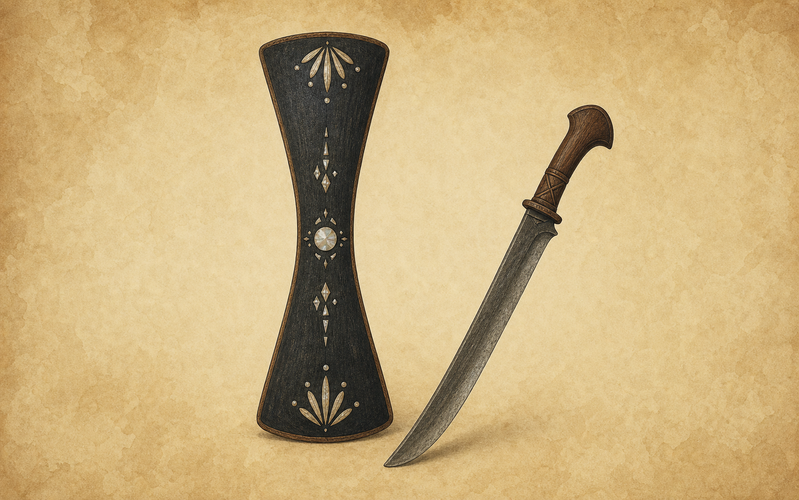
The Maluku Islands are often remembered through cloves, nutmeg, maritime trade, and the long contest for control of eastern Indonesian seas. Yet their material culture also preserves a distinct language of martial objects. Among the most recognizable are the salawaku, a narrow wooden shield, and the parang, a cutting blade or machete-like sword. Together they form an image of readiness that appears in stories, public monuments, and Cakalele dance.
For a museum visitor, the pair is valuable because it joins object design with movement. The salawaku is not a broad wall of defense. It is slim, waisted, and mobile. The parang is not only a tool of force. In performance and memory it becomes part of a disciplined posture. Read together, they show how warfare, ceremony, protection, and identity could meet in one regional tradition.
Islands, Trade, and Armed Readiness
Maluku's position between Sulawesi, New Guinea, the Banda Sea, and the wider spice routes gave the islands a long history of contact. Local polities, coastal communities, traders, and later European companies all moved through a maritime world where alliance and conflict were never far apart. Weapons in this setting belonged to practical defense, but also to public signs of authority and courage.
The salawaku and parang should be understood within that island geography. Communities were connected by sea, and defense often depended on mobility, local knowledge, and collective action. A shield that could be moved quickly and a blade suited to close encounter made sense in such a world. Their later appearance in dance and emblematic display suggests that the memory of armed readiness outlived many of its original military settings.
The Shape of the Salawaku
The salawaku is usually described as a long, hourglass-shaped shield carved from wood. Its upper and lower sections are broader, while the middle narrows around the hand. Many examples are darkened on the front and decorated with shell, mother-of-pearl, ceramic fragments, or painted motifs. The back often includes a raised central rib that also forms the handle.
This construction matters because the shield is read through the body. The narrow center allows quick movement, while the long vertical form covers the bearer in a different way from a round shield. Some interpretations connect the shield's parts to bodily imagery, with upper and lower zones, a spine-like rib, and eye-like inlays. Such readings should be presented carefully, because meanings varied by community and source, but they remind us that the shield was not merely a plank of wood.
Parang and the Paired Weapon System
The word parang is widely used in Indonesia for large knives, machetes, and sword-like cutting blades. In Maluku, the paired expression parang salawaku has become especially strong. It evokes a warrior carrying the shield in one hand and the blade in the other, balancing defense and attack. This pairing is familiar from Cakalele performance, where the visual rhythm of shield and blade helps define the dance.
The exact form of the parang could vary. Museum interpretation should avoid presenting a single standardized blade as the only Moluccan type. What matters here is the relationship between objects. The shield protected, caught, or deflected; the blade answered. In performance, this relationship becomes visible as stance, step, turn, and gesture. The pair is therefore both equipment and choreography.
Cakalele and Martial Performance
Cakalele is commonly described as a war dance from Maluku and neighboring eastern Indonesian contexts. In many descriptions, male dancers carry a salawaku in the left hand and a parang, spear, or similar weapon in the right. Drums, gongs, and wind instruments give the performance its force. The result is not a simple reenactment of combat, but a public transformation of martial memory into rhythm and display.
This is important for museums because objects that appear in dance are still active cultural forms. A salawaku in a case may seem silent, but in performance it flashes, turns, hides, and reveals the body. The parang is lifted, angled, and restrained. The dance teaches viewers that martial heritage can be remembered without reproducing violence. It frames courage as something disciplined by music, costume, community, and inherited protocol.
Protection, Ancestry, and Symbol
The term salawaku is often associated with protection or repelling danger. That meaning can be physical, but many interpretations also point toward ancestral protection. Decorative inlays and dark surfaces should therefore be read as more than ornament, while still avoiding claims that every mark has one fixed meaning. In island societies with rich local traditions, symbols can shift between villages, lineages, and performance settings.
The shield's decoration may refer to the body, ancestors, courage, or social memory. Its materials may also point to contact: shell and ceramic fragments belong to a maritime world of exchange as well as local craft. A museum label can help visitors see both dimensions. The salawaku protected a person, but it also helped place that person within a world of ancestors, islands, and remembered conflict.
From Warfare to Heritage
The historical conditions that once made such weapons necessary changed through colonial rule, missionization, Indonesian state formation, and modern public culture. Objects once connected to defense or raiding could become heirlooms, stage equipment, emblems of regional pride, or collection pieces. This movement does not make them less important. It gives them a longer biography.
Today, parang salawaku imagery appears in cultural festivals, dance groups, local identity, and public representations of Maluku. It can symbolize courage without calling for violence. It can recall older forms of resistance, but also the shared performance of belonging. Museums should make this transition visible, because visitors often meet the objects after they have already passed through many lives.
Reading the Objects in a Museum
A careful museum reading begins with material evidence. What wood was used? Is the front painted, smoked, or polished? Are the inlays shell, ceramic, or later replacements? Does the handle show wear? Is the associated parang a local blade with known provenance, or a later pairing made for display? These questions help separate documented history from attractive assumption.
The second step is context. A salawaku from Seram, Buru, Halmahera, or Ambon may not carry exactly the same local meaning. A dance shield may differ from a shield associated with older conflict. A tourist object may preserve a recognizable form while changing materials and use. Interpretation should therefore be layered: visible form, known provenance, possible symbolic meaning, and present heritage role.
Conclusion
The Moluccan salawaku and parang show how martial objects can carry more than military function. Their power lies in the relationship between protection and movement, wood and blade, ancestral memory and public performance. The shield narrows at the hand as if made for motion, while the parang completes the image of a body prepared to defend and respond.
For museums, the pair offers a compact lesson in eastern Indonesian material culture. These are weapons, but they are also signs of identity, choreography, protection, and memory. When interpreted with care, the salawaku and parang help visitors see Maluku not only as a spice region of global history, but as a living cultural landscape where objects continue to move between past and present.