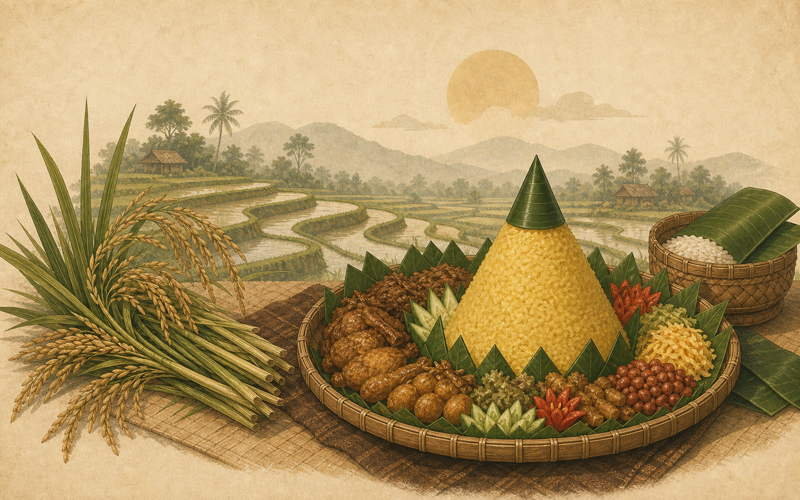
Rice is one of the most familiar foods in Indonesia, yet familiarity can hide its cultural depth. A bowl of steamed rice may appear ordinary, but it belongs to a long history of farming, cooking, offering, sharing, and naming. Across the archipelago, rice has helped shape landscapes, household routines, feast days, ritual obligations, and ideas of regional belonging.
For museums, rice offers a way to connect everyday material culture with larger questions of identity. Rice barns, woven trays, irrigation channels, cooking pots, harvest tools, and ceremonial dishes are not isolated objects. They point toward communities that have used rice to organize labor, express gratitude, mark social transitions, and remember the particular character of a place.
Rice as Staple and Cultural Marker
Rice is widely recognized as a principal staple across much of Indonesia. Britannica places Indonesia among the major rice-growing countries of Asia, while Indonesian cultural writing often treats rice as central to ordinary meals as well as to festive dishes. In daily language, a meal may feel incomplete without rice, even when vegetables, fish, meat, or sambal are present.
Yet rice is never merely a neutral calorie source. It can signal hospitality, prosperity, ritual readiness, or care for guests. The same grain may appear as plain white rice at home, yellow rice for celebration, compressed rice cakes for travel or ceremony, or carefully shaped rice for a communal feast. These forms allow communities to turn a shared staple into local expression.
Landscapes of Water, Soil, and Labor
Regional rice traditions begin with geography. Wet-rice cultivation depends on water control, seasonal timing, seed selection, field maintenance, and coordinated labor. In some places, rice grows in irrigated terraces; elsewhere, cultivation may be shaped by rain-fed fields, river plains, upland conditions, or household gardens. Each setting leaves its mark on local knowledge.
This ecological variety matters because identity is often tied to the work of adapting to land and water. Terraced fields, canals, bunds, granaries, and drying yards are cultural landscapes as much as agricultural infrastructure. They show how communities have turned environmental conditions into patterned work, shared memory, and inherited skill.
Bali and the Subak World
Bali provides one of the clearest examples of rice agriculture as a regional identity system. UNESCO describes the Cultural Landscape of Bali Province as a network of rice terraces and water temples shaped by the subak system. Subak is not only a method for distributing water through canals and weirs. It is also a cooperative institution connected to temple life and to the Balinese philosophical principle of Tri Hita Karana, which links relations among the spiritual realm, human communities, and nature.
This system helps explain why a Balinese rice terrace should not be interpreted only as scenery. Its beauty is inseparable from decisions about irrigation, ritual calendars, temple obligations, and collective responsibility. Water moving through a field is also water moving through a social and sacred order. In a museum, maps, farming tools, temple offerings, and photographs of terraces can therefore be read together as evidence of a living landscape.
Java, Celebration, and Shaped Rice
In Java and in many Indonesian public settings, shaped rice has become a powerful language of celebration. Yellow rice, often colored with turmeric and cooked with aromatic ingredients, is associated with joy, dignity, and good fortune. Indonesia Travel notes that yellow rice is often served at occasions such as weddings, birthdays, anniversaries, births, and house ceremonies, and that it may be shaped into the cone-like form known as nasi tumpeng.
Tumpeng is more than a decorative dish. It gathers rice, side dishes, leaves, trays, and social protocol into one ceremonial arrangement. The act of presenting and sharing it can express gratitude and respect, while the surrounding dishes make abundance visible. Although strongly associated with Javanese cultural forms, tumpeng has become familiar across Indonesia, showing how a regional food tradition can become a national symbol without losing its layered local associations.
Sundanese Memory and the Rice Barn
In Sundanese cultural contexts, rice traditions often draw attention to storage, protection, and reverence. The rice barn, or leuit, is not simply a practical structure for keeping grain dry. It can also represent continuity between harvest, household welfare, ancestral memory, and customary discipline. Where rice is treated with ceremonial care, storage becomes part of the moral life of the community.
Sundanese traditions associated with Nyi Pohaci or Dewi Sri show how rice may be imagined as a living gift rather than an inert commodity. Museum interpretation should be careful here, because practices differ among communities and change over time. Still, the broader pattern is clear: rice is handled through rules, gestures, and stories that protect both food security and cultural identity.
Rice Foods as Regional Speech
Rice also speaks through cuisine. Across Indonesia, different rice preparations carry local signatures: turmeric-colored nasi kuning, coconut-rich nasi uduk, compressed ketupat or lontong, grilled or wrapped rice parcels, and many forms of rice served with regional fish, vegetables, spices, and sambal. These foods are not just recipes; they are edible maps of trade, ecology, religion, and taste.
The same ingredient can therefore create many identities. A rice dish in North Sulawesi, Bali, Java, Sumatra, or Kalimantan may share the basic grain but differ in seasoning, side dishes, ritual context, and social meaning. This variety is central to Indonesia's cultural history. Unity is not produced by sameness, but by the repeated transformation of a common staple into local forms.
Change, Memory, and Museum Interpretation
Rice traditions continue to change. Urban life, tourism, land conversion, modern kitchens, market supply chains, and changing religious practice all influence how people grow, cook, display, and remember rice. Some ceremonial forms remain active in village settings; others appear in restaurants, public festivals, family events, or cultural performances. Continuity often survives through adaptation.
Museums can present this change without treating tradition as loss. A modern tumpeng at an office anniversary, a photographed terrace in Bali, a household rice cooker, and an older wooden granary can all belong to the same story if interpreted carefully. Each reveals how rice moves between field and table, sacred and ordinary, local pride and national recognition.
Conclusion
Regional rice traditions in Indonesia show that a staple food can become a language of place. Rice connects water systems, harvest labor, household care, ceremonial presentation, and regional taste. It helps people remember where they come from and how their communities relate to land, season, and one another.
For museum audiences, rice is therefore an ideal subject for interpretation. It begins with the ordinary and opens into the historical. Through rice, visitors can understand how Indonesian local identities are made not only in courts, monuments, or written texts, but also in fields, kitchens, barns, trays, offerings, and shared meals.