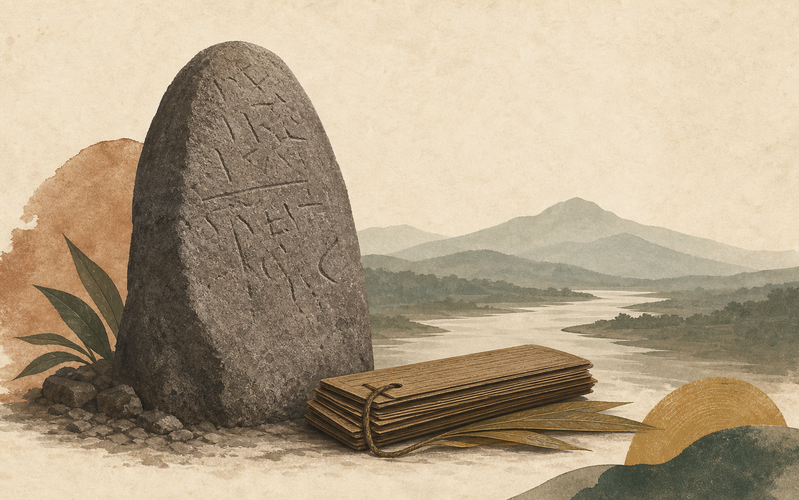
The names Sunda and Galuh carry more than the outline of former kingdoms. In West Java, they also evoke courts, inscriptions, manuscript memory, sacred landscapes, and later stories about ideal kingship. For a museum, this layered inheritance is both valuable and delicate. It allows objects and texts to speak about political history, but it also asks curators to separate firm evidence from beloved remembrance.
The difficulty is not a weakness of the subject. It is precisely what makes Sunda and Galuh important. Their history survives through stone, palm-leaf manuscripts, place names, scholarly reconstruction, and living cultural references. A museum-style reading should therefore treat these kingdoms as historical realities whose memory continued to grow long after their courts changed, moved, or disappeared.
Kingdoms in a West Javanese Landscape
Sunda and Galuh belonged to the historical world of western Java, a region shaped by mountains, river valleys, inland courts, and routes toward the north coast and the Sunda Strait. The political geography was not fixed in the way a modern map suggests. Capitals, alliances, and centers of prestige could shift, while later memory often gathered several places into one broader Sundanese past.
Galuh is especially associated with the eastern part of the Sundanese cultural region, while Pakuan Pajajaran in the Bogor area became strongly linked with the later Sunda kingdom. Museum interpretation should avoid making that landscape too simple. The historical sources point to a political world in motion, where dynastic claims, court locations, and regional identities changed across centuries.
This moving geography matters because memory often attaches itself to place. A stone inscription, an old capital site, or a name preserved in local tradition can make a vanished court feel present. Visitors encountering the history of Sunda and Galuh are not only studying rulers and dates. They are seeing how West Java turned landscape into historical evidence and cultural belonging.
Inscriptions as Anchors of Memory
Inscriptions are among the most important anchors for this history because they tie memory to material evidence. The Batutulis inscription in Bogor is central because scholarship treats it as a major remain from the Sunda kingdom when its capital was at Pakuan Pajajaran. It is not simply a stone with writing. It is a historical object that connects royal commemoration, place, and political memory.
The AMERTA study of Batutulis emphasizes why such evidence must be read carefully. Older readings and transliterations left uncertainties, partly because of paleographic problems, and the article presents a renewed reading intended to clarify what the inscription records. That kind of scholarly care is essential for museum work. A damaged or difficult inscription should not be forced to say more than it can support.
For visitors, Batutulis also shows why inscriptions are powerful museum objects. They are durable, local, and public. A manuscript may travel into a library, but an inscribed stone can remain tied to a remembered landscape. It helps explain why Pakuan Pajajaran and the Bogor area continue to occupy such a strong position in the historical imagination of West Java.
Manuscripts and Old Sundanese Learning
Manuscripts give a different kind of evidence. They do not function like inscriptions fixed in stone, but they preserve language, instruction, genealogy, moral thought, and historical imagination. UNESCO describes the Sang Hyang Siksa Kandang Karesian manuscript as a sixteenth-century Sundanese manuscript kept in the National Library of Indonesia, written in Old Sundanese language and script on gebang leaf.
That manuscript is not a political chronicle in the narrow sense, yet it matters for understanding the cultural world around late Sundanese courts. UNESCO notes that it contains guidelines and moral teachings reflecting customary law in the sixteenth century, while also shedding light on wider political and trade relations. Such details help museums explain that a kingdom was not only a palace or a battlefield. It was also a learned world of conduct, language, and social ideals.
Other Old Sundanese textual traditions, including chronicle-like materials discussed by scholars, contribute to the memory of rulers in Galuh, Pakuan, and Pajajaran. These texts should be handled with care because manuscript traditions can blend earlier remembrance, courtly ideology, and later copying. Their value lies not only in factual extraction, but in showing how West Javanese society organized the past into meaningful stories.
Sri Baduga, Siliwangi, and the Ideal King
Few names demonstrate the complexity of history and memory more clearly than Prabu Siliwangi. In contemporary West Javanese culture, Siliwangi is deeply associated with Sundanese identity, public naming, and the idea of an exemplary ruler. Yet scholarship warns that the name cannot be treated as a simple label found unchanged in every early source.
The Paramita article on Prabu Siliwangi argues that the figure stands between history and myth. It notes that the character is remembered emotionally in Tatar Sunda and that various opinions exist about identification. The article points especially toward Sri Baduga Maharaja, who ruled the Sunda kingdom from Pakuan Pajajaran in the late fifteenth and early sixteenth centuries, as a major historical figure behind this remembered name.
This distinction is valuable in a museum setting. To say that Siliwangi is partly legendary does not dismiss the figure. Rather, it explains how historical memory works. A remembered king can preserve ideals of justice, prosperity, bravery, and cultural pride even when the exact relationship between name, title, and person remains debated. Museums can honor the memory while showing visitors how historians evaluate evidence.
Galuh in Shared Sundanese Memory
Galuh occupies a special place because it links the eastern Sundanese region to the broader story of Sunda. In some historical narratives, Galuh appears as an early or related center of authority; in later memory, it helps widen the geography of Sundanese kingship beyond Pakuan Pajajaran alone. The result is a historical imagination with more than one center.
This matters because West Javanese identity was never built from a single city only. Rivers, highlands, old court sites, and regional traditions all contributed to how people remembered power. Galuh allowed the eastern landscape to remain present in the story, while Sunda and Pajajaran gave later memory a western courtly focus. The relationship between these names is therefore both historical and symbolic.
For museums, Galuh is a reminder to resist tidy timelines that reduce everything to one capital after another. The better approach is to show a network of remembered places. Visitors can then understand why the same cultural memory may include Galuh, Pakuan, Pajajaran, Sri Baduga, and Siliwangi without collapsing them into a single, unchanging entity.
From Court History to Cultural Heritage
The afterlife of Sunda and Galuh is visible in public names, regional pride, school lessons, local heritage sites, and cultural performances. This afterlife is not merely decorative. It is how historical kingdoms become part of social identity. People remember them because they offer a language for belonging, dignity, and continuity in West Java.
At the same time, heritage memory can blur distinctions. A popular story may join separate periods, treat titles as personal names, or turn political defeat into moral triumph. Museums have a responsibility to make these transformations visible. They should not flatten oral tradition into literal chronology, but neither should they strip memory of meaning.
A strong exhibition would therefore place different kinds of evidence beside one another. Inscriptions could show royal commemoration. Manuscripts could show Old Sundanese language and ethical thought. Maps could trace remembered landscapes. Contemporary references to Siliwangi could show how historical memory continues to shape identity. Together, these materials would let visitors see both the past and its continuing life.
Conclusion
Sunda and Galuh survive because West Javanese history was preserved in more than one medium. Stone inscriptions, manuscripts, scholarly debates, place memory, and legendary names all contribute to the way these kingdoms are known today. Each source has limits, but each also carries part of the story.
For museums, the task is not to choose between history and memory as if only one mattered. The better task is to show how they interact. Sunda and Galuh were real historical polities, and their remembrance has become a real cultural force. Read carefully, their legacy reveals how West Java continues to make meaning from its royal past.
The Sundanese kujang offers an object-focused comparison of textual evidence, Pajajaran memory, and modern regional symbolism.