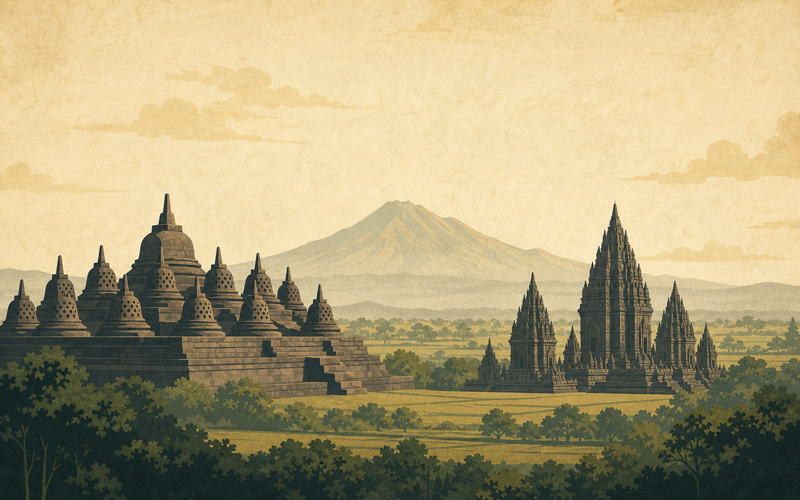
Central Java is one of the great historical landscapes of Southeast Asia. Between volcanic mountains, river valleys, and fertile agricultural plains, early Javanese rulers and communities created monuments that still shape how Indonesia remembers the deep past. The Mataram Kingdom, understood here as the early Hindu-Buddhist courtly world of Central Java, did not leave a single capital that can be read like a modern city plan. Its legacy is distributed across stone temples, inscriptions, roads, fields, water systems, and sacred horizons.
For a museum visitor, this matters because Mataram history is not only a list of dynasties. It is a way of seeing landscape as cultural evidence. Borobudur, Prambanan, smaller temples, and the plains around them show how religious imagination, royal authority, craft labor, and local ecology became inseparable.
A Kingdom Read Through Landscape
The early Mataram world is usually associated with Central Java from roughly the eighth to tenth centuries. Evidence is uneven, and historians debate details of political succession, dynastic names, and court locations. What is clearer is that Central Java supported a highly organized society capable of mobilizing labor, sponsoring religious specialists, commissioning inscriptions, and building some of the most ambitious monuments in island Southeast Asia.
Unlike later states whose palaces are better documented, early Mataram is often approached through its sacred architecture. Temples help reveal political ambition, but they also point beyond the palace. They required quarrying, transport, design, ritual knowledge, agricultural surplus, and skilled communities of builders and sculptors. A stone monument therefore records a social landscape as much as a royal decision.
The geography of Central Java helps explain the density of sacred sites. Volcanic soils made intensive agriculture possible, while mountains supplied dramatic horizons and religious associations. Rivers and plains connected settlements, fields, and temple compounds. The kingdom's sacred geography was made from these natural features, but also from the work of people who selected, shaped, and interpreted them.
Borobudur and Buddhist Sacred Movement
Borobudur is the best-known monument linked to this Central Javanese world. Built in the eighth and ninth centuries, it is a vast Buddhist monument near Magelang, arranged as a stepped structure that guides movement upward through terraces, reliefs, and stupas. UNESCO describes the Borobudur Temple Compounds as an exceptional expression of Buddhist ideas joined with local traditions of sacred place.
The monument's design matters because it is not simply a building to be viewed from outside. It invites circumambulation, slow ascent, and repeated looking. Relief panels, Buddha images, square terraces, circular platforms, and the central stupa create a disciplined journey through stone. In museum terms, Borobudur can be understood as architecture, scripture, sculpture, and ritual path at once.
Its setting is equally important. Borobudur stands within a landscape of hills, rivers, and other temple sites, including Mendut and Pawon. Scholars have discussed relationships among these monuments, though not every proposed alignment or ritual sequence can be proven with certainty. What can be said carefully is that Borobudur belonged to a wider sacred environment, not to an isolated hilltop alone.
Prambanan and Hindu Royal Cosmology
Prambanan, located east of Yogyakarta, presents a different but related expression of Central Javanese sacred power. The main compound is dedicated to Shiva and is the largest Hindu temple complex in Indonesia. UNESCO dates the compound to the tenth century and emphasizes its importance as a major example of Hindu religious architecture in Java.
The vertical forms of Prambanan, especially the towering central temples, communicate a different visual language from Borobudur's broad terraced mass. Yet both monuments use architecture to organize sacred movement and cosmic order. Prambanan's temple layout, sculptural programs, and shrine hierarchy turn stone into a religious map, giving physical form to divine presence and royal devotion.
The coexistence of Buddhist and Hindu monumental traditions in Central Java should not be simplified into a story of easy harmony or constant conflict. The evidence suggests a courtly culture in which different religious communities could receive patronage at different times. Mataram's sacred landscape was plural, but that plurality was shaped by power, prestige, and competition as well as devotion.
Labor, Water, and Agricultural Wealth
Sacred landscapes are often remembered through their most visible monuments, but those monuments depended on less visible systems. Temple building required agricultural surplus. Central Java's volcanic plains could support wet-rice cultivation, and rice agriculture depended on water management, seasonal knowledge, and organized labor. Without farmers, canals, paths, and village communities, royal religious architecture would have been impossible.
This background keeps the monuments from becoming detached masterpieces. A temple was also a claim on resources. It could receive land grants, ritual obligations, and offerings. Inscriptions from early Java often record gifts, boundaries, privileges, and religious foundations, showing that sacred institutions were embedded in economic and legal life.
Museums can make this point by displaying architectural fragments beside maps, farming tools, inscriptions, and environmental interpretation. The sacred landscape was not created only by priests and rulers. It was sustained by cultivators, artisans, transport workers, stone carvers, and communities whose names often remain unknown.
Mountains, Ancestors, and Local Meaning
Central Java's monuments drew on Indian religious vocabularies, including Buddhist and Hindu cosmological ideas, but they were not foreign objects dropped unchanged into Java. Local ideas of mountain sanctity, ancestor reverence, and powerful places helped shape how imported forms were understood. UNESCO's interpretation of Borobudur notes the blending of Buddhist concepts with indigenous ancestor worship, a reminder that religious translation was creative.
Mountains in Java were more than scenery. Volcanoes and highlands marked the horizon, shaped agriculture, and offered a language of height, fertility, danger, and spiritual force. Monumental architecture could echo this mountain symbolism, turning built form into a sacred ascent. At Borobudur, the climb through terraces creates a bodily experience of elevation; at Prambanan, soaring temple towers draw the eye upward.
This local grounding is essential. Mataram's sacred landscapes were neither purely Indian nor purely local in a narrow sense. They were Javanese creations made through encounter, adaptation, and selection. Their power came from joining Asian religious ideas with the specific terrain and social life of Central Java.
From Courtly Memory to Indonesian Heritage
The political center of Java shifted over time, and by the tenth century major courtly attention moved away from Central Java toward eastern Java. Scholars continue to debate the reasons, including political change, environmental pressures, and volcanic activity. Whatever the combination of causes, the temples remained as durable anchors of memory even when royal power moved elsewhere.
Modern heritage work has given these landscapes new public meanings. Borobudur and Prambanan are now UNESCO World Heritage sites, national symbols, pilgrimage destinations, research fields, and places of tourism. Their preservation involves archaeology, conservation science, local communities, government institutions, and debates about access, ritual use, and visitor impact.
For Indonesia today, the early Mataram world offers a powerful lesson in cultural depth. It shows that the archipelago was never culturally isolated. Central Java participated in Asian religious and artistic networks while producing forms that were unmistakably local. The sacred landscape is therefore both Indonesian and international, rooted and connected.
Conclusion
The Mataram Kingdom is best understood not only through rulers, dates, or dynastic labels, but through the landscapes it helped make sacred. Borobudur, Prambanan, and the wider temple fields of Central Java reveal a society that turned stone, water, agriculture, mountain horizons, and religious knowledge into enduring cultural form.
To walk these sites today is to encounter more than monuments. It is to read a landscape shaped by devotion, labor, power, and imagination. Central Java's sacred places remind us that heritage lives where human meaning and the physical world meet.