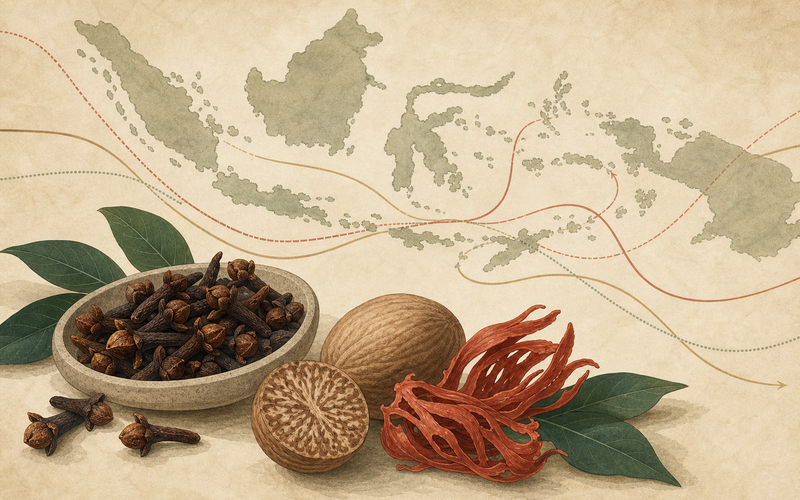
The history of Indonesian spices is often introduced through European voyages, but the routes themselves are older than that familiar frame. Long before Portuguese, Spanish, Dutch, or English ships competed for cloves and nutmeg, island communities in eastern Indonesia were already connected to wider maritime exchange. Spices moved because people knew where trees grew, when harvests were ready, which ports could gather goods, and how monsoon winds shaped travel across seas.
For museums, this earlier history matters because it changes the center of the story. Indonesian spice routes were not empty lines on a map waiting to be discovered. They were social routes made from local cultivation, seafaring skill, political negotiation, and port life. To follow them before European colonialism is to see the archipelago as an active maritime world with its own knowledge, ambitions, and long-distance connections.
Spices Rooted in Island Landscapes
The most famous Indonesian spices of the precolonial trade were not spread evenly across the archipelago. Cloves were historically associated with the northern Moluccas, including islands around Ternate and Tidore. Nutmeg and mace were linked especially with the Banda Islands. This geography is essential because the value of these spices came partly from their limited natural range. They were local plants before they became global commodities.
Cultivation and collection depended on knowledge held close to place. Harvesters needed to recognize the right stage for clove buds, while nutmeg required attention to the fruit, seed, and red aril known as mace. Drying, sorting, storing, and carrying spices also required care because their value depended on quality. A museum display can therefore interpret spice history through tools, baskets, drying spaces, port weights, or botanical specimens, not only through maps of foreign voyages.
Routes Through the Eastern Archipelago
Before spices crossed the Indian Ocean, they first had to move through Indonesian waters. Boats carried goods from Maluku toward regional collecting points, passing through chains of islands that linked eastern Indonesia with Sulawesi, Java, Bali, and the western archipelago. These routes were not a single highway. They were flexible pathways shaped by season, safety, political ties, and the availability of cargo.
Ports mattered because they gathered products from many smaller places. A clove harvest from one island might pass through several hands before reaching a larger market. Local rulers, sailors, and brokers all influenced access. In this sense, the spice route was not only a commercial system but also a political landscape. Control over harbors, alliances, and tribute could matter as much as control over the plants themselves.
Asian Networks Before European Arrival
Indonesian spices entered older Asian trade networks that connected Southeast Asia with China, India, Sri Lanka, Arabia, and the eastern Mediterranean. UNESCO describes spice routes as a maritime part of the broader Silk Roads, while Britannica notes that Arab and Chinese traders were active in spice-producing regions before European oceanic expansion. These connections carried goods, but also words, religious ideas, technologies, ceramics, textiles, and habits of taste.
This wider network helps explain why the spice trade cannot be reduced to a simple movement from Indonesia to Europe. Many consumers and merchants were Asian. Spices were used in medicine, food, ritual, perfumery, and elite display across several regions. Ports in the Indonesian archipelago participated in this circulation by exchanging spices for cloth, metal goods, ceramics, beads, and other imports that then entered local economies and status systems.
Harbor Kingdoms and Coastal Power
Trade routes encouraged the growth of coastal and island polities. In Maluku, Ternate and Tidore became important centers partly because of their relationship to clove-producing areas and maritime exchange. Farther west, ports along Java, Sumatra, and the Malay Peninsula served as intermediaries linking eastern products with international markets. These places were not merely stopping points. They were centers where diplomacy, taxation, religious life, and cultural exchange took shape.
The emergence of Islamic harbor kingdoms in parts of the archipelago also belonged to this world of trade. Muslim merchants, scholars, and travelers moved along commercial routes, and local rulers in several ports adopted Islam in ways connected to regional politics and exchange. This process varied from place to place and should not be simplified into one cause. Still, the relationship between maritime commerce and religious change is an important part of the precolonial spice-route story.
Monsoon Knowledge and Maritime Skill
Spice routes depended on environmental knowledge. Sailors paid attention to monsoon winds, currents, reefs, safe anchorages, and seasonal timing. The journey from Maluku to western markets was not only a matter of distance but of reading the sea correctly. This knowledge was practical, inherited, and constantly tested by experience. It made maritime exchange possible long before European navigational ambitions entered the region.
The human skill behind these routes is easy to lose when history is shown only through imported maps. A museum approach can restore that skill by foregrounding boats, navigation, port architecture, and oral memory of seafaring communities. Indonesian sailors and regional traders were not background figures in a European drama. They were among the people who made the spice trade work.
Goods, Meanings, and Museum Evidence
Spices were small, portable, and valuable, but their history can be traced through many kinds of objects. Imported ceramics in Indonesian sites, foreign coins, weights, ship remains, manuscripts, and place names all help show how trade connected communities. Cloth is especially important because textiles often moved in the opposite direction from spices, becoming gifts, payments, or markers of status in local societies.
These exchanges also produced cultural meanings. Spices could represent wealth, connection, and political access. Imported goods could become heirlooms, ritual objects, or signs of prestige. A clove or nutmeg seed in a display case may look modest, yet it points toward a much larger world of labor, movement, desire, and negotiation. The challenge for museums is to make that invisible network visible without turning it into a romantic legend.
Re-centering the Precolonial Story
European colonialism changed the spice trade through conquest, monopoly, violence, and forced control over production. That later history must be told honestly. Yet beginning the story with Europeans can unintentionally erase the people who built and sustained the earlier routes. Precolonial Indonesian spice trade was already complex, international, and politically meaningful.
Re-centering the story means paying attention to Malukan growers, island sailors, harbor rulers, brokers, and consumers across Asia. It also means recognizing that the archipelago was not isolated before colonialism. Indonesian communities were part of a connected maritime world in which local knowledge and global movement met. This perspective gives visitors a fuller and more respectful understanding of spice history.
Conclusion
Indonesian spice trade routes before European colonialism were shaped by island ecologies, maritime expertise, port politics, and Asian commercial networks. Cloves, nutmeg, and mace traveled far, but their journeys began in specific Indonesian landscapes and communities. Their movement across seas was made possible by people who understood plants, winds, harbors, and relationships.
For museum interpretation, this history offers a useful correction. The spice trade was not born when Europeans arrived. It was an older archipelagic and Asian system that European powers later tried to control. By starting with Indonesian routes and communities, museums can tell a more accurate story of exchange, power, and cultural heritage.