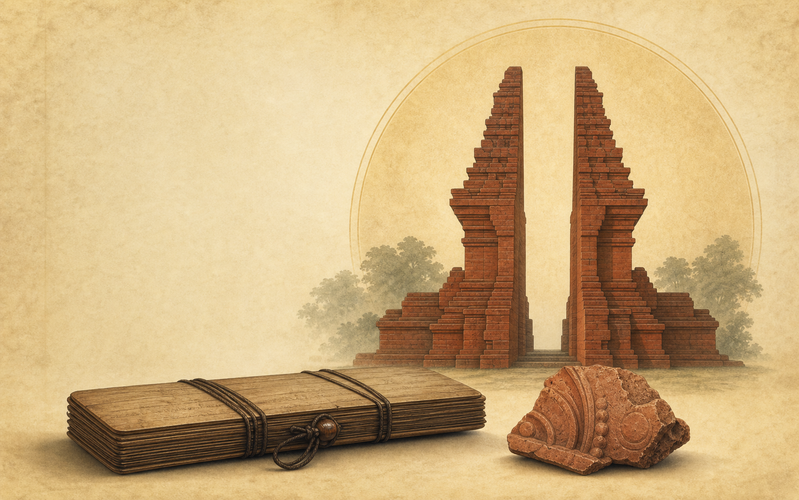
The Nagarakretagama is often the first doorway into the world of Majapahit. Composed in 1365 in Old Javanese, the poem praises King Hayam Wuruk and describes royal journeys, sacred geography, and the moral order imagined around the court. It is precious because few sources offer such a close fourteenth-century view of a Javanese kingdom at the height of its prestige.
Yet court culture cannot be reduced to one poem, however important. Majapahit also survives through red-brick remains, temple sites, terracotta figures, metal objects, inscriptions, later manuscripts, and inherited ideas about etiquette and rank. A museum approach asks how these traces speak together. The result is a fuller, more careful picture of a court where political authority was made visible through ritual, movement, objects, and controlled access to sacred power.
A Poem and Its Limits
The Nagarakretagama, also known as Desawarnana or "Description of the Country," is not a neutral government report. It is a courtly work shaped by praise, religious imagination, and literary discipline. Its author, Prapanca, presents the king as the center of an ordered world, and the poem's descriptions of journeys and ceremonies help readers understand how Majapahit wanted royal authority to be seen.
That does not make the poem unreliable in a simple sense. It gives valuable information about places, officials, religious foundations, and the ideals of rule. The caution is different: it should be read as a crafted act of representation. Like a temple relief or a royal portrait, it tells us both about historical life and about the forms through which power wished to appear.
The Court as Ritual Landscape
Majapahit court culture was not confined to a palace building. It extended across spaces of procession, worship, residence, and administration. Sites associated with Trowulan in East Java, often discussed as the region of the Majapahit capital, suggest a landscape of gateways, bathing places, canals, brick structures, and religious compounds. Even when the exact function of a structure remains debated, the overall impression is of an environment arranged for movement and hierarchy.
In such a landscape, rank could be expressed physically. Who approached, where they waited, what route they followed, and which thresholds they crossed all mattered. The court was therefore not merely a place where decisions were made. It was a stage where social order was rehearsed and made visible through ceremony.
Royal Journeys and Public Authority
One of the strongest images preserved in the Nagarakretagama is the king in motion. Royal travel was not casual sightseeing. It allowed the ruler to visit religious foundations, encounter regional elites, receive homage, and confirm relationships across the realm. The journey transformed geography into political theater.
This mattered because Majapahit authority was probably not centralized in the way a modern state is centralized. Influence depended on kinship ties, prestige, religious patronage, tribute, and the presence of royal representatives. A royal progress could remind communities that the court was distant yet present, sacred yet administrative, idealized yet involved in practical obligations.
Objects of Refinement and Rank
Museum objects help bring court culture down from the level of poetry into material life. Majapahit-period and Majapahit-related collections include terracotta heads, figurines, architectural ornaments, bronze vessels, gold ornaments, beads, and ritual objects. Removed from their original settings, these objects may seem small, but together they suggest a world attentive to display, touch, dress, and ceremonial use.
Terracotta is especially important because it connects elite and urban life with local craft. Figures from East Java can reveal hairstyles, ornaments, gestures, and ideals of beauty or status. Metal objects and jewelry point to wealth, ritual offering, and bodily presentation. Such materials remind visitors that court culture was experienced not only in texts but also through surfaces, textures, and the disciplined use of things.
Religion, Kingship, and Ancestors
Religion stood near the center of Majapahit political culture. Hindu-Buddhist forms shaped royal legitimacy, temple patronage, and commemorative practice. Rulers and royal relatives could be linked with divine imagery after death, while temples and sacred sites helped place dynastic memory within a wider cosmic order.
This does not mean that the court was purely theological. Religion, politics, and art worked together. A sanctuary could honor the dead, support ritual specialists, express dynastic rank, and anchor royal claims to a landscape. The court's sacred language gave political relationships a deeper frame, while political patronage gave religious institutions protection and visibility.
Etiquette, Administration, and Social Memory
Court culture also depended on conduct. Titles, dress, controlled speech, gift exchange, and bodily discipline were ways of making hierarchy legible. These details are harder to reconstruct than monuments, but they are essential. A court exists through repeated behavior as much as through buildings.
Majapahit's later memory in Java and Bali suggests that the prestige of refined conduct outlived the empire itself. Later courts did not simply preserve Majapahit unchanged, but they could remember it as a source of classical authority. This afterlife is part of the historical story. It shows how court culture can survive as an ideal, a vocabulary, and a standard of elegance even after political structures change.
Reading the Evidence Together
The most responsible way to present Majapahit court culture is to avoid choosing between text and object. The Nagarakretagama gives voice to courtly ideals. Archaeological sites reveal built environments and urban planning. Museum collections show craft, ornament, and ritual equipment. Inscriptions and later manuscripts add administrative and literary layers.
Each type of evidence has limits. Texts praise, objects travel, sites erode, and later traditions reinterpret. But when placed together, they allow visitors to see Majapahit as a lived courtly world rather than a single famous poem or a single ruined capital. The evidence becomes strongest when its gaps remain visible.
Conclusion
Majapahit court culture beyond the Nagarakretagama was a world of ceremonies, roads, thresholds, objects, ancestors, and disciplined behavior. The poem remains indispensable, but it is one part of a wider archive. Its royal vision becomes richer when read beside brick ruins, terracotta figures, metalwork, inscriptions, and inherited memories of courtly refinement.
For museums, this wider view matters. It turns Majapahit from a distant name into a historical environment where power had to be performed, seen, touched, and remembered. The court was not only written into poetry. It was built into landscapes, carried in objects, and renewed through the long cultural memory of Indonesia.