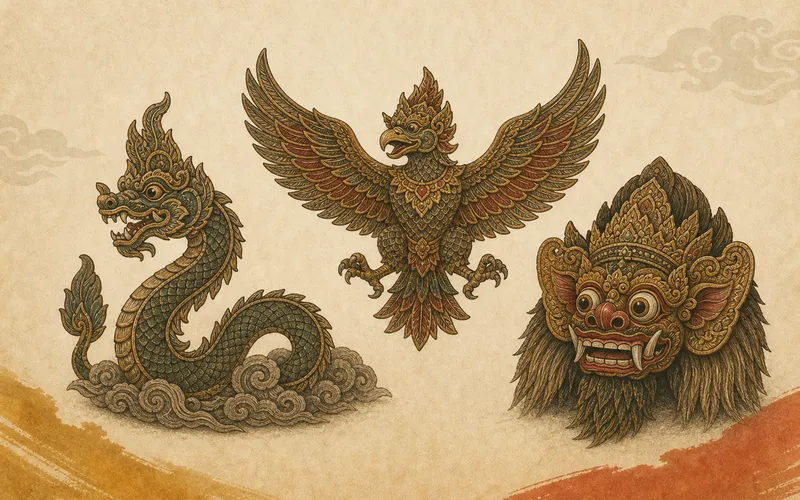
Indonesian mythical beings include Garuda, a birdlike figure associated with Vishnu; naga, serpent beings found in several narrative and artistic traditions; and Barong, known through Balinese performance. They do not form a single national pantheon. Their names, appearances, and roles vary between communities and between stories, ritual practice, and later public symbols.
This overview follows examples from Java and Bali while linking to distinct Batak traditions in North Sumatra. “Mythical creatures” is a convenient visitor category, but it should not turn living religious figures or humanlike spirits into interchangeable fantasy animals.
Mythical Beings as Cultural Language
In folklore, a mythical creature often condenses a large set of ideas into a memorable image. A bird, serpent, mask-like guardian, or hybrid beast can communicate hierarchy, danger, wisdom, or spiritual force more quickly than abstract explanation. Oral traditions depend on that power of compression. When stories are retold across generations, a powerful creature becomes a stable narrative anchor, even as details shift according to region, audience, or performance context. This is one reason such beings remain visible in Indonesian storytelling traditions long after political and religious circumstances change.
For museums, this means mythical creatures should be read as cultural language rather than as isolated curiosities. A carved figure on a doorway or a creature painted in a manuscript is not simply an example of imaginative design. It belongs to a system of signs that once worked in ceremonies, teaching, entertainment, and the marking of sacred or protected space. Interpreting these beings responsibly therefore requires attention to context: who used the image, where it appeared, what story accompanied it, and what social or ritual work it performed.
Garuda and the Idea of Noble Power
Garuda is one of the best-known mythical beings in the Indonesian world. In the wider Hindu tradition, Garuda is a great bird associated with Vishnu, and in Indonesia the figure acquired long-lasting cultural visibility through literature, temple art, and later national symbolism. The importance of Garuda lies not only in its dramatic appearance, but also in what it communicates: elevation, strength, vigilance, and rightful authority. These qualities made the figure especially adaptable across centuries and media.
In museum interpretation, Garuda is a useful example of how a transregional mythic image becomes locally meaningful. The figure appears in art historical contexts connected to Hindu-Buddhist Java and Bali, but it is also familiar in modern Indonesia as a symbol of the state. This continuity does not mean the meaning has remained identical. Rather, the figure has been repeatedly reinterpreted. A museum can therefore show Garuda as both an ancient mythological being and a later civic emblem, demonstrating how folklore-derived imagery can move from sacred narrative into political and public life.
The Met's bronze Krishna on Garuda, attributed to Central Java in the second half of the ninth century, supplies a specific historical example. It formed part of a hanging lamp and depicts a narrative involving Krishna, Garuda, and serpent guardians. The object's date documents this representation, not the first appearance of the entire tradition. Met collection record.
Naga, Water, and the Layered Cosmos
Another important mythical being is the naga, usually represented as a serpent or dragon-like creature. Across South and Southeast Asia, naga figures are often associated with water, the underworld, protection, and sacred potency. In Indonesian settings, naga imagery appears in architecture, narrative traditions, and decorative arts, though local meanings vary. The naga is especially valuable for museum study because it reveals how mythic images can travel across regions while remaining open to local reinterpretation.
The association between serpent beings and water has particular resonance in the archipelago, where rivers, rain, irrigation, and maritime routes shape everyday life. In folklore and visual culture, a powerful serpent can suggest both life-giving abundance and latent danger. That ambiguity is important. Mythical creatures are rarely one-dimensional symbols of good or evil. They often mark thresholds between controlled human space and wider cosmic or natural forces. When curators explain naga imagery, they are not only discussing style; they are also opening a conversation about how communities imagined the structure of the world and the powers that sustain or threaten it.
Protective Creatures in Performance and Sacred Space
Not all Indonesian mythical figures are shared evenly across the archipelago. Some are strongly rooted in particular ritual and artistic traditions. Barong in Bali is a clear example of a protective being known through dance and masked performance. Although outsiders sometimes describe Barong too generally as a monster or mythical animal, that language is too narrow. In Balinese cultural practice, Barong is better understood through the interplay of performance, ritual presence, and ideas of protection. The figure belongs to a living context, not only to folklore in the abstract.
Javanese and Balinese art also includes fierce guardian imagery, including figures such as Kala that appear at gateways and temple thresholds. These beings are significant because they occupy spaces of transition. They guard entrances, mark boundaries, and warn that movement between ordinary and sacred zones requires recognition of unseen force. In oral tradition and visual culture alike, such protective creatures teach that the world is structured by limits. A museum display that isolates a mask or a temple fragment without that spatial meaning risks reducing a guardian figure to style alone.
UNESCO distinguishes sacred, semi-sacred, and entertainment genres in Balinese dance. That distinction matters when discussing Barong: a staged performance and a local ritual setting should not automatically be described as the same event. UNESCO: Balinese dance.
Oral Performance, Storytelling, and Transmission
Mythical creatures persist not just because they were carved in stone or preserved in collections, but because they were continually retold. Wayang traditions are especially important here. In puppet performance, mythological and legendary beings gain voice, gesture, and dramatic function. Stories can teach ethics, entertain audiences, and connect present communities to older narrative worlds. Even when a creature comes from a text or court tradition, performance allows it to circulate more broadly and acquire new local nuances.
This transmission is never perfectly uniform. Storytellers, puppeteers, dancers, and ritual specialists adapt characters to audience needs and local expectations. As a result, Indonesian folklore does not operate like a fixed canonical script. It is a living interpretive practice. Museums increasingly acknowledge this by pairing objects with recordings, performance documentation, and community knowledge. That approach is especially important for mythical beings, whose fullest meaning often emerges in motion, voice, and narrative sequence rather than in static display.
UNESCO's documentation identifies wayang as a transmitted performance tradition. A puppet's role is best understood through its repertoire, performers, and audience, rather than by assigning its shape one permanent moral meaning. UNESCO: wayang puppet theatre.
Sea-Queen Traditions and the Social Life of Belief
Coastal traditions add a useful distinction: a spirit associated with a place is not necessarily an animal-shaped creature. Nyai Roro Kidul is discussed in scholarship as a queen or spirit of Java's southern ocean. Robert Wessing's study of Puger in East Java examines local uses of that tradition, rather than proposing one version for every coastal community. Wessing, “Nyai Roro Kidul in Puger”.
For museum interpretation, this helps separate the existence of a documented belief from proof of the supernatural events it narrates. Accounts of protection, authority, and dangerous waters belong to stories and ritual understandings. Their local social importance can be studied without presenting the story as a verified historical event.
Continue through Performance and Storytelling. Explore Beliefs and Rituals, coastal ritual and offerings, and wayang storytelling. For a different regional example, see the Toba Batak singa; for daily Balinese practice, see offerings and canang sari.