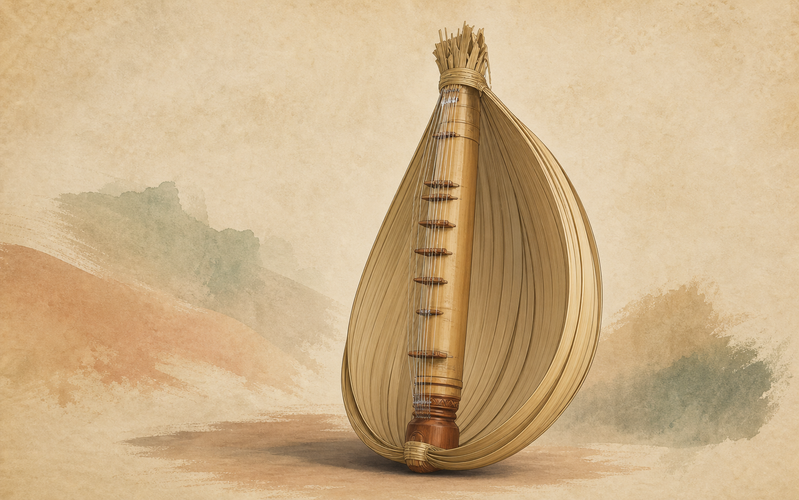
The sasando is one of the most memorable instruments in the Indonesian archipelago because it looks almost like sound made visible. A central bamboo tube carries the strings, while a broad fan of dried lontar palm leaves opens around it as a resonator. The form is practical, elegant, and immediately tied to place: Rote Island, part of East Nusa Tenggara, where lontar palms, dry landscapes, and local music traditions have long shaped everyday cultural memory.
For a museum, the sasando invites visitors to think about music as material culture. It is not only a device for melody, but also a record of plant knowledge, hand skill, regional identity, and changing performance contexts. Its history should be told carefully, because legends, craft lineages, old instruments, and modern stage practice all preserve different kinds of truth.
Rote Island and an Eastern Indonesian Sound
Rote Island lies in the Lesser Sunda region, close to Timor and within the province of East Nusa Tenggara. The sasando, also known in Rotenese forms such as sasandu, is strongly associated with this island world. Its presence in wider Indonesian cultural life helps balance a story of national music that is often dominated by Java, Bali, and Sumatra.
The instrument's regional identity matters because musical traditions are shaped by landscapes. Rote is known for dry conditions and for the importance of the lontar palm in local life. In the sasando, lontar leaves do not merely decorate the object. They form the resonating fan that helps project and color the sound.
This makes the sasando a good example of how local environments become cultural technology. The materials are not accidental. Bamboo, palm leaf, string, and small bridges come together as a musical answer to a particular island setting.
How the Instrument Is Built
The sasando belongs to the broad family of tube zithers. Its core is a bamboo cylinder, around which strings are stretched from one end to the other. Small wedges or bridges lift the strings away from the bamboo surface, allowing each string to vibrate clearly and produce a particular pitch.
Around this central tube sits the most recognizable feature: a folded, fan-like resonator made from dried lontar palm leaves. The resonator is sometimes described as basket-like or shell-like because it wraps the instrument in a curved acoustic chamber. It is both structural and visual, giving the sasando the silhouette by which many Indonesians recognize it immediately.
Older and newer forms may differ in the number of strings, tuning systems, and performance needs. Some modern instruments are adapted for broader repertoire or amplified performance. Those changes should not be treated as a loss by default. They show how musicians keep a local instrument active in changing social worlds.
Playing With Two Hands
The sasando is played from the open side of the lontar resonator. The player's hands reach toward the strings and pluck them with coordinated movement. To an observer, the gesture can suggest a harp, but the construction and playing logic remain rooted in the tube zither form.
Both hands are important. Depending on the instrument and repertoire, one hand may emphasize lower or accompanying tones while the other shapes melody, ornament, or higher notes. The effect is intimate and layered, allowing one musician to suggest several musical roles at once.
This technique also reminds us that an instrument is never complete without embodied knowledge. A museum object can show bamboo, strings, and palm leaves, but performance reveals timing, touch, memory, and listening. The sasando's sound lives in the relationship between maker, player, and material.
Legend, Memory, and Historical Caution
Local traditions often connect the sasando with origin stories, including tales in which a beautiful sound is dreamed, remembered, and then recreated as an instrument. Such stories should not be read as technical histories in the narrow sense. They are better understood as cultural memory: ways of explaining why an instrument feels meaningful and extraordinary.
Museum interpretation can honor these stories without turning them into fixed evidence for dates or individual inventors. Legends often preserve values rather than documents. In the sasando's case, they highlight inspiration, listening, natural materials, and the transformation of experience into craft.
At the same time, surviving instruments and collection records provide another kind of evidence. A late nineteenth-century sasando in a museum collection, for example, tells us that the instrument had entered documented collecting histories by that period. Oral memory and material evidence therefore work together, though they do not always answer the same questions.
From Local Practice to National Heritage
The sasando has become an emblem of East Nusa Tenggara and a recognizable symbol of Indonesian cultural diversity. Indonesia's national intangible heritage listings include Sasandu or Sasando under East Nusa Tenggara performing arts, reflecting official recognition of the tradition's cultural importance.
Such recognition can help preservation by supporting education, documentation, and public pride. It can also create new responsibilities. When an instrument becomes a provincial or national symbol, there is a risk that simplified images replace the complexity of local practice. The fan-shaped silhouette may become famous while the knowledge of tuning, making, repertoire, and language receives less attention.
Good heritage work therefore asks who continues the tradition, who teaches it, and how communities benefit from wider visibility. The sasando should be celebrated not only as a beautiful object, but also as a living practice maintained by players and makers.
Change, Adaptation, and Modern Stages
Like many traditional instruments, the sasando has not remained frozen in one form. Performers have adapted it for new audiences, new tunings, ensemble settings, and amplified sound. Modern versions may be heard in cultural festivals, educational programs, recordings, and public performances far from Rote.
Adaptation sometimes produces debate. Some listeners value older forms for their closeness to remembered local practice, while others welcome technical changes that make the instrument easier to hear on large stages. Both views can be reasonable when they are expressed with respect for the communities involved.
For museums, this is an opportunity to avoid the false choice between "authentic" past and "modern" present. The sasando's survival depends on continuity and invention together. A tradition remains alive because people keep deciding that it matters.
Looking Closely in a Museum
When displayed in a museum, a sasando should be interpreted through both sight and sound. Visitors can examine the bamboo tube, string arrangement, bridges, and lontar resonator, then listen for how those parts shape tone. A silent display risks making the instrument seem only sculptural, while sound alone can hide the intelligence of its construction.
The object also encourages comparison with other Indonesian instruments made from bamboo or used in regional performance traditions. Yet comparison should not blur specificity. The sasando is not simply a generic "Indonesian harp." Its Rotenese association, lontar resonator, and tube-zither construction give it a distinct identity.
Careful display can also connect the instrument to environmental knowledge. Lontar palm, bamboo, hand tools, drying, folding, stringing, and tuning all belong to the story. The sasando is a musical object, but it is also an archive of making.
Conclusion
The sasando carries Rote Island's cultural memory through a form that is at once delicate and confident. Its bamboo body, raised strings, and lontar palm resonator show how local materials can become refined musical technology. Its performances show how knowledge passes through hands, ears, and community settings.
Seen responsibly, the sasando is neither a static relic nor a simple provincial emblem. It is a living Indonesian heritage form: rooted in Rote, recognized nationally, and still open to change. That is why it belongs in a museum story not only as an instrument to admire, but as a tradition to listen to carefully.