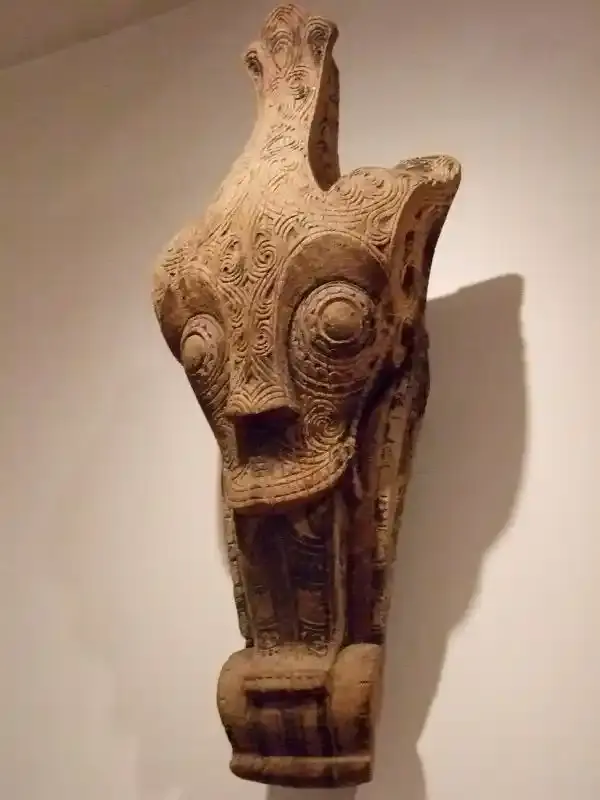
In Indonesian and Malay, singa ordinarily means “lion.” On this museum page it refers to a composite supernatural guardian in Toba Batak art from North Sumatra. It is an apotropaic figure: an image understood as warding off harmful forces. Its form combines features rather than depicting a zoological lion. The Met: Singa architectural ornament.
Meaning and Form in Toba Batak Art
The Met connects the name with the Sanskrit word for lion, while distinguishing the Batak image from that animal. Its collection description notes prominent eyes, a projecting muzzle, and hornlike features. These are guides to recognizing a tradition, not a requirement that every carving look identical. The Met collection record.
The photograph here shows a carved head with prominent round eyes, an open mouth, and tall projections above the forehead. Those visible features can be described directly. The page's available documentation does not establish this particular carving's maker, date, or original building.
Houses, Rice Granaries and Protective Context
Singa heads appear on Toba Batak houses and rice granaries. Their architectural placement matters: they belonged to inhabited and socially meaningful spaces, not only to ornament viewed in isolation. The protective role is a documented cultural interpretation, not a claim that the image has demonstrable supernatural power. The Met: Singa.
A second Met ornament is attributed to a dwelling or rice barn and dated to the late nineteenth or early twentieth century. Its description records a possible attachment hole, showing how physical details can help reconstruct architectural use. That date belongs to the comparative museum object; it does not date the carving pictured here. The Met: Architectural Ornament.
What the Evidence Can Establish
These collection records support a Toba Batak context and a protective interpretation. They do not establish a ninth-century origin for all singa carving or identify every singa as a particular named serpent deity. Broader comparisons with other guardian imagery require their own historical evidence.
Explore Batak Culture and Sumatra. Related objects include the naga morsarang container and tunggal panaluan staff. The broader folklore overview places regional beings alongside storytelling and performance traditions without treating them as a single mythology.