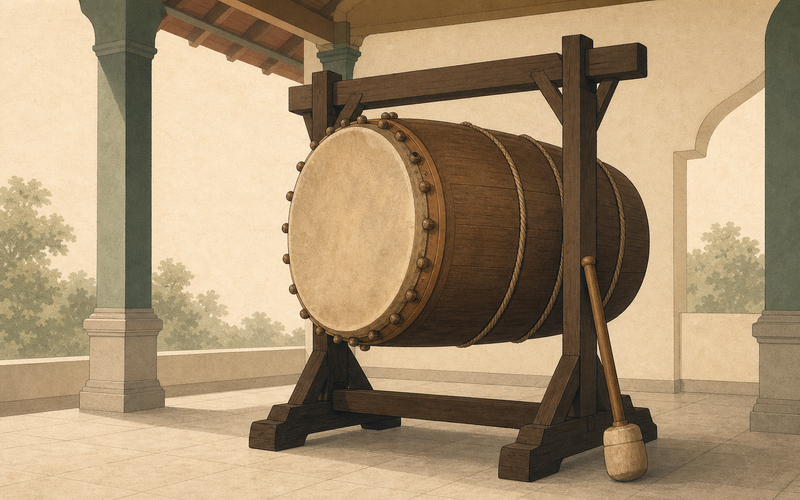
A bedug is immediately recognizable by its scale and voice. The large wooden drum is commonly suspended horizontally on a frame, allowing a player to strike a skin-covered end with a mallet. Its low sound can travel beyond a mosque veranda and into surrounding streets. Before electronic amplification became ordinary, that reach made the bedug a practical instrument for coordinating people across a neighborhood. Yet usefulness alone does not explain why it remains visible and audible in Indonesian Muslim life.
The bedug belongs to a history in which religious observance, local craftsmanship, architecture, and communal listening meet. It has marked prayer time, accompanied Ramadan and Eid observances, and become a prominent object at historic and national mosques. The drum does not have one identical role everywhere in Indonesia, and its early history should not be reduced to a simple origin story. What can be seen more clearly is how communities adapted a familiar acoustic technology to Islamic settings and gave it enduring social meaning.
A Monumental Drum Made to Be Heard
The bedug is a membranophone: sound is produced when a stretched skin vibrates after being struck. A typical example has a substantial hollow wooden body with animal-hide membranes secured at its ends. The drum rests in a supporting frame rather than being carried, and the player uses a beater or mallet. Dimensions, wood, hide, mounting, and decoration vary. These differences matter because a bedug is usually made for a particular architectural and acoustic setting, not as a standardized factory instrument.
Its physical presence is part of its cultural effect. Even when silent, a bedug announces the mosque as a place where sound organizes collective life. The frame raises the instrument for playing and display, while the broad membrane and resonant body turn a single action into a signal heard at a distance. In a museum, the object may look self-contained. In use, however, it forms a system with the player, the covered veranda or tower, the surrounding settlement, and listeners who understand when its sound calls for attention.
Sound as a Form of Timekeeping
Mechanical clocks can divide time precisely, but communal time depends on more than measurement. It must also be communicated. The bedug made a religious schedule public by transforming a known moment into a shared acoustic event. Its sound could reach people who were working, trading, or gathering beyond the mosque compound. In this role, it did not calculate prayer time; it announced that the community had reached a significant point in the day.
The bedug is commonly associated with a signal given before the adhan rather than with replacing the human call to prayer. Local sequences and rhythms vary, so no single pattern should be treated as universal. The essential principle is more stable: repeated strokes create an audible transition from ordinary activity toward worship. This makes the drum a technology of attention. It asks listeners to pause, recognize a collective timetable, and orient themselves toward the mosque.
The Mosque, the Veranda, and the Tower
Placement shapes how a bedug is understood. Many examples are sheltered near a mosque veranda, where they remain accessible to players and protected from weather. Menara Kudus in Central Java offers an especially distinctive arrangement. There, the drum is placed high in the brick tower associated with the mosque complex. Research on the site identifies the bedug as both a marker of prayer time and an important element in an architectural ensemble widely discussed in relation to Javanese cultural adaptation.
Menara Kudus is valuable precisely because it joins sound, object, and building. The bedug is not decoration applied to the tower; its position enables it to communicate over distance. At the same time, the tower gives the instrument a public visual identity. Scholars debate how individual architectural forms at Kudus should be interpreted, and caution is necessary when assigning a single religious origin to them. The safer observation is that the complex demonstrates how an Indonesian mosque could incorporate local building knowledge and acoustic practice into a specifically Islamic place.
Ramadan, Takbiran, and Festive Sound
The bedug becomes especially prominent when religious time expands from a daily rhythm into a festive season. During Ramadan, its sound is widely associated with moments such as the breaking of the fast, although practices differ among communities. On the nights before Eid, groups may play bedug alongside the recitation of the takbir. Here the drum does more than transmit information. Repeated rhythm gathers attention, supports collective participation, and gives the occasion a recognizable soundscape.
Contemporary events at Jakarta's Istiqlal Mosque show that this function is still active at the national level. Istiqlal's official record of Eid al-Adha takbiran in 2026 describes bedug playing accompanying the takbir. Such use should not be mistaken for an unchanged survival from a distant past. Performance settings, amplification, audiences, and institutions have changed. Its continuity lies instead in a durable idea: the bedug can turn religious time into a shared public experience through sound.
Craft, Scale, and the Life of an Object
Making a large bedug requires knowledge of wood, hide, tension, balance, and resonance. The body must be strong enough to support broad membranes, while the frame must hold the finished drum securely and allow it to sound freely. Because organic materials respond to humidity, age, and repeated striking, care is not separate from performance. Maintenance preserves both the object and the clarity of the signal it was built to produce.
The monumental bedug at Istiqlal Mosque illustrates how craftsmanship can become part of an institution's public story. The mosque describes its drum as hand-carved from red meranti wood from Kalimantan. This does not make it a model for all bedug; rather, it shows how a particular example can connect material, skilled labor, national space, and visitor education. Ornament and impressive scale give the instrument ceremonial presence, while its identity as a working drum keeps that presence grounded in sound.
Continuity in an Amplified Age
Loudspeakers, clocks, phones, and digital schedules now communicate prayer times efficiently. These technologies changed the acoustic environment in which the bedug operates. In some mosques the drum is less central to everyday signaling; in others it remains part of a sequence that includes amplified adhan. Its continued presence therefore cannot be explained by practical necessity alone. Communities may value it as a familiar sound, a marker of place, or an inherited practice that gives local form to religious observance.
This continuity is selective rather than uniform. Not every Indonesian mosque has a bedug, and not every Muslim community interprets its use in the same way. A museum account should preserve that diversity. It should also resist presenting technology and tradition as simple opposites. When a bedug sounds alongside a loudspeaker, old and new media are not necessarily competing. Together they show how communities layer communication systems while deciding which sensory forms still make worship and celebration feel collectively recognizable.
Interpreting the Bedug in a Museum
A museum can document a bedug's materials, dimensions, maker, age, and place of use, but those facts only begin its interpretation. The instrument was designed to occupy acoustic space. Visitors need help imagining distance, rhythm, sequence, and response: where the drum stood, who played it, what followed its signal, and how listeners distinguished a routine call from a festive performance. Sound recordings and photographs of architectural context can restore some of the relationships lost in a silent gallery.
Responsible display should also distinguish evidence from attractive legend. Claims about a bedug's precise origin, extraordinary age, or symbolic meaning need documentation tied to the individual object or community. Broad statements about all Indonesian mosques flatten regional and institutional differences. By presenting the drum as both material artifact and living medium, museums can show something more compelling: heritage persists not because an object remains unchanged, but because people continue to hear, maintain, and reinterpret it.
Conclusion
The bedug gives physical form to shared time. Wood, hide, air, architecture, and human action combine to send a signal beyond the mosque itself. Across prayer, Ramadan, takbiran, and public ceremony, its sound has helped turn a timetable into a communal experience. Historic Menara Kudus and contemporary Istiqlal Mosque reveal different scales of that relationship, from a distinctive local tower to a national religious institution.
Seen this way, the bedug is neither merely a musical instrument nor a relic displaced by amplification. It is a piece of Indonesian Islamic material culture whose meaning arises whenever object, place, rhythm, and community come together. Preserving it therefore means caring for more than a drum. It means documenting the knowledge and listening practices that allow its deep voice to remain intelligible.