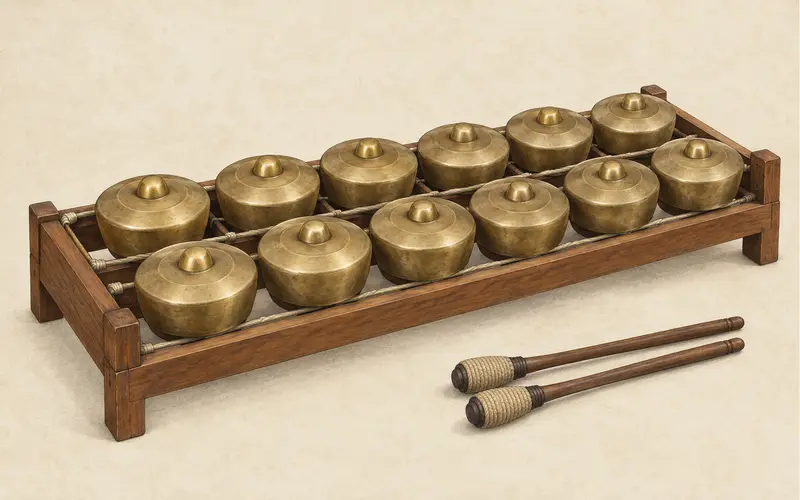
The bonang is a set of small, bossed gongs laid horizontally on cords in a wooden rack and struck with padded beaters. In Central Javanese gamelan, it contributes melodic elaboration: patterns that give shape and movement to a piece. This article focuses on the two-row bonang of gamelan ageng and on practice documented in Yogyakarta and Surakarta. Vetter: bonang barung.
For its ensemble setting, begin with gamelan instruments and cultural roles. The wider collection is Music and Dance.
Gongs, cords, and a wooden rack
Each gong has a raised central boss, or pencu. The rack holds the gongs with their bosses facing upward, leaving them accessible to the player's beaters. Vetter's Yogyakarta inventory records bonang barung with ten or twelve gongs for slendro and fourteen for pelog. The number of gongs therefore depends on the instrument's tuning system and configuration. Yogyakarta bonang barung.
Bronze is one documented material, but bonang also exist in iron. Grinnell's collection describes a twelve-gong iron example made from joined sheet-metal components, resting on ropes in a rectangular wooden rack. Its construction offers a useful comparison with the workshop evidence discussed in Javanese bronze gong making. Grinnell collection record.
Barung, panerus, and panembung
Bonang names distinguish registers as well as sizes. In Vetter's account of Yogyakarta palace gamelans, bonang barung occupies the middle register, panerus—also written penerus—the highest, and panembung the lowest. The panerus has smaller gongs; the panembung has larger ones. These relationships help explain why similar-looking racks have different places in the musical texture. Vetter: bonang penerus.
Striking and controlling resonance
The player holds a padded wooden beater in each hand and strikes the bosses. Grinnell's record describes a clear pitch, sharp attack, and moderately long decay, with damping needed to control the lingering sound. Listening for the beginning and ending of a note makes the player's control more apparent than watching the striking motion alone. Grinnell: playing and sound production.
Mipil and imbal: shaping the musical line
Teguh and Widiandari's 2021 study explains bonang barung techniques in Surakarta-style karawitan. In mipil, notes are played individually in alternation; the bonang can anticipate pairs of balungan notes and guide the saron players. Imbal alternates strokes between bonang barung and bonang panerus, making a shared pattern. These are choices within the working-out of a piece, rather than a single pattern repeated in every performance. Teguh and Widiandari, pp. 24–25.
A documented setting: Yogyakarta soran
The Yogyakarta court lists bonang barung and panerus among the instruments of gendhing soran, with panembung included for certain gamelans. Soran is a loud presentation used at the beginning of uyon-uyon and to announce some performance occasions. The court's 2021 album provides a named listening context for this ensemble sound. For regional comparison, see Javanese and Balinese gamelan. Keraton Yogyakarta: Gendhing Soran Volume 1.
A bonang in a museum collection
The Metropolitan Museum of Art catalogues Bonang Barung or Kromo, accession 89.4.777a–c, as Javanese and late nineteenth century. Its recorded materials are bronze, wood, felt, and polychrome; the record lists ten gongs. These details identify one historical instrument alongside the broader configurations described above. Met collection record.
An interpretive display can pair such an object with a recording and an explanation of the player's part. The rack makes the arrangement visible; the sound reveals how separate gong strokes become a musical line.