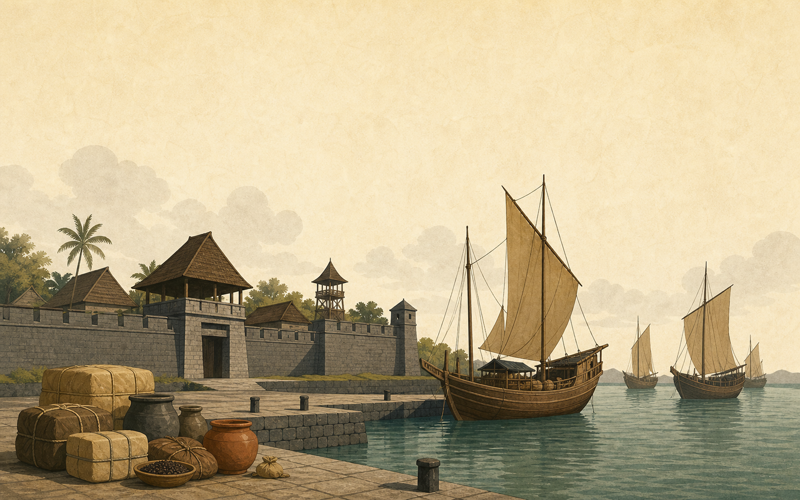
The story of Gowa-Tallo belongs to the busy waters around South Sulawesi. It is a history of rulers, ports, fortresses, Islamic learning, foreign merchants, and ships moving between the spice islands and the wider Asian sea lanes. From the sixteenth into the seventeenth century, Makassar became one of the most important maritime centers in eastern Indonesia.
For a museum, Gowa-Tallo is valuable because it refuses a simple division between local culture and global history. Makassarese courts acted within their own political traditions, yet their power was shaped by cloth, spices, metal goods, religious teachers, envoys, firearms, and treaties. Makassar was not a distant edge of world commerce. It was one of the places where that commerce became Indonesian history.
Twin Courts and a Coastal Partnership
Gowa and Tallo were linked Makassarese polities in southwestern Sulawesi. Gowa held strong inland and territorial authority, while Tallo was closely associated with the coast and maritime exchange. Their relationship changed over time, but by the height of Makassar's influence the two were so closely connected that many historians discuss them together as Gowa-Tallo or simply as the Makassar kingdom.
This partnership mattered because it joined different kinds of power. Agricultural land, noble lineages, warriors, harbor communities, boatmen, and diplomatic contacts all strengthened the same political field. A ruler who could command the inland population but ignore the sea would remain limited. A coastal ruler who could welcome merchants but lacked military backing would also be vulnerable. Gowa-Tallo drew strength from combining both worlds.
The Makassarese chronicles, preserved and studied through works such as William Cummings's translations of Gowa and Talloq traditions, show that local histories remembered kingship through genealogy, achievement, alliance, and moral reputation. These texts are not modern administrative records, but they are essential evidence for how Makassarese courts described order and legitimacy.
Makassar as an Open Port
Makassar's rise was closely tied to its function as an open port. Ships from different communities could gather there to buy, sell, repair, negotiate, and seek protection. Traders moved cloth, rice, forest products, metals, ceramics, and spices through the harbor. The city's importance came partly from geography, but also from policy. Rulers benefited when merchants trusted Makassar as a place where trade could continue even amid rivalry elsewhere.
South Sulawesi sat between several maritime worlds. To the east lay Maluku, famous for cloves and nutmeg. To the west were Java, the Malay world, and routes toward the Indian Ocean. To the north and south were other island passages used by sailors, migrants, and traders. Makassar could serve as a meeting point without producing all the commodities itself.
This role makes Makassar different from a port whose fame rests only on one local product. Its wealth came from connection. Goods entered from surrounding kingdoms and distant islands, then left in other ships with new owners and new meanings. The harbor transformed geography into opportunity.
Islam and Courtly Authority
The adoption of Islam by Gowa's ruler in 1605, noted in broad historical references such as Encyclopaedia Britannica, marked a major turning point. Islam did not make Makassar maritime; the port already stood within active trading circuits. But conversion gave the court new religious language, new relationships with Muslim merchants and teachers, and a wider diplomatic vocabulary shared across much of Southeast Asia.
Islamization also changed how authority could be represented. Royal power could now be expressed through Islamic titles, rituals, scholarship, and patronage, alongside older Makassarese ideas of nobility and sacred legitimacy. The court did not simply abandon local forms. It layered new religious connections onto existing structures of rank, oath, and alliance.
For museums, this layered world is important. A Qur'anic manuscript, a royal chronicle, a grave complex, a weapon, or a trade ceramic might appear to belong to different categories. In the Makassar context, they can be read together. They reveal a courtly culture in which commerce, faith, status, and memory reinforced one another.
Forts, Ships, and Political Reach
Maritime influence was never only commercial. It required defense, intimidation, negotiation, and visible authority. Makassar's coastal strongholds, including Somba Opu in the Gowa world, expressed the need to protect a port that had become politically valuable. Fortification signaled that trade was not floating freely outside power. It was guarded by rulers and contested by rivals.
Gowa-Tallo's expansion in South Sulawesi brought neighboring communities into its sphere through alliance, pressure, and conquest. Such influence should not be imagined as a modern state with fixed borders. It worked through obligations, tribute, marriage ties, strategic ports, military campaigns, and recognition of senior rulers. The sea made this political reach flexible, but it also made it fragile.
Ships were central to that flexibility. They carried warriors and envoys as well as goods. They linked the Makassar court to Maluku, Java, Nusa Tenggara, and foreign traders. They also carried news. In a maritime kingdom, information could be almost as valuable as cargo, because knowing which port was safe, which ruler had changed alliance, or which fleet was approaching could decide policy.
Rivalry with the Dutch East India Company
Makassar's openness eventually brought it into sharp conflict with the Dutch East India Company, or VOC. The VOC sought tighter control over the spice trade, especially in eastern Indonesia. Makassar's role as a free and competitive port challenged that ambition because it allowed merchants to move goods outside Dutch monopoly arrangements.
The conflict was not simply Europeans against Indonesians. Local rivalries mattered deeply. The Bugis prince Arung Palakka of Bone became a key ally of the VOC against Gowa. This reminds us that seventeenth-century South Sulawesi politics cannot be reduced to a foreign intrusion alone. Regional ambitions, court rivalries, and grievances shaped the war as much as commercial strategy.
The Treaty of Bungaya in 1667 severely limited Gowa's power and confirmed VOC influence in Makassar. Even so, the treaty should be understood as a turning point, not as the disappearance of Makassarese history. The port continued to matter, and Makassarese and Bugis maritime communities remained active across the archipelago.
Cultural Memory and Museum Evidence
Gowa-Tallo survives through several kinds of evidence. Chronicles preserve royal memory. Fort remains and place names hold the landscape of power. European company records reveal conflict, trade, and diplomacy, though they must be read with awareness of VOC interests. Local oral traditions and court heritage keep the names of rulers, places, and events socially alive.
Museum interpretation works best when these materials are not forced into a single voice. A Makassarese chronicle may emphasize royal order and genealogy. A VOC document may emphasize commercial control or military anxiety. An archaeological site may show the physical conditions of defense and settlement. Together, they let visitors see a port city from several angles.
The most important lesson is that Makassar's maritime world was made by people who knew how to manage difference. Foreign merchants, Muslim scholars, local nobles, boat crews, artisans, soldiers, and envoys all passed through the same political landscape. Their interactions made Gowa-Tallo powerful, and their conflicts made that power vulnerable.
Conclusion
The Gowa-Tallo kingdom shows how maritime influence could grow from partnership, policy, religion, and strategic geography. Makassar became influential because its rulers turned a coastal position into a political instrument. They welcomed merchants, negotiated with distant powers, adopted Islam, fortified their port, and competed for authority in the spice-trade world.
Its legacy is not only a story of rise and defeat. It is a reminder that eastern Indonesia was an active maker of early modern history. Through Gowa-Tallo, Makassar became a place where local kingship and oceanic commerce met, leaving a maritime memory that still belongs in the center of Indonesia's cultural story.