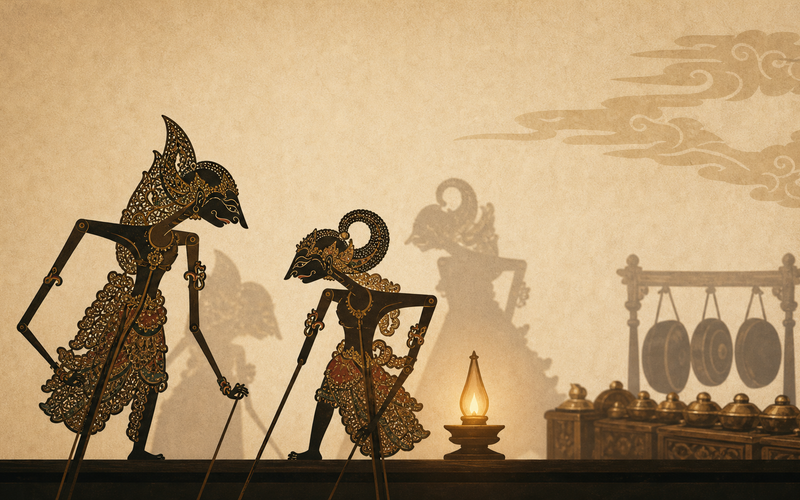
Indonesian shadow puppet storytelling is among the archipelago's most celebrated performance traditions. Known most widely through wayang, and especially wayang kulit or leather shadow puppetry, it combines visual art, music, literature, ritual, and social commentary. For many audiences, the performance is not only entertainment but also a medium for ethical reflection, historical memory, and communal gathering.
The history of this art is long and layered. It cannot be reduced to a single origin point, because scholars have debated how older local ritual practices, Indian epic literature, courtly patronage, and later Islamic cultural settings contributed to its development. What is clear is that shadow puppet storytelling became one of the most influential artistic forms in Java and Bali, while related forms flourished elsewhere in Indonesia.
Early roots and the problem of origins
The history of wayang is difficult to reconstruct with certainty because performance traditions often leave fewer early material traces than architecture or inscriptions. Scholars generally agree that wayang has deep roots in Java, but they differ on how to weigh indigenous ritual elements against influences from South Asia. The very antiquity of the form is suggested by Old Javanese literary references, yet the exact shape of the earliest performances remains uncertain.
Wayang should not be understood simply as a direct import of Indian theatre. Although the great Sanskrit epics became central to the repertory, the performance system in Java developed distinctive features: stylized leather puppets, the role of the dalang, local languages, and gamelan music. These features indicate adaptation rather than simple borrowing.
By the time of the Hindu-Buddhist polities of Java, stories from the Mahabharata and Ramayana had already entered local literary and artistic life. Reliefs at Central and East Javanese temples show familiarity with epic narratives, though they are not evidence of shadow theatre by themselves. They do, however, demonstrate that these stories had become part of the cultural world from which wayang drew much of its narrative power.
Wayang in the Hindu-Buddhist courts of Java
During the period of Hindu-Buddhist kingdoms in Java, especially in East Java, literary adaptation played a major role in shaping the wayang tradition. Old Javanese and later Javanese court literature did not merely retell Indian epics; it reworked them for local audiences, values, and political settings. Characters, genealogies, and moral emphases could shift, and the stories became part of a specifically Javanese cultural universe.
Courtly environments were important because they supported poets, ritual specialists, musicians, and artisans. In such settings, wayang was linked to refined language, ethical instruction, and ideas of kingship. The performance could mirror the ordered world of the court while also allowing room for humor, improvisation, and commentary. This balance between hierarchy and flexibility became one of the hallmarks of the tradition.
The visual form of the puppets also reflects long processes of stylization. Wayang kulit figures are not naturalistic portraits. Their elongated limbs, sharply profiled faces, and elaborate headdresses communicate rank, temperament, and moral character. In museum collections they are often admired as artworks, but historically they were made to move, speak, and cast shadows in performance.
The dalang and the structure of performance
At the center of shadow puppet storytelling stands the dalang. This single performer manipulates the puppets, voices multiple characters, directs the musicians, and controls the rhythm of the night. In many traditions, a full performance can last for hours, often extending from evening until dawn. The dalang must therefore be not only a skilled artist but also a master of memory, language, and timing.
The dalang has often been described as more than an entertainer. In Javanese cultural life, the puppeteer has historically held a respected position as a transmitter of stories, moral teachings, and symbolic knowledge. Depending on context, performances may accompany life-cycle ceremonies, communal celebrations, or commemorative events.
A wayang performance is inseparable from music. In Java and Bali, shadow theatre is accompanied by ensembles whose sound shapes mood, marks transitions, and supports speech and song. The screen, lamp, banana-trunk base for the puppet rods, and arrangement of puppets all form part of a highly structured performance environment. Audiences may watch either the shadow side or the puppeteer’s side, each offering a different experience of the same event.
Islamization and continuity in the archipelago
From the late first millennium into the second millennium, Islam spread gradually through many parts of the Indonesian archipelago, especially through trade networks, port cities, and local courts. Rather than causing the disappearance of wayang, this transformation often led to new forms of accommodation and reinterpretation. In Java, shadow theatre continued to flourish under Muslim patronage and within increasingly Islamicate cultural settings.
Later Javanese tradition sometimes associates the adaptation of wayang to Islamic society with the Wali Songo, the nine saints of Javanese Islam. Such accounts are important in cultural memory, though historians treat some details as later tradition rather than firmly documented fact. What is historically clear is that wayang remained a powerful medium in Muslim Java.
In some regions, new narrative materials entered the repertory. Alongside epic cycles, performers could draw on local romances, court chronicles, and stories with Islamic associations. The result was not a break with the past but a layered tradition in which older literary worlds and newer religious identities coexisted. This capacity for adaptation helps explain the long survival of shadow puppet storytelling.
Regional diversity beyond a single model
Although wayang kulit is most strongly associated internationally with Central and East Java, Indonesian shadow theatre is not a single uniform tradition. Bali has its own shadow puppet practices, shaped by Balinese Hindu ritual life, local language, and distinctive musical and ceremonial contexts. Balinese performances may be connected to temple festivals and rites in ways that differ from Javanese courtly and village settings.
Java itself contains multiple forms. There are regional differences in puppet design, vocal style, musical accompaniment, and preferred story cycles. Some traditions emphasize the Mahabharata, others the Ramayana, and still others local tales such as the Panji cycle.
Beyond Java and Bali, related theatrical forms developed in other parts of Indonesia, though not always as shadow theatre in the strict sense. The broader category of wayang can include wooden puppets, scroll performance, and human dance-drama traditions linked to the same narrative world. This diversity reminds us that Indonesian puppet storytelling is best understood as a family of connected arts rather than a single fixed genre.
Colonial documentation, scholarship, and museum collecting
During the Dutch colonial period, wayang attracted the attention of administrators, scholars, collectors, and artists. Manuscripts were copied, performances were described, and puppets entered museum collections in Indonesia and Europe. This documentation preserved information, but it also reframed wayang through colonial categories of folklore, ethnography, and art history.
Museum collections today often contain finely carved and painted puppets that demonstrate regional styles and workshop traditions. Yet the museum setting can separate the object from the living event for which it was made. A puppet displayed in a case no longer moves in relation to music, voice, and light. For this reason, many museums now interpret wayang not only as material culture but also as performance heritage.
Modern scholarship has expanded understanding of wayang by examining literature, ritual, politics, and social life together. Even when rooted in old stories, wayang has never been a static survival from the past.
Wayang in modern Indonesia
In modern Indonesia, shadow puppet storytelling remains a recognized emblem of national culture while also retaining strong regional identities. Performances continue in ceremonial, educational, and public settings, and some puppeteers have adapted the form for radio, television, shorter stage formats, and new audiences. These changes show the resilience of the tradition rather than its decline alone.
UNESCO’s inscription of wayang puppet theatre has highlighted its international significance. Such recognition has supported preservation efforts, training, and public awareness. At the same time, the vitality of wayang still depends on performers, musicians, craftspeople, and communities who sustain it in practice.
Contemporary audiences encounter wayang in many ways: as a night-long village performance, a palace-associated art, a school subject, a museum display, or a national symbol. Across these settings, the central features remain recognizable: the play of light and shadow, the authority of the dalang, and the enduring power of stories to connect past and present.
Related Reading
For interpretation of meaning and symbolism, see the spiritual meaning of Javanese wayang kulit performances, Wayang Kulit symbolism, and Wayang Kulit and the Javanese worldview.
Conclusion
The history of Indonesian shadow puppet storytelling is a history of continuity through change. From early Javanese literary worlds to Hindu-Buddhist courts, from Islamicate cultural settings to colonial museums and modern heritage programs, wayang has repeatedly adapted without losing its core identity as a narrative performance art.
For museums, wayang offers a particularly rich subject because it unites object, sound, text, and ritual. A single leather puppet can open onto centuries of artistic exchange and social meaning. To study the history of Indonesian shadow puppet storytelling is therefore to encounter one of the archipelago’s most sophisticated and enduring cultural traditions.