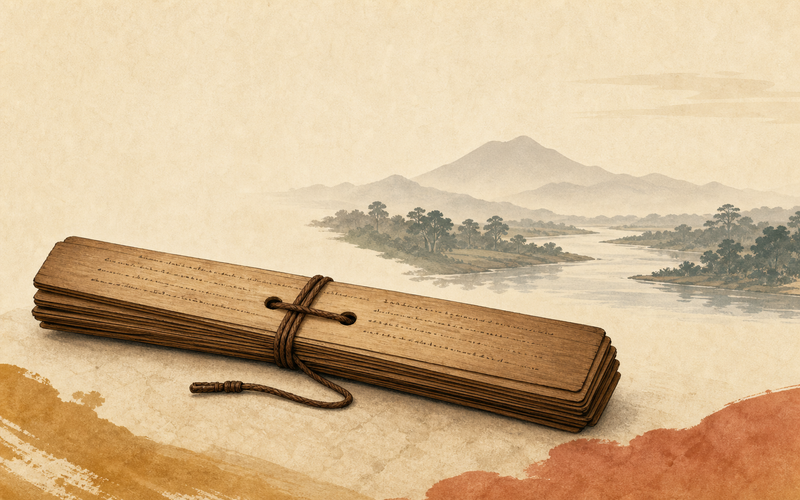
The Kediri Kingdom occupies a distinctive place in the cultural history of Java. It was not the earliest Hindu-Buddhist polity in the island, and it did not leave a single monumental complex as instantly recognizable as Borobudur or Prambanan. Yet Kediri remains memorable because its courtly world became closely associated with Old Javanese literature. For museums, this is an important reminder that historical power can survive not only through stone, metal, and architecture, but also through language, poetic memory, and the repeated copying of texts.
Kediri, also remembered through names such as Kadiri, Panjalu, and Daha, rose in eastern Java after the division of Airlangga's realm in the eleventh century. By the twelfth century it had become one of the most important centers in Java. Britannica describes Kediri as the dominant kingdom in eastern Java from the eleventh to the early thirteenth century and notes its strength in commerce, naval activity, and literature. That combination matters. Literary production did not float apart from political life. It was tied to courts, patronage, prestige, and the ways rulers wished to be remembered.
Kediri in Eastern Javanese History
The historical setting of Kediri begins with the reshaping of eastern Java after Airlangga, a ruler remembered for restoring authority after earlier conflict. Later tradition says his realm was divided between rival branches, commonly associated with Janggala and Panjalu or Kadiri. Historians treat such traditions carefully, because literary and inscriptional sources were shaped by courtly purposes. Even so, they point toward a landscape of competing centers along the Brantas River basin, where agriculture, river movement, and access to wider trade all mattered.
Kediri's capital is often associated with Daha, near the modern Kediri area in East Java. The kingdom's political history is less visible to visitors than that of some later states because surviving material remains are scattered and uneven. This absence can be misleading. A museum interpretation of Kediri should not suggest that a quieter archaeological profile means a minor historical role. In the twelfth century, Kediri appears as a confident courtly center whose influence was expressed through diplomacy, economy, religious patronage, and literary refinement.
Court, Patronage, and Poetic Authority
Old Javanese literary culture depended on trained poets, courtly audiences, and a shared knowledge of Sanskrit-derived forms. The kakawin, a long poem composed in Old Javanese using meters adapted from Indian models, became one of the most prestigious forms of classical Javanese expression. These poems were not simple translations of Indian stories. They reworked inherited narratives for Javanese court settings, placing ethical, political, and aesthetic concerns into a local language of kingship.
Kediri is especially important because several major works are linked to its period and courtly environment. The Kakawin Bharatayuddha, associated with Mpu Sedah and Mpu Panuluh, retold part of the Mahabharata world in Old Javanese form and is traditionally connected with the reign of King Jayabhaya. Other works often discussed in relation to this literary age include the Smaradahana of Mpu Dharmaja and the Gatotkacasraya of Mpu Panuluh. Attribution, dating, and manuscript transmission can be complex, but the broader pattern is clear: Kediri became a remembered center of poetic production.
Bharatayuddha and the Politics of Epic Memory
The Bharatayuddha is central to Kediri's literary reputation because it shows how epic material could become politically meaningful in Java. The Mahabharata was known across many parts of Asia, but each retelling created new emphasis. In an Old Javanese court, the story of dynastic conflict, legitimate rule, loyalty, grief, and cosmic order could speak to local concerns about power and moral responsibility.
The poem is often linked to Jayabhaya, one of Kediri's most famous rulers. Later Javanese memory also associated Jayabhaya with prophecy, although museum interpretation should separate later legendary traditions from what can be securely stated about the twelfth-century court. The safer point is still powerful: Kediri's court used refined literary language to frame royal authority within a larger moral universe. Poetry offered more than entertainment. It gave political life a sacred and ethical vocabulary.
Language, Manuscripts, and Survival
The literary heritage of Kediri survives because texts continued to be copied, studied, adapted, and performed after the kingdom itself disappeared. Old Javanese manuscripts were preserved in later manuscript cultures, especially in Bali, where many classical Javanese works remained part of learned and ritual life. This long transmission complicates any simple idea of origin. A poem associated with Kediri may be known today through much later manuscripts, copies, editions, and oral or performative echoes.
For museums, that chain of survival is as important as the original court. A manuscript is not merely a container for an old poem. It is evidence of generations who considered the poem worth preserving. The physical form of later palm-leaf or paper manuscripts, the scripts used to copy them, and the communities that read them all shaped how Kediri's literary world remained visible. The kingdom's heritage therefore belongs both to twelfth-century eastern Java and to the later custodians of Old Javanese learning.
Literature Beyond the Palace
Although kakawin poetry was closely tied to elite culture, its stories did not remain locked inside courts. Epic characters such as the Pandawa, Kresna, Arjuna, Bhima, and Gatotkaca became part of wider Javanese and Balinese narrative worlds. Over time, classical literary materials entered performance, wayang traditions, moral teaching, and regional storytelling. These later lives should not be confused with the original Kediri texts, but they show how court literature could travel into broader cultural imagination.
This movement also helps explain why Kediri matters today. Visitors may encounter names or stories connected with the Mahabharata through wayang before they ever hear of Old Javanese kakawin. A museum can use that familiarity as a bridge. By tracing later performance motifs back toward classical literary traditions, it becomes possible to show how Indonesian cultural history is layered: Indian epic, Javanese court poetics, local religious imagination, and later performance practice all interact without becoming the same thing.
Interpreting Kediri in the Museum
Kediri asks museums to build exhibitions around evidence that is sometimes textual rather than monumental. Inscriptions, manuscripts, literary references, maps of eastern Java, and comparative displays of later manuscript transmission can all help visitors understand the kingdom. A gallery might place the Brantas River landscape beside excerpts from kakawin tradition, showing that literature emerged from a real political geography rather than an abstract literary world.
Responsible interpretation should also make room for uncertainty. Many surviving texts come through later copies, and literary works have their own conventions of praise, symbolism, and exaggeration. Court poetry cannot be read as a modern chronicle. At the same time, it should not be dismissed as fiction without historical value. It reveals ideals of kingship, ethical imagination, aesthetic discipline, and the prestige of learned language. Those are historical facts of culture, even when individual episodes in a poem are not direct records of events.
Conclusion
The Kediri Kingdom's legacy is unusually literary. Its power is remembered through the prestige of Old Javanese poetry, through names of poets and rulers, and through stories that later generations continued to copy, read, and perform. That legacy does not replace archaeology or political history. Instead, it expands the evidence through which a museum can make eastern Java's past intelligible.
Seen in this way, Kediri is not only a vanished kingdom between better-known eras. It is a reminder that literature can become a historical monument of its own. The courtly poems associated with Old Java preserve more than beautiful language. They preserve ideas about order, conflict, devotion, kingship, and memory that helped shape Indonesian cultural inheritance long after Kediri's political authority had passed.