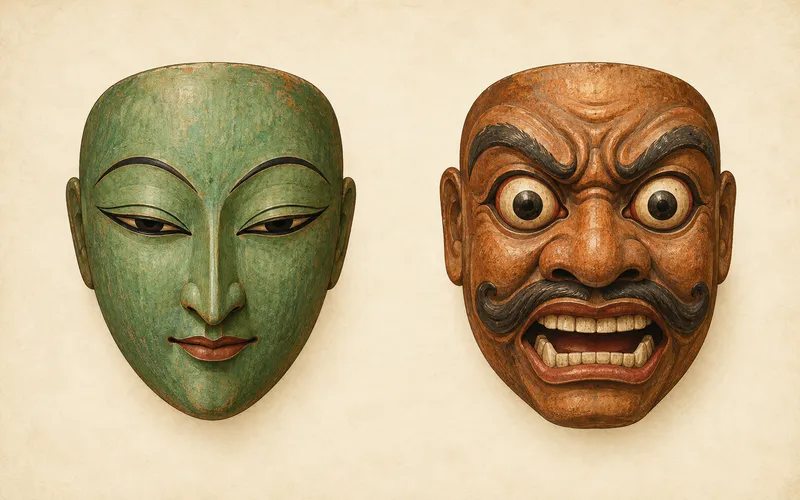
Topeng means mask in Indonesian and also names traditions of masked performance. In Java and Bali, carved faces become theatrical characters through a dancer's movement, music, and narrative. Cirebon's character dances, Malang's Panji theatre, and Balinese historical and ceremonial drama share the use of masks, but have different repertoires and performance settings.
Transformation here begins with a practical relationship: wood supplies a fixed expression while the performer supplies changing posture, rhythm, and presence. Understanding a mask therefore requires looking beyond its face to the tradition in which it is used.
Cirebon: Five Characters and Local Styles
BRIN's documentary on the Palimanan style identifies the five characters of Panca Wanda: Panji, Samba, Rumyang, Tumenggung, and Kelana. It names Mimi Soedji as a leading practitioner and emphasizes variation among regional styles. This is a repertoire learned through particular teachers, rather than a universal chart of mask meanings. BRIN: Palimanan-style Topeng.
The surrounding Cirebon court and coastal cultural history provides regional context. For a visitor, the useful next question is which style and performer a mask belongs to: the name of a character alone cannot recover the choreography.
Malang: Carving for Panji Theatre
Government cultural documentation locates an important workshop tradition in Kedungmonggo, Karangpandan, Pakisaji, Malang, associated with sculptor and dancer Karimoen and the Asmorobangun studio. It describes wooden masks being shaped, carved, sanded, and painted for theatre commonly drawing on Panji stories. In its examples, Panji has narrow eyes and a green face, while Klana has round eyes and a red face. These are locally documented conventions. BPNB Yogyakarta: Topeng Malangan.
That connection between carving and dancing changes how we look at a museum object. The eyes, nose, and mouth establish an expression, but its theatrical effect also depends on the angle of the head and the body carrying it.
Bali: Historical Drama and Character Types
The Metropolitan Museum records a Balinese martial-ruler mask, accession 2022.265, dated to the nineteenth–early twentieth century. Wood, shell inlay, hair, and mineral pigments produce a wide-eyed, open-mouthed face. The catalogue places it in babad, local historical plays, and interprets its forceful keras character in contrast to refined halus roles. Metropolitan Museum: martial-ruler mask.
This documented object offers a specific example of performed authority. Its date belongs to the surviving mask; it does not supply an invention date for Balinese Topeng or verify every event narrated in a babad.
Sidakarya: Ceremony and Completion
Indonesia's heritage database records Topeng Sidakarya as Balinese performing heritage designated in 2015 and connects its religious setting to the narrative Babad Bebali Sidakarya. That narrative explains the tradition within a cultural and religious framework; it is not an archaeological chronology. Indonesian heritage record.
The government-published study Topeng Sidakarya describes the solo format called Topeng Pajegan, in which one performer takes on the performance. It also records a closing blessing involving yellow rice and uang kepeng, coins understood in that setting as symbols of prosperity. Topeng Sidakarya study.
UNESCO's 2015 decision distinguishes sacred, semi-sacred, and entertainment contexts in Balinese dance and stresses transmission through training. Ceremonial purpose depends on the particular performance, not merely on the presence of a carved mask. UNESCO decision.
Transformation through the Performing Body
Compare Topeng with Sundanese wayang golek and Javanese wayang kulit: all invite attention to how an object becomes a character, but masked dancers and manipulated puppets use different mechanisms. In Topeng, the performer's own body carries the face.
Our broader discussion of sacred objects and their uses considers the relationship between material and practice. Here, “transformation” need not imply possession. It can describe the visible act of becoming a dramatic role; religious interpretations require evidence from the particular community and occasion.
Looking at Topeng in a Museum
Begin with the record: where was the mask made, who carved or performed with it, and how was its character identified? Then examine the construction and any documented repairs or performance wear. A performance photograph or recording can explain something a front-facing display cannot: how a fixed face changes when the dancer turns, pauses, or approaches the audience.
Explore the Masks collection with these questions in mind. A mask is both a crafted object and one part of a larger performance, whose knowledge resides with makers, dancers, musicians, and audiences.