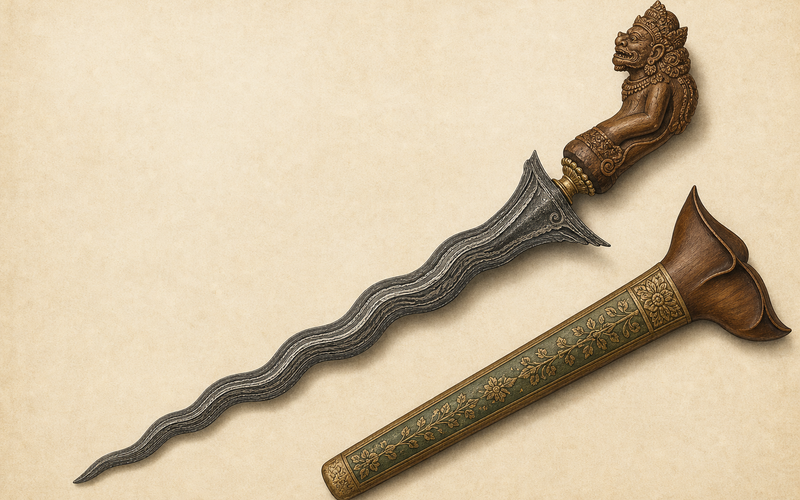
The Balinese keris is often described first as a weapon, but that word is too narrow for the lives these objects have led. In Bali, as in other parts of Indonesia, the keris could be worn, inherited, guarded, cleaned, displayed, danced with, and interpreted through stories of power and restraint. Its value did not rest only in the steel. It also lived in the hilt, sheath, owner, ceremony, and remembered chain of people who cared for it.
This wider biography is especially important in court and temple contexts. Courts gave the keris a language of rank and cultivated bearing. Temples placed it within systems of protection, offering, and ritual presence. The same object could therefore move between social and sacred worlds without losing coherence. A museum reading of the Balinese keris should begin with that double life: it is material culture, but it is also a sign of authority disciplined by ceremony.
A Blade With More Than Martial Meaning
The keris belongs to a broad Indonesian and Southeast Asian family of asymmetrical daggers, many with straight or wavy blades and patterned metal surfaces. UNESCO recognizes the Indonesian kris as intangible cultural heritage, emphasizing not only the object but also the knowledge, symbolism, craftsmanship, and ritual practices surrounding it. That distinction matters. A keris is not fully understood if it is separated from the makers, owners, specialists, and ceremonies that gave it meaning.
In Bali, the keris became closely connected with ideas of spiritual force and personal responsibility. Some blades were treasured as heirlooms, while others formed part of ceremonial dress or were kept as protective objects. These roles do not cancel the weapon's martial ancestry. Instead, they show how martial potential could be transformed into social and ritual authority. The blade retained an aura of danger, but courtly and religious settings asked that danger to be held under control.
Courtly Rank and Composed Presence
Balinese courts were worlds of visible hierarchy. Dress, gesture, language, seating, procession, and objects all helped make rank legible. Within such a setting, the keris could work as a sign of status before it ever functioned as a weapon. A finely mounted blade worn in the correct context suggested refinement, lineage, and a disciplined relationship to power. It announced that the bearer stood within an order governed by etiquette.
The Metropolitan Museum of Art's Balinese kris from the eighteenth or nineteenth century offers a useful example of how such authority could be carved into form. Its wooden hilt has been interpreted in relation to Arjuna, the heroic Pandava prince of the Mahabharata cycle. The museum notes qualities such as noble bearing, serenity, refinement, and heroic composure in the figure. Whether one reads the hilt as Arjuna or another epic being, the important point is that the keris does not present power as brute force. It presents power as cultivated self-command.
Temple Protection and Ritual Force
Temple life gave the keris another field of meaning. In Balinese Hindu practice, sacred space is not merely decorative or symbolic; it is maintained through offerings, purification, performance, and proper relations among visible and invisible beings. Objects that enter this sphere can become participants in ritual order. A keris kept, carried, or displayed in such a context may be understood as protective, charged, or tied to the responsibilities of a temple community.
This does not mean that every Balinese keris had the same ritual role. Museum objects often arrive with partial histories, and it would be careless to assign one universal function to all blades. Still, the broader Balinese setting helps explain why a keris could be treated with reverence. Its sharpness, age, beauty, and inherited associations made it suitable for communicating controlled force. In temple contexts, that force could be aligned with protection rather than aggression.
Epic Memory in Hilt and Gesture
Balinese keris hilts are especially important because they can carry iconography drawn from Hindu epic and local artistic traditions. The Met's Balinese kris hilt, associated with Arjuna, shows how a weapon could become a compact statement about character. Arjuna is not simply a warrior. In Indonesian retellings, he often embodies refined masculinity, beauty, discipline, and moral testing. A hilt shaped through this imagery places the blade inside a world of ethical and spiritual narrative.
Such imagery also softens the boundary between court and temple. Epic stories were performed, painted, carved, recited, and remembered across Balinese cultural life. When an epic figure appears on a keris, the object can summon lessons about duty, restraint, divine instruction, and the burden of action. The hilt turns the weapon into a teaching surface. It asks the viewer to see not only the possibility of violence but also the discipline required to govern it.
Heirlooms, Care, and Authority Over Time
Many keris were valued because they carried history. An inherited blade could link a family or courtly house to ancestors, patrons, makers, or past ceremonies. This kind of authority grows slowly. It is built through preservation, narration, and ritual care. A keris that remains in a household, palace, or temple setting can accumulate meaning through repeated acts of cleaning, wrapping, presenting, and remembering.
Museums often encounter such objects after they have left those living systems. The blade may remain visible, but its local biography may be incomplete. That is why careful interpretation should avoid treating provenance gaps as empty space. Instead, they should remind viewers that a keris once existed in relation to people and practices. Its authority was not simply owned; it was maintained. The person who cared for the blade helped sustain the social and ritual world around it.
Display, Performance, and Controlled Danger
The keris also appears in Balinese performance traditions, where controlled danger can become a visible part of ritual drama. The well-known keris dance associated with Barong and Rangda dramatizes forces of protection, trance, and threat. In such settings, the keris is not a neutral prop. It condenses ideas about spiritual struggle and embodied risk. The performance makes clear that the blade's power lies partly in its dangerousness and partly in the ritual frame that contains it.
This helps explain why the keris could serve both courtly and sacred authority. Courts valued composed presence, while temples valued ordered relations with forces beyond ordinary sight. In both settings, the keris made latent power visible without reducing it to violence. The object mattered because it could be carried, shown, invoked, and restrained. Its authority depended on the disciplined handling of danger.
Reading the Whole Object
A museum visitor should look beyond the blade. The hilt, sheath, metal fittings, surface pattern, and signs of repair or wear all contribute to meaning. A Balinese keris with a carved figure may speak through epic imagery; another with restrained fittings may emphasize age, lineage, or local taste. The sheath can mark the object's public face, while the blade may carry more hidden forms of knowledge. No single part explains the whole.
This whole-object reading is also a way to respect Balinese cultural complexity. The keris belongs to craft, performance, ritual, courtly etiquette, family memory, and art history at once. It cannot be reduced to a battlefield category or a decorative souvenir. Its power comes from crossing categories while remaining recognizable as a disciplined form. That is what makes it so valuable for museum interpretation.
Conclusion
The Balinese keris stands at the meeting point of rank, ritual, memory, and controlled force. In court life, it could signal refinement and status. In temple settings, it could participate in protection and sacred order. In carved hilts and performance contexts, it could recall epic ideals of duty, composure, and spiritual testing. Across these settings, the keris made authority visible by binding danger to discipline.
For museums, the lesson is clear: a Balinese keris should be read as a lived object, not only as a weapon. Its blade matters, but so do its hilt, sheath, owner, setting, and ritual biography. When those layers are restored, the keris reveals a Balinese world in which beauty, power, and responsibility were deliberately held together.