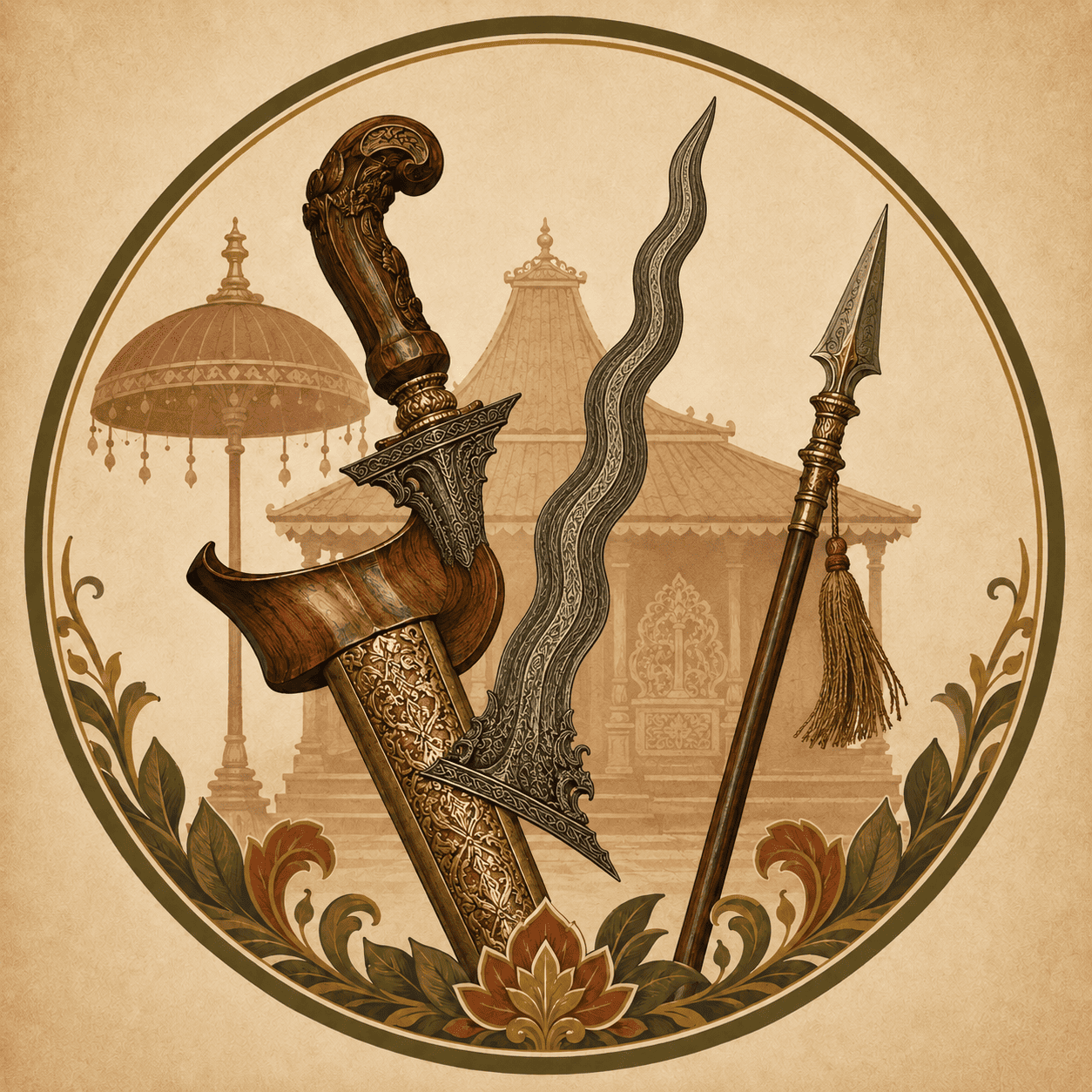
The Keris as Weapon, Heirloom, and Sacred Object
This article explores how the Indonesian keris moved between practical use, inherited prestige, and sacred meaning while remaining one of the archipelago's most culturally charged objects.
Topics
Ceremonial weapons, martial heritage, and heirlooms tied to power and identity.
Weapons and Regalia is designed as an editorial pathway rather than a simple list of entries. This page helps readers trace how objects, historical context, and cultural interpretation connect across time. Ceremonial weapons, martial heritage, and heirlooms tied to power and identity. By framing the material this way, each article becomes part of a larger narrative about memory, identity, social practice, and the changing meanings attached to material culture in Indonesia and beyond.
At this stage, the topic includes 6 articles, and the collection will continue to grow as new objects, references, and comparative sources are added. Each piece is prepared with emphasis on source transparency: what is documented, where information comes from, and how interpretation is formed. When sources diverge, those differences are stated clearly instead of flattened, so readers can evaluate evidence with better context and stronger critical grounding.
In practical terms, this landing page is meant to support focused exploration. You can start with one article, follow links across related items, and compare recurring motifs, techniques, and historical signals. The goal is not just to deliver isolated facts, but to build cumulative understanding through careful sequencing. Over time, this topic section functions as a living archive, open to refinement, correction, and informed contributions from researchers and engaged readers.
This article explores how the Indonesian keris moved between practical use, inherited prestige, and sacred meaning while remaining one of the archipelago's most culturally charged objects.
A museum-style survey of Indonesian traditional weapons, showing how blades such as the keris, mandau, badik, rencong, and kujang express regional identity, craftsmanship, ceremony, and memory.
This article examines how Indonesian weapons such as the keris, rencong, badik, mandau, and kujang came to embody regional memory, status, craft knowledge, and heritage.
A museum-style history of how Indonesian weapons moved from warfare and court power into heirloom traditions, collecting, and cultural heritage.
An overview of how Indonesian bladed weapons, especially the keris, moved beyond combat into ritual life, dress, diplomacy, and hereditary prestige.
An exploration of the historical development and cultural significance of the Indonesian keris.