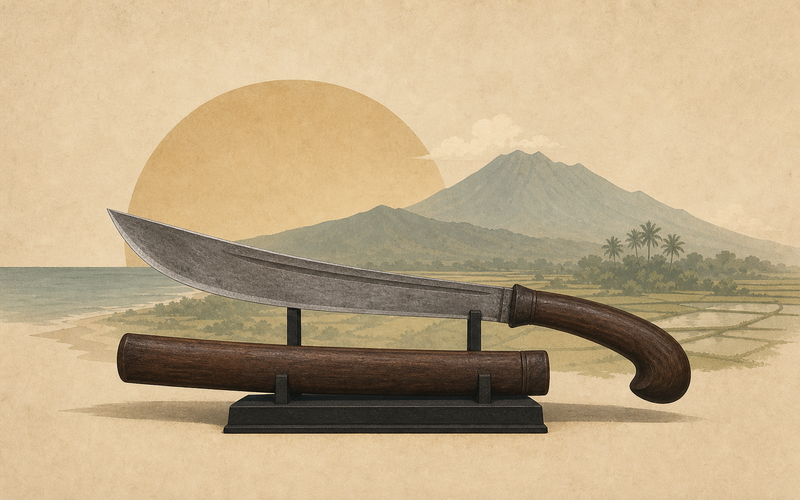
The Sasak klewang belongs to the material world of Lombok, an island where local identity has long been shaped by farming villages, mountain and coastal landscapes, Islamic practice, older ritual memory, and encounters with outside powers. At first glance, a klewang can be placed in the broad family of Indonesian swords and large cutting blades. In a museum setting, however, it asks for a more careful reading. Its value is not only in the sharpened edge, but in the histories that made such an object meaningful.
For the Sasak people of Lombok, weapons could speak to household protection, village defense, masculine discipline, inherited skill, and remembered struggle. The klewang therefore should not be treated as a generic weapon from the archipelago. It is better understood as a regional object that helps visitors think about Lombok's social life and political memory. When displayed responsibly, it opens a conversation about craft and courage without turning local resistance into romance or spectacle.
Lombok and the Sasak Setting
Lombok lies east of Bali and west of Sumbawa, within the Lesser Sunda Islands. Its landscapes range from coastal settlements and rice-growing lowlands to the northern presence of Mount Rinjani. Britannica describes the island as largely populated by Sasak communities, with Balinese settlement especially important in the west and other communities present in urban and coastal areas. This mixed setting matters because Lombok's history cannot be reduced to isolation. It has always been shaped by contact, migration, trade, and political pressure.
The Sasak are the largest ethnic group on the island. Their language, village organization, agricultural life, and religious practices give Lombok a cultural identity distinct from Bali, even though Balinese influence has also been historically significant. A Sasak klewang therefore belongs to a world where local forms existed beside wider Indonesian and regional traditions. The object is both specific and connected: specific to Lombok's memory, connected to the larger story of blades across island Southeast Asia.
A Regional Blade Form
The word klewang is used in different parts of Indonesia for sword-like cutting weapons, so it should not be imagined as one fixed shape everywhere. In Lombok, a Sasak klewang is best approached as a regional blade category rather than as a single standardized design. Examples may vary in length, curvature, hilt treatment, scabbard materials, and surface finish. Some would have been plain working or fighting objects, while others could gain status through age, ownership, ornament, or memory.
This variety is important for museums. A blade in a collection may have arrived with a simple label, an incomplete acquisition record, or a colonial-era category that tells more about the collector than about the maker. Instead of forcing every klewang into a rigid typology, interpretation can begin with visible evidence: the shape of the blade, the balance between edge and point, the material of the hilt, the quality of the scabbard, and signs of repair or long keeping. These details let the object speak without making it carry more certainty than the record allows.
Village Defense and Everyday Authority
In many Indonesian societies, blades moved between daily life and moments of danger. A large cutting blade could belong near fields, paths, houses, and village boundaries, but in times of conflict it could also become a weapon. The Sasak klewang fits this wider pattern. It reminds us that martial objects were often embedded in ordinary life rather than stored in a separate military world. Defense began with communities, households, kin groups, and local leaders.
Authority in such settings was not abstract. It was made visible through conduct, dress, speech, ritual participation, and objects carried on the body. A blade could mark readiness and responsibility as much as aggression. For a museum visitor, this is a useful shift in perspective. The klewang was not simply a tool for violence. It could be part of how local men understood discipline, obligation, and the protection of family or village space.
Balinese Rule and Sasak Memory
Lombok's nineteenth-century history gives the klewang a sharper interpretive background. Britannica notes that Balinese power became established on Lombok and that Dutch intervention in 1894 ended Balinese rule and brought direct Dutch control. Sasak communities were not passive within this history. Relations across the island varied, and the record includes tensions, alliances, coercion, rebellion, and appeals to outside power. The memory of local resistance grew within these uneven conditions.
It would be careless to claim that every Sasak klewang in a museum case was carried in a named rebellion. Most objects lack that level of documentation. Yet it would also be too narrow to separate the blade entirely from resistance memory. Weapons are often remembered not because every specimen has a complete biography, but because the form belongs to a social world where conflict, defense, and political pressure mattered. The klewang can therefore stand near the history of Sasak resistance while still requiring careful language.
Dutch Intervention and the Problem of Liberation
The Dutch conquest of Lombok complicates the story further. In some accounts, Dutch intervention appeared to certain Sasak leaders as a way to escape Balinese domination. But colonial power rarely leaves a simple moral ledger. The same intervention that ended one form of rule also produced Dutch control over the island. A museum article should make room for that complexity. Local resistance and colonial expansion could become entangled, especially when one outside power presented itself as a solution to another.
For the klewang, this means avoiding a simple heroic storyline. The blade can symbolize courage and local defense, but it also sits within a painful history in which communities faced limited choices. Some people resisted Balinese authority, some negotiated, some suffered violence, and colonial forces used the situation to enlarge their own rule. The object does not solve this history. It helps hold it in view.
Craft, Keeping, and Heirloom Meaning
A klewang's cultural power also depends on making and keeping. Metalwork, hilt fitting, scabbard construction, and maintenance all required knowledge. Even a plain blade represents choices of proportion, edge, grip, and balance. These practical decisions are part of the object's heritage. A sword that feels reliable in the hand is also a record of craft intelligence.
Over time, such blades could become heirlooms. A weapon no longer used in conflict might remain in a household because it belonged to an ancestor, marked a family story, or represented local dignity. In this stage of its life, the blade's meaning changes. It may become less about immediate defense and more about continuity. The edge is still present, but the strongest force may be memory: who kept it, who named it, who explained it to the next generation.
Reading the Klewang in a Museum
A responsible display of a Sasak klewang should begin with place. Lombok, Sasak culture, and the island's layered political history give the blade its frame. The label should then move from form to meaning: what kind of blade it is, how it relates to local defense, and why it can evoke memories of resistance. If the record is incomplete, the museum should say so plainly. Uncertainty is not a failure. It is part of honest interpretation.
The object also benefits from comparison. Placed beside discussions of the keris, badik, rencong, kujang, mandau, or balatu, the Sasak klewang shows the diversity of Indonesian martial heritage. Each blade tradition carries different relationships to rank, ritual, region, and memory. The klewang's particular strength is its ability to connect local craft with Lombok's political history, especially the difficult passage from Balinese domination into Dutch colonial rule.
Conclusion
The Sasak klewang is a compact but demanding museum object. It is a blade, but also a witness to local identity, village defense, inherited craft, and the memory of resistance on Lombok. Its meaning should be neither inflated into legend nor flattened into weapon classification. The most respectful interpretation allows the object to remain both practical and historical.
Seen in this way, the klewang helps visitors understand how communities remember power. A blade may survive because it was useful, but it continues to matter because people attach stories, obligations, and dignity to it. For Lombok's Sasak heritage, the klewang offers one such form: a weapon whose edge now points back toward the complex history of local endurance.