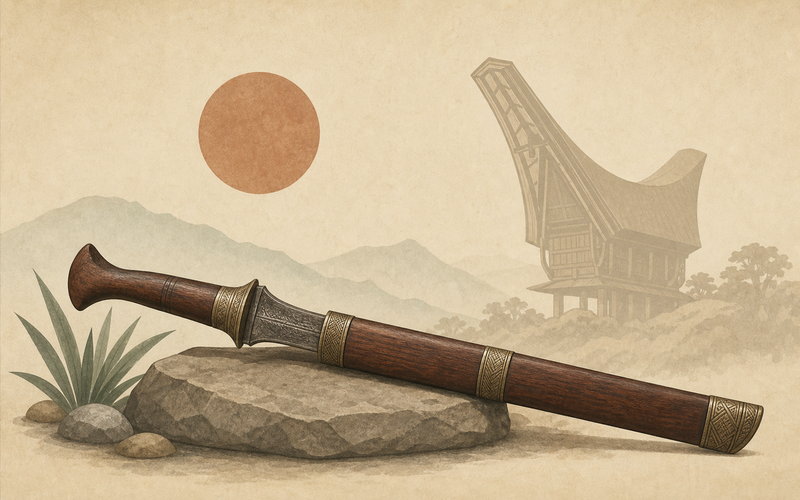
Toraja highland blades belong to a cultural landscape where objects are rarely only practical. In the mountains of South Sulawesi, houses, carved panels, textiles, buffalo imagery, ritual gifts, and heirlooms all help express relations between living families, remembered ancestors, and ranked communities. A blade labeled gayang, gajang, penai, or dua lalan should therefore be read with care. It may look at first like a weapon, but in a museum it also points toward status, memory, and the social life of keeping.
The term gayang is not always used consistently in English-language catalogues, and the spelling gajang also appears in discussions of Sulawesi swords. Toraja-specific objects may be catalogued with other local names. This uncertainty is not a reason to avoid interpretation. It is a reason to interpret more honestly. A responsible museum label can explain that the blade belongs to a wider highland martial tradition while acknowledging that names and typologies can shift across languages, collectors, and local usage.
The Toraja Highland Setting
The Toraja live in the uplands of South Sulawesi, a region whose steep valleys and mountain settlements helped shape distinctive forms of architecture, ceremony, and social organization. Their culture is widely known for tongkonan ancestral houses, elaborate funeral rites, carved woodwork, and the ceremonial importance of buffalo. These better-known forms provide the interpretive frame for highland blades. Weapons did not exist outside this world; they moved within it.
Status in Toraja society has historically been expressed through descent, ritual responsibility, property, public generosity, and visible signs of household standing. A blade could take its place among these signs, especially when kept as an heirloom or displayed in relation to a respected family line. Its meaning depended on more than steel. It depended on who owned it, who carried it, where it was stored, and what stories were attached to it.
Names, Forms, and Museum Caution
Indonesian blade names often travel unevenly across regions. A term may refer to a broad family of swords in one context, a more specific local form in another, or a collector's label in a museum record. For Toraja highland blades, this is especially important. Some sources use gayang or gajang for sword-like blades from Sulawesi, while Toraja objects may also be described with names such as penai or dua lalan. The words matter, but they should not be treated as perfectly fixed categories.
The object itself offers evidence. Blade length, curvature, edge profile, hilt material, scabbard construction, binding, and ornament can all help identify how an item was made and valued. A plain, durable blade may have been admired for usefulness. A finely fitted example may have signaled rank, wealth, or careful keeping. Museum interpretation should begin with what can be seen and documented, then move carefully toward social meaning.
Blades and Highland Authority
In many Indonesian communities, a blade marked readiness, discipline, and household authority as much as warfare. Toraja highland blades fit this broader pattern. They could defend people and property, but they could also show that a person belonged to a household capable of protecting its interests. In this sense, the weapon was tied to responsibility. To carry or keep it was not only to possess a dangerous object, but to occupy a role within a social order.
Authority in the highlands was never expressed through weapons alone. It appeared in speech, ritual hosting, the ability to contribute to ceremonies, the possession of valued animals, and the maintenance of ancestral houses. A blade became meaningful when placed within that network. It could strengthen the image of a household, but it did not create status by itself. Its force came from the relationship between material form and social recognition.
Heirlooms, Houses, and Ancestral Memory
Toraja ancestral houses are more than buildings. They are centers of descent, memory, and obligation. Heirloom objects kept in relation to such houses can carry the weight of family continuity. A blade preserved across generations may therefore become a witness to ancestry. Even if it was originally made for practical use, its later life could become ceremonial, commemorative, or protective in a symbolic sense.
This shift from weapon to heirloom changes how visitors should look at the object. The edge remains important, but the history of keeping becomes equally important. Marks of repair, patina, a replaced binding, or an old scabbard may reveal that the object was valued long after its first period of use. In a museum case, these traces can be more revealing than a polished surface. They show that the blade had a biography.
Ceremony, Exchange, and Public Standing
Toraja ceremonies are often discussed through funerals, buffalo sacrifice, feasting, and the public display of social resources. Blades should not be inserted into these ceremonies without evidence for a particular object, but the ceremonial setting still helps explain the social world in which such heirlooms mattered. Public events made rank and obligation visible. Families affirmed relationships through contributions, gifts, and acts of remembrance.
Within that environment, a highland blade could become part of a household's visible dignity. It might be brought out, discussed, inherited, or associated with an ancestor whose name carried weight. Its meaning was relational. It stood beside other valued things rather than above them. This is why a museum display benefits from showing blades near photographs, house models, carved motifs, or discussions of ceremonial exchange, not only beside other weapons.
Conflict and the Limits of the Record
Toraja communities were not outside conflict. Highland societies faced local rivalries, defensive needs, and the pressures of colonial expansion and missionary activity. Blades could be part of that history. Yet museums must resist the temptation to attach dramatic battle stories to every object. Many collection records are thin. A blade may be documented by region, material, or collector, but not by owner, event, or exact village.
Careful interpretation can still be powerful. Instead of claiming that a specific blade was used in a named conflict, a label can explain that such weapons belonged to a world where protection, honor, and social standing mattered. It can also admit when provenance is incomplete. This honesty protects both the object and the community whose heritage it represents. Uncertainty, handled well, invites visitors to think rather than merely consume spectacle.
Reading a Toraja Blade Today
To read a Toraja blade today, begin with the object and widen outward. Notice the line of the blade, the grip, the scabbard, and any signs of long storage. Ask whether the object seems plain, ornamented, repaired, or carefully fitted. Then connect those observations to Toraja highland life: ranked households, ancestral houses, ritual obligation, and the importance of public memory.
This method avoids two mistakes. The first is reducing the blade to violence. The second is turning it into a vague spiritual symbol without evidence. Between those extremes lies a better museum reading. The blade is a crafted object made for a world in which defense, dignity, inheritance, and identity were intertwined. Its cultural value comes from that interweaving.
Conclusion
Toraja gayang and related highland blades deserve a careful place in Indonesian martial heritage. They show how a weapon can become part of a broader language of rank, household memory, and ancestral continuity. Their names may vary, and many individual histories remain incomplete, but their interpretive value is strong when handled with restraint.
In the museum, such a blade should not be asked to perform as legend. It should be allowed to remain an object with material presence and social depth. Its steel, hilt, scabbard, and traces of keeping lead visitors toward the highland world that gave it meaning: a world where status was lived publicly, ancestors remained present, and objects helped families remember who they were.