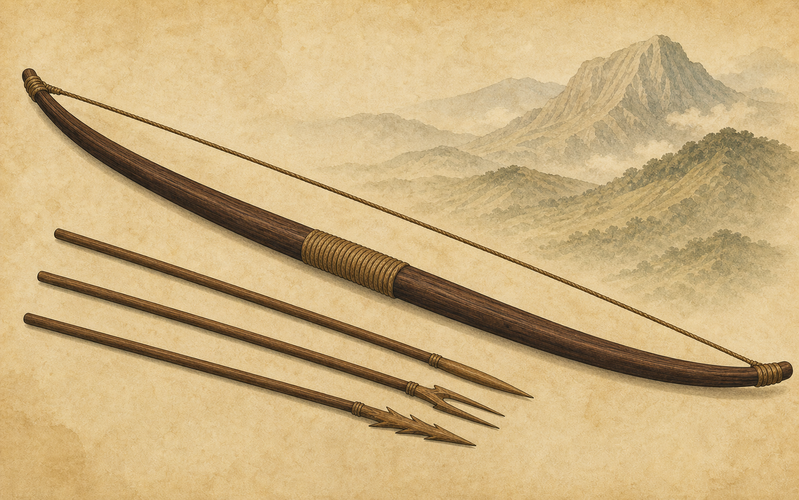
Across Papua, bows and arrows belong to a long history of everyday skill, environmental knowledge, and local defense. They are often described as weapons, but that single word is too narrow. A bow could help provide food, guard a settlement, announce readiness in a public gathering, or become a valued object displayed in a house or museum. Arrows could be made for birds, pigs, or human opponents, and their heads might reveal careful choices of wood, bamboo, bone, or other local materials.
For a museum visitor, Papuan archery opens a window onto the relation between landscape and society. New Guinea contains high mountains, fertile valleys, forests, swamps, rivers, and coasts. Communities developed different ways of moving through those worlds, and their tools followed. To read a Papuan bow or arrow well is to ask not only how it was fired, but where it was carried, what it was made from, and what rules surrounded its use.
Landscapes That Shaped Archery
The western half of New Guinea, now within Indonesia, includes some of the most varied environments in Southeast Asia and Oceania. Highland basins such as the Baliem Valley sit within mountain chains, while southern and northern regions include rivers, forests, wetlands, and coastal zones. Materials for bows and arrows were therefore never abstract. They came from particular plants, trees, bamboo, grasses, fibers, and sometimes animal bone.
This diversity helps explain why Papuan archery should not be reduced to one standard type. A highland bow made for movement across gardens and open ground did not answer exactly the same needs as equipment used near sago swamp, river, or coast. Even when objects look simple at first glance, their proportions, stringing, arrow shafts, and heads reflect generations of practical adjustment.
Tools for Hunting and Defense
Bows and arrows were valuable because they could serve more than one purpose. Hunting required distance, quiet movement, and knowledge of animal behavior. Wild pigs, birds, and smaller forest animals demanded different strategies, and arrowheads could be shaped accordingly. Some heads were plain and penetrating, while others were pronged or barbed to improve their effect on particular prey.
The same technology could also enter conflict. In highland settings, older descriptions of Dani and neighboring societies record periods of ritualized or small-scale warfare between local groups. Such conflict should not be romanticized. It involved injury, death, grief, and social tension. At the same time, it was often governed by local expectations about alliance, revenge, compensation, and public courage, rather than by the territorial conquest familiar from modern state warfare.
Arrow Types and Technical Knowledge
The most revealing museum lesson often lies in the arrowheads. Some Papuan traditions distinguish hunting arrows from war arrows, and within those categories there could be further variation. A bird arrow might have a split or pronged end, while a pig arrow might require a stronger penetrating point. Arrows intended for conflict could differ in shape, serration, and symbolic seriousness.
Such variation shows that archery was a technical system. The maker had to understand weight, balance, shaft straightness, point strength, and the behavior of local materials. The user had to know range, timing, and the movement of a target. A museum label that says only "bow and arrows" misses this complexity. The better question is: which arrow, for which task, in which place?
Warfare, Rules, and Social Meaning
Local warfare in Papua was not simply a matter of weapons. It was embedded in social relations. In the Baliem Valley, anthropologists and filmmakers recorded conflicts connected to alliance groups, revenge cycles, mourning, and public display. Bows and arrows were visible in those encounters, but they worked alongside speech, watchfulness, ritual, and the management of fear.
Many accounts also suggest that weapons carried rules. A spear, bow, or arrow might be kept in a particular place, handled with respect, or restricted to appropriate uses. These rules matter because they turn a weapon into a social object. Its power is not only in the wound it can make, but in the discipline expected from the person who owns or carries it.
Performance and Heritage Display
Today, many visitors encounter Papuan martial imagery through festivals, cultural performances, photographs, and museum displays rather than through conflict itself. War dances and staged demonstrations can preserve gestures of courage, alertness, and group identity while removing them from immediate violence. Bows and arrows in these settings are often carried as heritage signs, not as active instruments of harm.
This shift is important. Objects do not freeze at the moment when they were made. A bow once used for hunting may later become a household display, a festival prop, a souvenir, or an accessioned museum object. Each stage changes the way people see it. The museum's task is to keep these layers visible, so the object is neither reduced to danger nor softened into decoration.
Reading Papuan Archery in a Museum
A careful reading begins with material evidence. Is the bow long and plain, or carefully finished? What fiber or plant material forms the string? Are the arrows uniform, or do their tips differ? Is there wear near the grip or along the shaft? Do the arrowheads suggest hunting, display, or conflict? These questions help visitors move from spectacle to close looking.
The second step is provenance. Papua is not one culture, and New Guinea is not one tradition. An object connected to the Dani, Lani, Hubula, Sentani, Asmat, Biak, or another community should be interpreted through that location and history whenever documentation allows. When provenance is uncertain, museums should say so plainly. Honest uncertainty is better than a confident but invented story.
Conclusion
Papuan bows and arrows show how a familiar technology can carry unfamiliar depth. They are tools of wood, fiber, and sharpened point, but they are also records of landscape, craft, discipline, and memory. Their forms reveal adaptation to hunting and defense; their histories point toward rules, performance, and social responsibility.
For Nusantara Museum, these objects belong within a wider story of Indonesian martial heritage. They sit beside keris, mandau, rencong, tombak, salawaku, and other regional traditions, yet they should not be folded into a generic weapons category. Papuan archery deserves to be seen on its own terms: precise, local, practical, and deeply connected to the communities that made and remembered it.