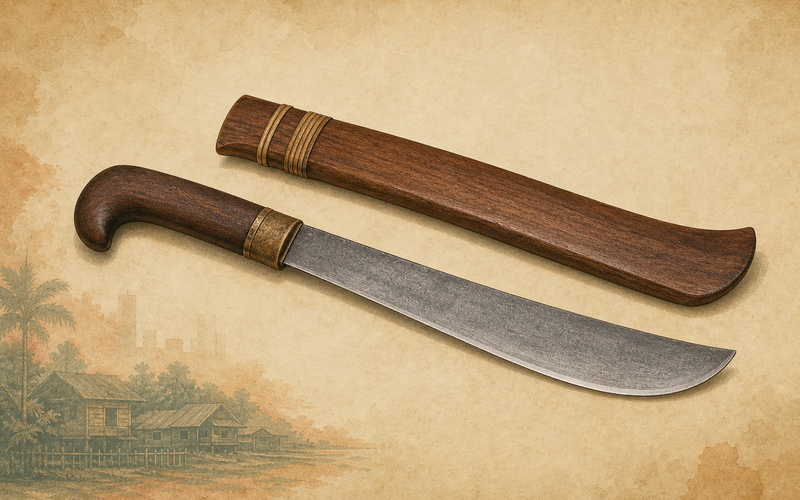
The golok is one of the most familiar blade forms in western Indonesia, yet its meaning changes sharply when it is placed in a Betawi setting. In Jakarta, the blade belongs not only to the category of tools or weapons, but also to the memory of kampung life, neighborhood guardianship, and martial training. It is a compact object through which visitors can approach the cultural history of a city that has always been shaped by movement, trade, and social mixture.
For the Betawi, whose identity grew in and around old Batavia and modern Jakarta, objects often carry urban histories inside ordinary forms. A blade at the waist, a front terrace for receiving guests, a performance at a neighborhood celebration, or a style of speech in a market can all become signs of belonging. The golok therefore invites a museum reading that is both material and social: what was the object, who used it, and why did later generations remember it as more than a sharp edge?
A Blade in the Betawi World
The word golok generally refers to a single-edged cutting blade, often compared to a machete or heavy knife. Across Indonesia and the wider Malay world, blades of this kind have been used for work, travel, clearing vegetation, food preparation, and protection. That broad usefulness is important. A golok was not automatically a ceremonial object, nor was it only a fighting weapon. Its first meaning often depended on the hand that held it and the place where it was carried.
In Betawi culture, the golok became especially visible because it could move between daily life and public reputation. A household might know the blade as a practical implement, while local stories might remember it as part of the image of the jawara, the neighborhood champion or strong figure associated with courage, protection, and sometimes disorder. Museums should not flatten that figure into a simple hero or villain. The jawara belongs to a complicated social world in which local authority, martial skill, and community respect could overlap.
Jakarta, Kampung, and Urban Identity
Jakarta is often described as a modern capital, but its cultural memory cannot be understood only through government buildings, traffic corridors, and business districts. Older patterns of kampung life remain central to how many communities remember the city. Betawi identity developed in this urban and suburban environment, shaped by Malay, Sundanese, Javanese, Chinese, Arab, European, and other influences that passed through Batavia over several centuries.
That mixed setting matters for interpreting the golok. The blade does not represent a closed or isolated tradition. It belongs to a port-city culture in which people, words, foods, music, clothing, and performance forms absorbed many influences while still becoming recognizably Betawi. A golok displayed in a museum case can therefore speak about the city itself: Jakarta as a place where local identity formed through contact, pressure, adaptation, and pride.
Maen Pukulan and Martial Discipline
Betawi martial heritage is commonly discussed through maen pukulan, a local expression associated with striking arts and pencak silat traditions. UNESCO's inscription of pencak silat as intangible cultural heritage from Indonesia helps frame this world as more than combat technique. Pencak silat includes movement, discipline, music, social teaching, and ethical instruction, although each region gives those elements its own flavor.
The golok's relationship to martial practice should be explained carefully. Not every Betawi martial lesson centered on blades, and not every golok was made for formal training. Still, weapons and empty-hand movement often belong to the same cultural environment. A blade can teach distance, timing, restraint, and respect for danger. In a museum setting, this connection helps visitors see the golok not as a static object but as part of embodied knowledge.
The Jawara Image
The jawara image gives the Betawi golok much of its narrative power. In popular memory, the jawara is a figure of toughness and local standing, a person who could protect a neighborhood, mediate conflict, or display skill. Such figures appear in many societies under different names, especially where formal authority was distant, contested, or mixed with local patronage. In Batavia and Jakarta, stories of strong men, martial teachers, guards, and community leaders became part of urban folklore.
The golok helped make that image visible. A blade worn at the side could signal readiness, masculinity, and social rank, but it could also create anxiety. Modern urban law and public safety changed the meaning of carrying such weapons openly. What might once have been read as local authority could later be treated as a security problem. This shift is important because it shows how the same object can move from everyday presence to heritage symbol as cities change.
Craft, Form, and Use
A golok is usually valued for its balance as much as for its decoration. The curve, thickness, handle, and sheath affect how the blade works in the hand. Some forms are better suited to cutting vegetation or household tasks, while others are remembered in relation to self-defense and display. Betawi examples should therefore be interpreted through both function and style, with attention to the maker's choices and the user's needs.
Museum visitors often look for ornamental richness, but a modest blade may tell an equally strong story. Wear marks, sharpening, replacement handles, and simple sheaths can reveal use over time. They remind us that heritage does not always begin as luxury. Many powerful cultural objects are ordinary things that became meaningful because families kept them, teachers used them, or communities attached stories to them.
Public Symbol and Heritage Memory
In contemporary Jakarta, Betawi culture is preserved and performed through festivals, cultural villages, museums, schools, arts groups, and family practice. Places such as Setu Babakan have become important for presenting Betawi houses, performance, food, and social customs to wider audiences. Within that public heritage environment, the golok can stand beside ondel-ondel, tanjidor, lenong, batik, and culinary traditions as one sign among many.
This public role changes the blade again. A golok in a heritage display is not being carried into a quarrel or used in a field. It becomes an educational object. Its danger is controlled by the museum frame, while its cultural meanings are opened for discussion. The challenge is to keep that discussion honest: neither reducing the blade to violence nor turning it into a romantic emblem without context.
Reading the Golok Responsibly
A responsible museum interpretation begins with what can be said securely. The golok is a widely recognized Indonesian blade form. It has practical uses and martial associations. In Betawi culture, it is tied to ideas of masculinity, courage, self-defense, and local authority. Betawi identity itself belongs to Jakarta's layered history as a port and colonial city, shaped by many communities and cultural exchanges.
More specific claims require more care. Stories about named masters, particular neighborhoods, or precise historical origins should be supported by reliable documentation when possible. Oral memory remains valuable, but it should be presented as memory rather than as simple archival fact. This approach respects tradition without asking the object to prove more than the evidence can bear.
Conclusion
The Betawi golok matters because it condenses a city into a blade. Its form recalls work, defense, craft, and the authority of local figures. Its memory reaches into maen pukulan, neighborhood life, and the ways Betawi culture has continued to mark Jakarta despite rapid urban change. It is not only a weapon, and it is not only a symbol. It is both an object and a relationship.
Seen in a museum, the golok asks visitors to think about how urban heritage survives. Some traditions remain through performance, language, food, or architecture. Others remain through objects that no longer circulate as they once did but still carry a charge of recognition. The Betawi golok belongs to that second category: a practical blade whose strongest work today may be to keep Jakarta's martial memory visible.