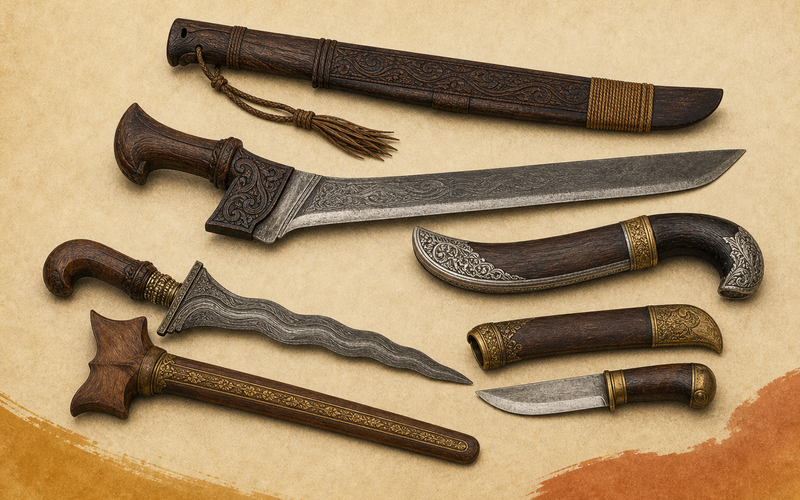
Traditional weapons from Indonesia are often presented as a single category, yet the archipelago contains many distinct blade traditions shaped by local history, environment, and social life. A museum visitor may encounter the keris of Java and Bali, the rencong of Aceh, the badik associated with South Sulawesi, the kujang of Sundanese heritage, or the mandau linked with Dayak communities in Borneo. These objects share the broad label of "traditional weapons," but they do not tell one uniform story.
What unites them is not identical form or identical function. Rather, they show how objects made for defense, hunting, rank, or warfare could also enter ceremonial dress, collective memory, and systems of cultural meaning. Some are better documented than others, and the keris remains the clearest case because UNESCO and Indonesian cultural institutions describe it explicitly as both weapon and spiritual object. Even so, a wider museum view shows that Indonesian martial heritage is regional, layered, and inseparable from material culture.
Why Regional Context Matters
The Indonesian archipelago is too large and diverse for any single weapon to stand for the whole. Curatorial language that collapses every blade into one "national tradition" risks obscuring the communities that made, used, and interpreted them. A rencong from Aceh belongs to a different historical and ceremonial world than a mandau from Kalimantan or a kujang associated with Sundanese culture. Their silhouettes, materials, and associated meanings are part of regional identity.
For that reason, museum interpretation works best when it begins from locality. The question is not simply what the blade was called, but who wore it, when it appeared, and in what setting it became meaningful. Some weapons were closely tied to everyday carrying or self-defense. Others became more visible in formal attire, prestige display, ritual performance, or historical memory. This variation is not a problem to be simplified away. It is one of the most important facts the objects themselves communicate.
The Keris as the Best-Documented Ceremonial Blade
Among Indonesian weapons, the keris has the strongest documentary record for ceremonial and spiritual importance. UNESCO describes the Indonesian kris or keris as a distinctive asymmetrical dagger that is both a weapon and a spiritual object, and notes that it has been used for display, ceremonial dress, heirloom transmission, and status marking. This makes the keris especially valuable for museum writing because its meanings are not speculative. They are supported by major heritage documentation.
The keris also shows how craftsmanship becomes part of cultural authority. UNESCO emphasizes the form of the blade, the pamor patterning, and the prestige of the empu who forges it. In other words, the object's significance lies not only in use but in making, connoisseurship, and inherited interpretation. A keris may therefore be read as a technical artifact, a sign of rank, a family heirloom, and a charged symbolic object at the same time. Few other Indonesian blades are documented with equal depth, which is why the keris often anchors broader discussions of martial heritage.
From Mandau to Badik: Local Uses and Local Meanings
Looking beyond the keris, museum collections show how regional blades retained their own visual and social identities. British Museum and Indonesian museum records for the mandau describe a Bornean weapon with carved handles, decorated sheaths, and additional attachments that make it immediately recognizable as more than plain equipment. Entries in the Indonesian museum registry note not only self-defense but also use in adat dance, suggesting that in at least some museum-documented contexts the mandau participates in performance and ceremonial representation as well as practical life.
The badik offers a different example. A record in the national museum registry identifies it with Bugis, Makassar, and Mandar communities of South Sulawesi and describes how it moved from hunting and protection into broader symbolic life. That does not justify claiming a single meaning for every badik everywhere. It does, however, support a careful museum argument: regional blades often lived multiple lives, practical in one context and identity-bearing in another. The important point is plurality of use, not a false search for one essence.
Weapons as Dress, Status, and Cultural Signs
Traditional weapons across Indonesia often matter because they appear on the body. Once a blade is worn in formal attire, public processions, ritual dance, or ceremonial gatherings, it begins to communicate visually even when never drawn. The keris is the clearest example of this transformation, but it is not the only one. Museum and heritage records around the archipelago repeatedly connect bladed objects to dress, display, or codified appearances in cultural events.
This shift from use to sign is central to museum interpretation. A worn blade can indicate adulthood, lineage, rank, masculinity, or local belonging, depending on context. In some cases, its meaning lies in adornment and in the right to carry it visibly. In others, it signals continuity with a remembered past, including royal, heroic, or ancestral associations. The blade then becomes part of social language. It is not merely a remnant of combat, but an object through which communities describe themselves.
The Kujang and the Problem of Symbolic Heritage
The kujang is especially useful for thinking about symbolic heritage because it survives strongly in Sundanese historical imagination and visual culture. Even when museum evidence does not allow broad claims about continuous everyday use across centuries, the weapon's cultural afterlife is undeniable. A museum registry entry for a kujang prototype mold presents multiple named forms and connects them to textual discussion of types and meanings. This suggests that classification and symbolic interpretation became part of the object's heritage history.
For museums, the kujang is a reminder that historical weapons can outlive their original practical contexts and remain powerful as emblems. Heritage objects do not need to preserve one unchanged function in order to matter. They may continue as icons in regional identity, educational storytelling, monuments, or curated reconstructions of the past. A careful article should therefore resist forcing every weapon into a simple martial timeline. Some survive most vividly as symbols, and that symbolic life is itself historically important.
Collecting Weapons Without Flattening Their Histories
Museum collections are valuable because they preserve form, ornament, and provenance, but collections can also create distortions. When weapons are removed from use and placed in display cases, they may seem to belong to a universal category of "arms" even when their makers understood them through kinship, ceremony, dress, or cosmology. This is why context notes, community histories, and regional labeling matter so much. Without them, viewers may see only steel and wood where communities saw ancestry, office, or obligation.
A responsible museum approach keeps both levels in view. Indonesian weapons can certainly be studied as blades, technologies, and signs of martial skill. But they should also be studied as works of carving, forging, costume, exchange, and memory. From keris to mandau, the object is never only the blade. It includes the sheath, the handle, the maker, the wearer, the locality, and the social world that gave it meaning.
Related Reading
For a chronological path, continue with Indonesian weapons through history. For ceremonial, heirloom, and regalia contexts, read traditional Indonesian weapons and their ceremonial roles. For focused object studies, see Bugis and Makassar badik blades, the Dayak mandau, and the Acehnese rencong.
Conclusion
Traditional weapons across the Indonesian archipelago are best understood as regional cultural objects rather than as a single undifferentiated class of arms. The keris shows with unusual clarity how a blade can function as weapon, heirloom, ceremonial accessory, and spiritual object. The mandau, badik, rencong, and kujang demonstrate in different ways that local history and local identity remain essential to interpretation.
For museums, the lesson is straightforward. These objects deserve to be displayed not only as evidence of warfare or technique, but also as evidence of how communities materialized memory, rank, artistry, and belonging. The richest interpretation begins when the weapon is seen as part of a cultural landscape, not as an isolated tool.