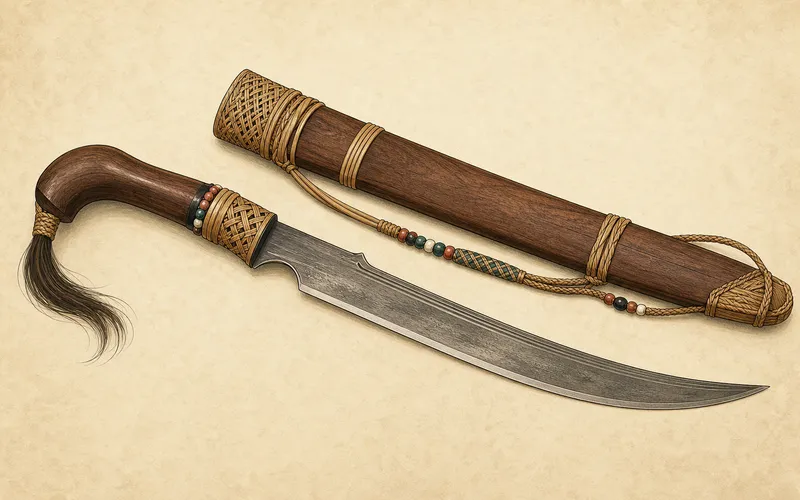
A mandau is a single-edged cutting blade, often described as a short sword or machete, associated with several Dayak peoples of Borneo, including Indonesian Kalimantan. Documented museum examples include Kayan and Kenyah objects. “Dayak” covers many communities, not one homogeneous culture, and names and uses vary locally.
Its distinguishing features can include an asymmetrical blade section, a carved hilt, and a wooden sheath with rattan binding and additional decoration. Practical cutting, historical combat, ceremonial wear, gift-giving, and heirloom value belong to different contexts; one object's history cannot establish all of them. The Lam Museum's Kayan example illustrates the connection between a working blade form and ceremonial elaboration.
A Blade from the Dayak World
"Dayak" is a broad term used for many Indigenous peoples of Borneo rather than a single uniform group. In Indonesia, Dayak communities live across Kalimantan, including West, Central, East, North, and South Kalimantan. This diversity matters because a mandau from one community, river region, or historical collection should not automatically be treated as proof for every Dayak tradition. Museums should identify a more specific community or place whenever documentation allows.
The mandau is nevertheless one of the best-known objects associated with Dayak material culture. Museum records and scholarly articles describe it as a sword or knife connected with Dayak groups of Borneo, with local names and forms varying across regions. Some sources discuss it among Kanayatn Dayak communities in West Kalimantan; others focus on Tunjung-Benuaq contexts in East Kalimantan or Kayan examples in wider Borneo collections. The shared term helps visitors begin, but the details should pull them toward local specificity.
Blade, Carved Hilt, Wooden Sheath and Decoration
The British Museum's Kenyah example, As,Bk.82.a, has a blade described as convex on one side, a wooden handle with a rattan grip, and a carved wooden sheath. A second sheath behind it holds a small long-handled knife. These are documented features of one assemblage, not compulsory features of every mandau. British Museum: Kenyah sword.
A separate British Museum record, As,+.5202.a, tentatively attributes its mandau to a Kayan group, possibly Longlat from the Upper Mahakam. Its materials include bone, brass, and horse hair. The qualification matters: a tentative attribution should remain tentative, and hair decoration should not automatically be identified as human. British Museum: mandau.
Compare the edge and blade section, the carving and grip of the hilt, and the sheath's bindings separately. Replacement fittings and later decoration can complicate an object's history. A careful catalogue records materials and collecting history before assigning symbolic meanings.
Practical Uses and Social Meaning
Several studies caution against defining the mandau only through warfare. In community descriptions, the blade can be connected with cutting grass, chopping wood, processing hunted animals, protection from wild animals, ritual occasions, and fighting. Such a range of uses is not unusual for traditional blades. Many objects that can serve in combat also belong to daily work, travel, display, and household knowledge.
This overlap is important for interpretation. A mandau in a case may look like a weapon first, especially to visitors used to classifying objects by function. But in Kalimantan contexts, function can be plural. The same object may carry practical value, social prestige, inherited memory, and ritual significance. Rather than asking whether the mandau was "really" a tool or "really" a weapon, museums can explain how its meanings changed with setting, owner, and occasion.
Historical Combat and Present Ceremonial Meaning
The Lam Museum places its Kayan mandau within a history that included combat and headhunting, while also describing festival wear and gifts for occasions such as weddings. These are historically situated uses, not a definition of contemporary Dayak identity. Lam Museum: Mandau Sword.
A museum label should discuss violence when the object's documentation warrants it, without using it as spectacle. Whether a particular blade was used in combat, inherited, carried ceremonially, or made for sale requires evidence about that blade. Its material craftsmanship remains significant even when its original owner's history is unknown.
Regional Variation and Collecting Histories
Mandau objects in museums often reached collections through colonial-era collecting, trade, missionary networks, private acquisition, or later heritage exchange. Those collecting histories influence what museums can say. A record may preserve a name, date, region, or collector, but it may also omit the maker, owner, community, or original occasion of use. Silence in the record is not neutral. It shapes interpretation.
Regional variation also complicates easy labels. A mandau associated with the Mahakam region, a Kayan example, a Kanayatn discussion, or a Tunjung-Benuaq interpretation may share broad features while differing in detail. Museums should therefore resist the urge to make one object stand for all of Kalimantan. The most honest label often says what is known, what is likely, and what remains uncertain.
Craft, Heritage, and the Present
The mandau continues to appear in heritage contexts today. It may be made for display, dance, cultural education, regional identity, souvenir markets, or ceremonial presentation. These contemporary uses do not make the object less authentic. They show that material culture continues to adapt. A blade once understood through protection or status can later become a sign of memory, artistry, and belonging.
For museums, this living dimension is a gift. It allows the mandau to be interpreted not as a relic from a vanished world, but as an object whose meanings continue to be discussed and remade. Contemporary craft can also help explain older examples: the choice of wood, the logic of rattan binding, the balance of blade and sheath, and the visual language of ornament all remain intelligible through making.
Reading the Mandau in a Museum
A good display of a mandau should give visitors time to look closely. The blade's curve, the handle, the sheath construction, the rattan work, the companion knife, and the ornamental additions all deserve attention. If the object includes human or animal materials, museums should explain them with sensitivity and avoid sensational phrasing. If the object's provenance is incomplete, that uncertainty should be stated plainly.
The mandau also belongs beside other Indonesian blades, but comparison should not erase difference. A keris, rencong, kujang, badik, or mandau may all be weapons, heirlooms, or identity markers, yet each comes from a distinct historical and regional world. Comparison is useful when it helps visitors see Indonesia's diversity. It becomes misleading when it treats all blades as interchangeable signs of a single martial past.
The Dayak mandau is therefore best understood as a crafted object of Kalimantan memory. It can speak about warriors, but also about makers, forests, rivers, movement, ceremony, and the changing meanings of heritage. In the museum, its sharpness is only one part of its presence. The fuller story lies in the materials that surround the blade and in the communities that have given those materials meaning.
The wider Weapons and Regalia collection and Indonesian weapons overview provide comparisons, including the South Sulawesi badik. Place the mandau alongside Dayak weaving traditions and the distinct riverine history of South Kalimantan's Banjar Sultanate.