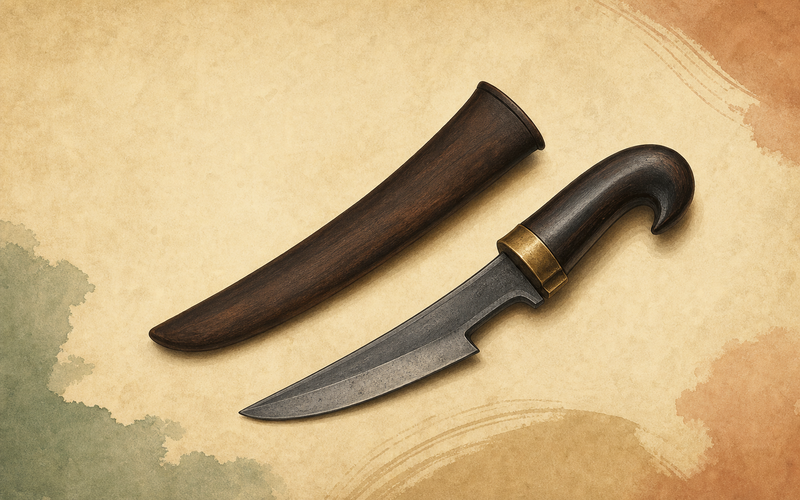
The rencong is one of Aceh's most recognizable cultural objects: a short, curved dagger whose small scale does not lessen its public force. In museum terms, it is a weapon, but that label is only the beginning. The rencong also belongs to dress, ceremony, local memory, craft knowledge, and the language through which Acehnese communities have described courage and personal dignity.
To read the rencong only as an implement of attack is to miss the social grammar around it. Cultural descriptions from Indonesia's Ministry of Education and Culture present it as a traditional weapon of Aceh and as an object whose contemporary role has shifted toward symbolism. In that shift, the rencong becomes especially interesting for a museum: it shows how a blade can carry honor without being reduced to violence.
A Dagger From Aceh
The rencong is strongly identified with Aceh, the northern region of Sumatra whose history includes Islamic courts, maritime exchange, anti-colonial resistance, and rich forms of local customary life. Official Indonesian cultural documentation lists the rencong as a traditional weapon of Nanggroe Aceh Darussalam and notes its recognition within Indonesia's intangible cultural heritage framework. That status matters because it places the object in a living cultural field rather than only in the category of antique arms.
Descriptions of the object usually emphasize its compact blade, distinctive angled form, and scabbard. Materials varied according to context and means. Cultural and museum sources refer to examples made with metal blades and fittings of wood, horn, ivory, or other valued materials. Such variation reminds us that the rencong was not a single standardized commodity. It could be plain, practical, refined, or ceremonial, depending on maker, owner, and occasion.
The Sultanate and Public Bearing
Indonesian cultural sources connect the rencong with the Aceh sultanate, including accounts that place it in use from the time of Sultan Ali Mughayat Syah, the first ruler of the Aceh sultanate in the early sixteenth century. The earliest maker is not securely identified, and older claims should be treated carefully. What is clear is that later memory associates the rencong with courtly authority, public masculinity, and the bearing of a person prepared to defend dignity.
The position of the rencong on the body helped create that meaning. Sources describe it as being tucked at the waist, where it was visible as part of a man's appearance. A weapon worn openly is not only a tool; it is also a sign. It tells others that the bearer belongs to a world of obligations, courage, and self-command. For rulers and local elites, expensive materials could make that sign more explicit. For common people, humbler materials could still carry the same moral vocabulary.
Honor, Courage, and Restraint
The word "honor" can sound abstract, but the rencong makes it material. Official cultural descriptions call it a symbol of bravery, toughness, and masculine dignity among the people of Aceh. In that language, the object does not simply promise aggression. It expresses readiness, responsibility, and the expectation that courage should be joined to social conduct. The rencong, worn close to the body, becomes a small object with a large ethical charge.
This is why a museum display should avoid presenting it as a theatrical prop. The rencong belongs to a social world in which dignity is visible, carried, and performed. It can mark the capacity to protect one's household, maintain reputation, and meet danger without appearing defenseless. At the same time, modern descriptions emphasize that its role as an attacking weapon has become less relevant. The honor it carries today is therefore largely symbolic, ceremonial, and historical.
Ceremony After Warfare
After Indonesian independence, the rencong's public role increasingly moved from armed use into ceremonial and representational life. Indonesian cultural sources describe it as worn at weddings, where it can symbolize the courage and responsibility expected of a groom in leading a household. It also appears in discussions of Seudati performance, where an object once associated with martial readiness becomes part of staged cultural expression.
This transformation is not unusual. Across Indonesia, blades such as the keris, badik, mandau, and rencong have often moved between practical, ceremonial, and symbolic roles. What distinguishes the rencong is the clarity of its Acehnese identity. When it is worn in ceremony, collected in museums, or reproduced as a regional souvenir, it continues to point back to Aceh rather than becoming a generic Indonesian dagger.
Form, Materials, and Local Knowledge
The rencong's form has attracted symbolic interpretation. Some local and cultural accounts read its shape as related to Arabic letters forming the phrase "bismillah." A careful museum text should present this as a documented interpretation rather than as a measurable property of every object. It is part of the cultural language around the rencong, especially in a region where Islamic identity has long been important, but individual blades still need to be studied by form, date, maker, material, and provenance.
The same caution applies to materials. Horn, wood, ivory, precious metals, and decorated sheaths can all appear in descriptions of rencong objects, but they do not carry one fixed meaning in every case. A richly made dagger may suggest rank, wealth, or ceremonial use; a plainer one may speak more directly to utility or local craft. The important point is that the rencong is both object and knowledge. It depends on makers who understand metal, grip, balance, ornament, and the expectations of Acehnese society.
Museums and Regional Memory
Museum collections help stabilize the rencong's story without closing it. A dagger recorded by the Asian Civilisations Museum as associated with Aceh and North Sumatra places the form within the wider material history of island Southeast Asia. Research on rencong morphology in the Museum of Aceh likewise points to the value of studying surviving objects closely, not only repeating broad legends about them.
At the same time, museums must leave room for living memory. The rencong remains a public emblem of Aceh, and its meaning is still renewed through ceremonies, craft production, local imagery, and educational writing. Its power lies in this double position: it is old enough to carry historical gravity, but present enough to remain legible to communities today.
Conclusion
The Acehnese rencong is a compact object with a spacious cultural life. It has been remembered as weapon, dress element, courtly sign, ceremonial object, craft achievement, and regional emblem. Its language of honor is not a single slogan but a set of meanings built through body, material, memory, and public display. For a museum, the rencong asks to be seen not only for its blade, but for the dignity people have placed around it.